
A Florida family standing between a new Bennington and a clean late-model Sun Tracker reasonably asks the same question: do pontoon boats hold their value well enough to make today's purchase price feel sensible at resale?
The short answer is that do pontoon boats hold their value is a question with a qualified yes, a well-maintained boat can preserve meaningful resale value, but no outcome is automatic, and the answer depends almost entirely on the individual boat, not the category.
This blog explains what actually drives pontoon resale value in Florida, how to evaluate any boat before you buy, and how owners can protect value over time, without relying on unverified depreciation percentages or a seller's broad claim.
What Does “Holding Value” Mean for a Pontoon Boat?
Value retention is the share of purchase price a boat can reasonably recoup when sold, after accounting for age, use, condition, and market demand. That definition matters because it separates two very different questions:
- Will this boat depreciate? Yes, pontoons are recreational purchases, not appreciating assets. Every new boat loses a portion of its value the moment it leaves the dealer.
- Will this boat depreciate more or less than alternatives? That depends on individual condition, not the category label.
Confusing the two leads buyers to pay too much based on a category claim, or sellers to price too high based on an unverified “pontoon boats hold value” assertion they read somewhere.
The NADA Guides marine section and BUCValu are the standard references appraisers use for wholesale, retail, and trade-in baselines in Florida, neither delivers a fixed percentage by boat type. Both require the exact year, make, model, engine, hours, and condition to return a meaningful number.
What Affects Pontoon Resale Value in Florida?
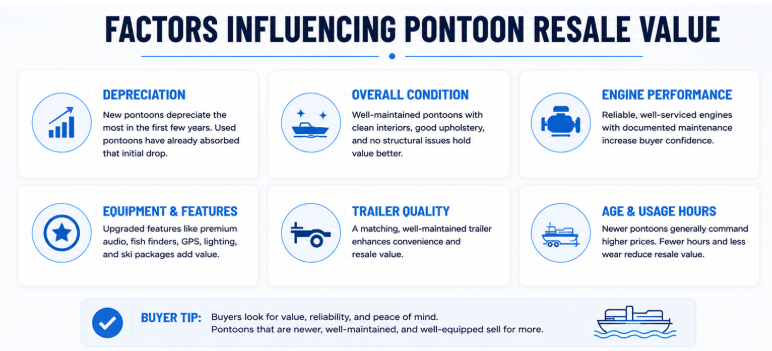
Florida conditions create a specific set of value risks that buyers in freshwater states rarely face. Run through this six-point check beside the boat, not from a listing photo:
- Water exposure history: Florida waterways range from freshwater lakes to tidal rivers to open saltwater bays. Saltwater and brackish water accelerate corrosion on pontoon tubes, hardware, and the engine. Ask the seller for documented water history. “Mostly freshwater” is not documentation.
- Pontoon tube and structural condition: Inspect the aluminum tubes directly. Surface pitting is common; deep pitting, cracks near welds, or sealant patches over structural areas are different problems. A professional marine survey from a National Association of Marine Surveyors (NAMS) or Society of Accredited Marine Surveyors (SAMS) member is the reliable way to establish structural condition before a high-value purchase.
- Upholstery and flooring: Florida UV exposure degrades marine vinyl faster than northern climates. Faded, cracked, or water-stained upholstery and delaminated flooring are both condition flags and negotiating points. Replacements are expensive and rarely recover their full cost at resale.
- Engine condition and hours: Engine hours are to a pontoon what mileage is to a truck, an input, not a verdict. A 300-hour engine with complete service records is a better buy than a 120-hour engine with no documentation. Request dated service receipts and verify the intervals against the manufacturer’s schedule. NMMA-member dealers and certified marine technicians can provide independent engine assessments.
- Storage and UV protection: Year-round boating in Florida is a feature and a depreciation risk. Boats stored outdoors without covers age faster cosmetically. Covered or dry-storage history supports both condition and resale presentation.
- Storm and water-damage history: Florida’s hurricane exposure is real. Ask about storm events, flooding, and any insurance claims. The Boat History Report can surface prior theft, damage, or title issues for documented vessels.
None of these factors creates a fixed discount by itself. What they do is separate the boats that genuinely hold value from those that look good in listing photos. Compare boats with similar model year, engine, configuration, and condition in the same Florida market.
How Long Do Pontoon Boats Hold Their Value?
The timeline of pontoon depreciation generally follows three phases:
| Ownership stage | What changes value | What to verify |
| New → first year | Boat becomes “used” on purchase | Transaction price, warranty terms, equipment |
| Years 1–5 | Use and condition separate similar boats | Engine hours, service history, storage, damage |
| Years 5+ | Individual history carries increasing weight | Records, corrosion, equipment condition, demand |
The largest single value change for most pontoons happens in the first year, when a new boat enters the used market. After that, conditions and records increasingly determine where a given boat lands relative to comparables.
Asking prices in current Florida pontoon listings are comparison inputs. They are not completed-sale values. Sold listing data from Boat Trader and professional appraisals establish what boats actually transact at.
Disadvantages of a Pontoon Boat Owners Should Budget For
Before calculating resale, the total ownership cost picture matters. Knowing the disadvantages of a pontoon boat upfront prevents surprises:
- Depreciation on purchase: The new-boat value drop is real. Buyers who plan to sell within two years face the steepest exposure.
- Operating limitations: Pontoons perform well in calm, protected Florida waters. Open-water chop, inlets, and offshore conditions are outside the design envelope for most configurations.
- Fuel consumption: Larger pontoons with high-horsepower engines consume meaningful fuel, especially at cruise speeds.
- Storage and dockage: Florida slip fees and dry-storage costs vary widely. They belong in the ownership budget before purchase, not after.
- Maintenance in saltwater: Flushing, anodes, corrosion protection, and more frequent service intervals add to the annual cost for coastal Florida boats.
- Insurance: Florida’s storm risk and theft environment affect marine insurance pricing. Verify coverage terms for the specific boat, location, and use before assuming a quote applies. You can compare marine insurance quotes on Boatzon to understand your options before committing.
A realistic total-cost worksheet, purchase price, financing, insurance, registration, fuel, storage, maintenance, and expected resale, is the foundation of a sound pontoon decision. You can also explore boat financing options and pre-qualify with no credit impact to understand the full ownership cost from the start.
Used Pontoon Boat Values: How to Estimate What a Boat Is Worth
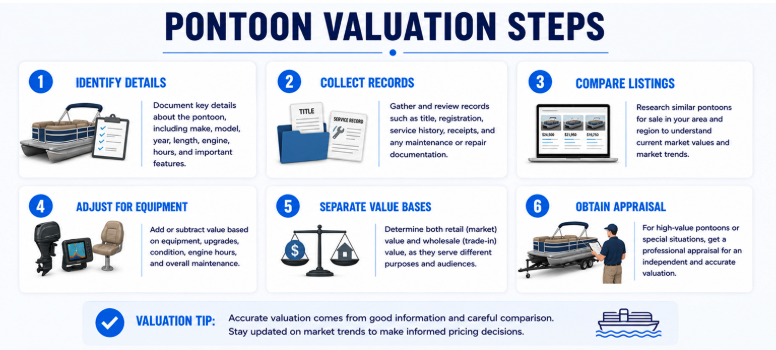
For buyers researching used pontoon boat values free, the practical process requires six comparison filters, not one:
- Year and make/model: A 2019 Bennington 22 SFX and a 2019 generic 22-foot pontoon are not comparable.
- Engine brand, configuration, and hours: Outboard versus inboard, Mercury versus Yamaha, 115 hp versus 250 hp all affect value separately.
- Condition tier: Excellent, good, fair, and poor are not interchangeable inputs. Rate the actual boat.
- Equipment included: Factory electronics, Bimini tops, ski tow bars, stereo upgrades, and trailers either add value or are already priced in.
- Water exposure: Freshwater, brackish, and saltwater histories are different condition baselines.
- Location and local demand: Florida coastal markets, Central Florida lakes, and the Panhandle each have different buyer pools and seasonal demand patterns.
Free resources include the NADA Guides marine lookup, BUCValu, and active Florida listings on Boatzon, filtered tightly to comparable specs, not used as proof of what the boat will sell for. You can browse current used pontoon boats for sale in Florida to benchmark asking prices against similarly specified listings.
When the financial stakes justify it, insurance, estate, lender requirement, or a high-value transaction, a NAMS or SAMS marine survey converts a condition estimate into a documented professional opinion.
New vs. Used Pontoon: Which Holds Value Better?
The new-versus-used value question has a conditional answer, not a universal one.
| Decision factor | New pontoon | Used pontoon |
| Purchase price baseline | Full new-boat price | Already reflects some depreciation |
| Condition certainty | Known starting condition | Requires independent verification |
| Warranty coverage | Verify written terms carefully | Confirm transferability in writing |
| Early depreciation exposure | Higher in years 1–2 | Lower, some has already occurred |
| Best scenario | Known condition + preferred features | Documented, late-model boat with clean records |
A documented late-model used pontoon can offer a better purchase-price-to-resale balance than new, but only when records and inspection support the condition claim. A low headline price on a boat with deferred maintenance, missing records, or undisclosed storm history is not a value purchase.
Our new vs. used pontoon comparison covers this decision in detail, including manufacturer-specific factors that can affect long-term value across the best pontoon boat brands.
How Owners Can Help a Pontoon Hold Its Value
The resale file is built during ownership, not at listing time. A future buyer will want:
- Dated service receipts organized chronologically, covering engine, fuel system, electrical, and safety equipment
- Repair invoices with parts and labor details
- Condition photographs taken annually and after any significant use or weather event
- Manufacturer manuals, keys, and warranty papers (original and any extended coverage)
- Title and ownership documents confirming clean transfer history
Practical ownership habits that protect value:
- Follow the engine manufacturer’s service schedule precisely, not approximately
- Flush and treat after every saltwater or brackish-water use, per the engine manual
- Address corrosion, upholstery damage, and electrical faults promptly rather than deferring
- Use covered or dry storage when possible, especially during Florida’s summer storm season
- Replace anodes on schedule; they are inexpensive and protect expensive aluminum
- Photograph the boat before and after each season as a dated condition record
Maintenance preserves more than function, it preserves the evidence a buyer needs to trust the asking price. For a detailed checklist, see Boatzon’s guides on how to maintain boat resale value and how to increase the value of your boat before you list.
Is a Pontoon Boat a Good Investment?
A pontoon is a recreational family purchase, not a conventional investment. The distinction matters because investments are evaluated on financial return; recreational purchases are evaluated on whether the use, enjoyment, and total cost align with the buyer’s expectations and budget.
A pontoon can still be a sound purchase when:
- The use plan matches the boat’s capabilities
- Total ownership cost (not just purchase price) fits the budget
- The ownership period is long enough to spread the initial depreciation
- Resale expectations are realistic rather than built on category claims
The BoatUS Foundation and Sea Grant programs at Florida universities publish consumer resources on responsible boat buying; neither organization endorses the idea that any recreational boat category is a reliable financial investment.
For Florida buyers weighing this decision, the most useful starting point is a realistic total-cost worksheet: purchase price, financing, insurance, registration, fuel, storage, maintenance, storm preparation, and expected resale. Use Boatzon’s boat loan calculator to run the numbers before choosing.
FAQ
Do pontoon boats hold their value well compared to other boat types?
Some pontoons preserve value better than comparable recreational boats; others depreciate faster. The outcome depends on the individual boat’s condition, engine, records, and local demand—not on a category-wide advantage. No verified data confirms pontoons as a category retain more value than similarly priced fishing or runabout boats.
How long do pontoon boats hold their value in Florida?
The largest value change typically occurs in the first one to two years of ownership, when a new boat transitions to use. After that, value retention is driven by condition, engine hours, maintenance records, water exposure, and market demand, all of which vary by boat, not by age alone.
What is the pontoon boat depreciation rate?
No single verified depreciation rate applies across all pontoons. Industry references like NADA Guides and BUCValu calculate current market value from the specific year, make, model, engine, hours, and condition, not from a fixed annual percentage. Any claim of a specific depreciation rate (e.g., “pontoons lose X% per year”) should be verified against the actual boat you are considering.
What are the main disadvantages of a pontoon boat?
The primary disadvantages include depreciation on purchase, operating limitations in rough water, fuel costs for larger engines, storage and dockage expenses, higher maintenance requirements for saltwater use in Florida, and storm preparation costs. These belong in the ownership budget before purchase, not after.
Where can I find used pontoon boat values for free?
NADA Guides marine lookup, BUCValu, and active Florida listings on Boatzon are the standard free resources. Filter by year, make, model, engine, hours, condition, and location for a meaningful comparison. Listing prices are asking prices, not completed-sale values; a professional marine appraisal establishes the latter when precision is required.
Does a tritoon hold value better than a standard two-tube pontoon?
A tritoon may attract buyers seeking higher performance or watersports capability, which can support demand in that segment. No verified resale premium has been documented across all tritoon models. Evaluate the specific boat’s engine, hours, condition, records, and local buyer demand rather than relying on a configuration-wide claim.
Does financing change what a pontoon will be worth at resale?
Financing does not affect market value, but it does affect total ownership cost and the equity position you hold at any point in ownership. A higher loan balance relative to current market value reduces flexibility at resale. Compare the full loan term and total interest cost alongside the expected ownership period before borrowing. Pre-qualifying without affecting your credit score is available through Boatzon.
How much is insurance on a $30,000 pontoon boat in Florida?
No responsible universal estimate exists based only on purchase price. A marine insurance quote reflects the specific boat, location, use pattern, storage method, operator history, requested coverage limits, and the insurer’s underwriting criteria. Florida’s storm exposure and theft environment affect rates independently of purchase price. Request quotes for the exact boat before purchase.
Compare the Boat, Its History, and the Full Cost
Do pontoon boats hold their value? Some do, and the ones that do share a common profile: clean engine history, dated maintenance records, appropriate storage, freshwater or well-maintained saltwater use, and documentation a buyer can independently verify. The ones that don’t share the opposite: deferred maintenance, missing records, undisclosed storm or water damage, and conditions that look acceptable until inspection.
Florida buyers should run the six-point condition check on every boat they seriously consider, separate asking price from completed-sale value, and budget total ownership cost, not purchase price alone, before deciding.
Browse pontoon boats for sale in Florida on Boatzon, compare financing options, pre-qualify without a credit impact, and compare marine insurance quotes, all in one place. For support, call 1-833-262-8966.