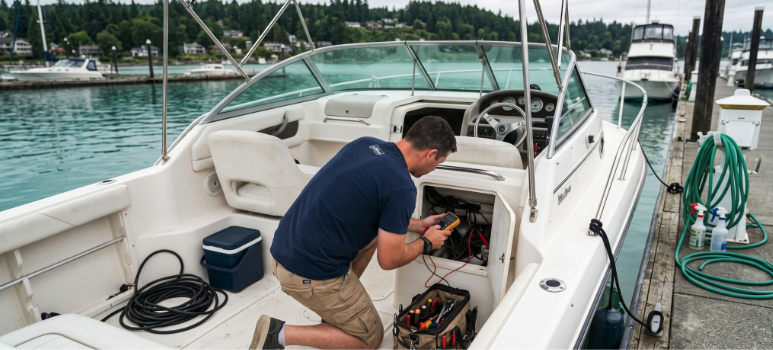

TL;DR: Negotiating a used boat is mostly preparation. The buyer who shows up with comparable sales, a pre-approval letter, a survey punch list, and a known walk-away number will get $2,000 to $8,000 off the typical asking price before anyone raises their voice. The buyer who improvises pays sticker.
A used boat negotiation is a conversation about the gap between what the seller wants and what the boat is actually worth right now. That gap is sometimes $0 and sometimes $15,000. Closing it is not a personality contest. It's a set of repeatable moves that experienced buyers run almost reflexively while less-prepared buyers focus on whether the seller seems nice. Nice is fine. Prepared is what gets the price down.
This guide covers ten tactics that consistently move the number. Some of them work before you visit the boat. Some of them work at the table. All of them depend on having the homework done before you start.
1. Anchor the conversation with comparable sales
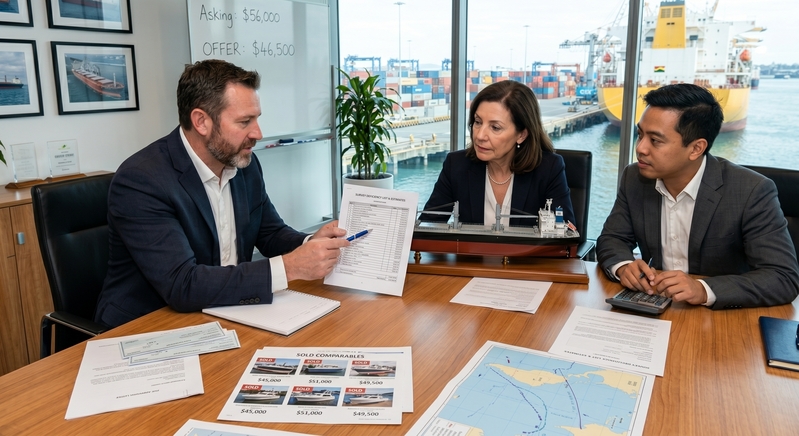
The single highest-leverage thing you can do is open the conversation by referencing what comparable boats actually sold for in the last 90 days. Asking-price data is noise; sold-price data is signal.
Pull three to five comparable sales by year, make, model, and condition. Add real-world recent sale data from boat-broker network reports, regional classified archives, and auction results. Print the numbers. Bring them to the table.
When the seller opens with their asking price, your response is not “that seems high.” Your response is: “I’ve pulled the last five comparable sales and they range from $42,000 to $48,000, with most at $45,000. How did you arrive at $56,000?” That question reframes the negotiation from “what will you accept” to “justify your number.” Sellers who can’t justify lower their number.
2. Lead with a pre-approval, not a budget
Walking in with a pre-approval letter from a marine lender does two things at once: it tells the seller you’re a serious buyer who can close, and it tells them you have a financing ceiling that you can’t exceed regardless of how charming they are. The seller knows you can write a check; they also know there’s a number above which the lender won’t fund.
Pre-approvals from Boatzon’s marine loan options typically come back within 24-48 hours after a pre-qualification application, and the pre-approval letter doesn’t commit you to anything. It’s pure leverage.
The cardinal rule: never share your maximum budget. Share the financed amount you’ve been pre-approved for, framed as the boat’s appraisal ceiling, not your personal budget. The two sound similar but feel completely different to the seller.
3. Show up cash-ready for a discount
For private-party sales, a verified cashier’s check in hand at the asking-price-minus-discount is often worth a 2% to 5% additional reduction on the spot. Cash closes today. Financed offers close in two weeks pending lender funding. Sellers who’ve already had a deal fall through know the difference.
For dealer purchases, cash leverage is weaker because dealers earn a referral fee on financing arrangements. But for private sellers, cashier’s check in hand is often the single most powerful close move.
4. Use survey findings as line-item negotiation
If you’ve ordered a survey (and for anything over $20,000 or any financed purchase, you should have), the deficiency list is a line-item ledger for negotiation. Don’t argue about the total. Walk through each item.
A list that looks like this is irrefutable:
- Transom soft spot – repair estimate from licensed yard: $2,800
- Trailer tires past 5-year date: $420
- Lower-unit gear oil contamination: $650
- Outdated VHF, no DSC: $300 replacement
- Replacement cushions for two compromised pieces: $1,100
Total: $5,270. That’s not an opinion. That’s a written estimate. The seller can either reduce by $5,270, agree to do the repairs before closing, or stop selling. There’s no fourth option. Most sellers who’ve been on the market more than 45 days will pick one of the first two.
5. Time the negotiation correctly
The single highest-discount window in the year is September through February, when sellers face winter storage costs, lower buyer traffic, and end-of-year pressure. A boat that wouldn’t move below $50,000 in April often sells for $43,000 in November. Northern-state sellers feel this pressure more sharply than southern-state sellers because their winter storage runs $1,500 to $4,000.
Within that window, the last week of December is often the best moment. End-of-year tax considerations, holiday distraction, and dealer push-to-close cycles all converge. Buyers who are willing to negotiate during the holidays often get the best deals of the year.
For private-party sales, days-on-market matters more than calendar date. A boat that’s been listed 90 days is far more negotiable than one listed last week.
6. Make a specific, written offer
Verbal back-and-forth is unproductive. Make a written offer with a specific price, specific contingencies, and a specific expiration. Print it. Hand it over. The medium changes the dynamic.
A reasonable offer letter includes:
- The exact dollar amount
- The deposit (typically 5-10% earnest money)
- Contingencies (survey, sea trial, financing approval)
- Closing date and inspection period
- A specific expiration (typically 48-72 hours)
Written offers force sellers to make written counters, which means the seller has to commit a number rather than waving their hand at one. A written counter at $48,000 is a fundamentally different document than a verbal “we’re not going below 48.”
7. Find one specific defect and anchor against it
Negotiation psychology works against any party that feels attacked. Don’t list 22 things wrong with the boat. Identify one specific defect that’s verifiable and meaningful, and anchor the conversation around it.
“The transom moisture reading on this boat is at the high end of the yellow range, and you can see the gel coat softening here at the corner. I’m offering $44,000, which accounts for the transom risk.”
That’s a complete argument with a single anchor point. The seller’s options are to refute it (hard, because moisture meter readings are objective), accept it, or counter with a smaller reduction that acknowledges the point. All of those move the price closer to yours.
The opposite (listing 22 things) invites the seller to dispute each one and gets you into a debate about whether cosmetic blistering really counts. Don’t do that.
8. Walk away (and mean it)
The single most powerful move in any negotiation is the credible threat to walk away. Credible is the operative word. A buyer who threatens to walk three times and doesn’t is a buyer the seller stops taking seriously. A buyer who walks once over a number that’s too high almost always gets a callback within 48 hours with a lower number.
Have a walk-away price worked out before you start. Write it down. Tell yourself: “If I can’t get this boat for $X, I’m out.” Then if the seller doesn’t get there, leave. Don’t text. Don’t email an updated offer. Just leave.
If your number was reasonable, you’ll often get the callback. If you don’t, that means the seller had a better offer or your number was too low. Either way, you’ve learned what the market actually is, and you can shop the next boat. Browse the boat marketplace to keep options live; if your first choice doesn’t work, the second one is often a better deal because you’ve calibrated your expectations.
9. Use the financing structure to your advantage
Some sellers care more about total price, some care more about how fast they get paid. Find out which one you’re dealing with.
If the seller wants speed, you can offer to close in 7 days with a higher price, or 21 days with a lower price. Sellers who need the cash by month-end will often choose the lower-price-faster option.
If the seller cares about total price, you can leverage your pre-approval to demonstrate that you’re a reliable closer at a number lower than their asking but still above their walkaway. That’s where written offers and pre-approvals do their best work together.
10. Get everything in writing at the close
The negotiation isn’t over until paper is signed. Every concession the seller made during negotiation needs to be in the bill of sale. If the seller agreed to throw in the trailer, the outboard cover, or a year of dock storage, write it down. Verbal promises at the boat ramp don’t survive the title transfer.
A good closing document includes:
- Exact purchase price
- All items conveyed with the boat (motor, trailer, electronics, accessories, equipment)
- All concessions and any seller-paid repairs
- Title transfer mechanics and timing
- Lien release confirmation if applicable
- “As-is” or warranty language as agreed
If the seller balks at writing it down, the concession isn’t real. Negotiate from there.
What not to do
A few things consistently kill negotiations:
- Insulting the boat. You can find flaws without telling the seller their boat is junk. Sellers’ feelings are not zero, and feelings move numbers.
- Lowballing without justification. An offer 40% below asking with no supporting comps just trains the seller to ignore you.
- Negotiating against yourself. Once you’ve made an offer, wait for the response. Don’t raise your own offer before the seller counters.
- Falling in love at the dock. The seller can read it on your face. The price goes up the moment the seller realizes you’ve already decided.
When negotiation doesn’t apply
Some boats aren’t negotiable. Concierge brokerage listings, recently listed premium models, and clean low-hour boats from owners who don’t need to sell often hold price within 2-3% of asking and don’t move further. That’s not a failure of negotiation; that’s the market. If you want a turnkey premium boat that won’t depreciate the moment you sign, you usually pay for it. The negotiation tactics in this guide bend the price by $3,000 to $10,000 on typical used boats in active markets, not by 30%.
Putting it together: a sample negotiation
A 28-foot center console listed at $58,000. Comps say $52,000. You’ve pre-qualified for up to $50,000 financed. You walk in with:
- Comparable sales sheet (3-5 sold examples at $49,000-$54,000)
- Pre-approval letter for up to $50,000
- Survey ordered, results pending
- Written offer: $48,000, $4,800 earnest money, 14-day contingency period, 21-day close
Survey comes back with $3,200 in legitimate deficiencies. You revise the offer to $46,500 with the survey list attached. Seller counters at $49,000. You hold at $46,500. Seller comes back at $47,500. You accept at $47,500 with all listed concessions in writing.
You paid $10,500 below ask. The boat is yours. The whole exchange took 14 days.
FAQ
How much can I expect to negotiate off a used boat’s asking price?
Typical discounts on actively negotiated used boats run 5% to 15% off asking, depending on time on market, season, and survey findings. Off-season private-party sales sometimes see 20%+ discounts. Premium boats at brokers run 2-5%.
Should I negotiate with a dealer the same way as a private seller?
Mostly yes, with one difference: dealers have other revenue streams (trade-ins, financing referral fees, service work) and can sometimes hold price on the boat while throwing in service credit or accessories. Ask what they can offer alongside price.
Is it better to negotiate by email, phone, or in person?
In person is best for the final number, after the boat has been seen. Email works well for the initial offer because it forces the seller to respond in writing, which holds them to their counters.
What’s a reasonable opening offer?
Lead with comparable sales data. An opening offer 5-10% below the average comparable sale is reasonable. An opening offer 25%+ below comps often gets ignored as not serious.
Do I need a buyer’s broker to help negotiate?
For boats over $100,000 or unusual brokerage situations, a buyer’s broker can be worth the 2-3% fee. For most used-boat purchases under $75,000, a well-prepared individual buyer does just as well.
What happens if the seller refuses to negotiate at all?
You walk away or you pay sticker. Some sellers genuinely won’t move. The lesson is to learn which sellers are negotiable before you waste time at the boat.
Should I share my budget with the seller?
No. Share your pre-approval ceiling if asked, framed as the appraised value the lender supports, not your personal maximum. Never share what you’d actually pay.
How do I handle a seller who’s emotional about the boat?
Acknowledge that the boat is meaningful to them. Then return to comparable sales. Emotion is real but it doesn’t change market value, and you can be respectful while holding your number.