
TL;DR: Federal documentation is a national registry for larger boats that supports financing and travel. State titling is simpler and works for most trailerable boats. Size and plans decide.
Federal documentation and state titling are two different ways to establish legal ownership of a boat, and for many buyers the choice is not obvious. Federal documentation registers your vessel with the U.S. Coast Guard's National Vessel Documentation Center, creating a national record of ownership recognized across state lines and abroad. State titling, by contrast, issues a title and registration through your state, much like a car. Both prove you own the boat, but they serve different vessels and different plans, and knowing which fits yours saves confusion, money, and paperwork down the road.
The decision usually comes down to how big your boat is, how you plan to use it, and how you intend to finance it. A small trailerable runabout and a 40-foot cruiser that travels internationally live in different worlds when it comes to registration, and the right path for one is the wrong path for the other. Since size drives the whole question, it helps to know your financing range before you start looking. Taking a minute to see what you pre-qualify for tells you which size tier you are realistically shopping in, and that tier is what decides whether documentation is even on the table.
What each option actually is
Understanding the two systems side by side clears up most of the confusion. They are not competing for the same boat so much as serving different tiers of the market.
State titling and registration
State titling is the default for the vast majority of recreational boats. You apply through your state agency, receive a title as proof of ownership, and register the boat for a numbered registration and validation stickers displayed on the hull. It is straightforward, inexpensive, and handled locally, which is why most owners of trailerable and smaller boats never consider anything else. Requirements and fees vary by state, but the process is familiar to anyone who has titled a vehicle.
For a boat you keep on a trailer, use on local lakes and rivers, and finance through a conventional loan, state titling covers everything you need. There is rarely a reason to reach for federal documentation with this kind of vessel.
Federal documentation
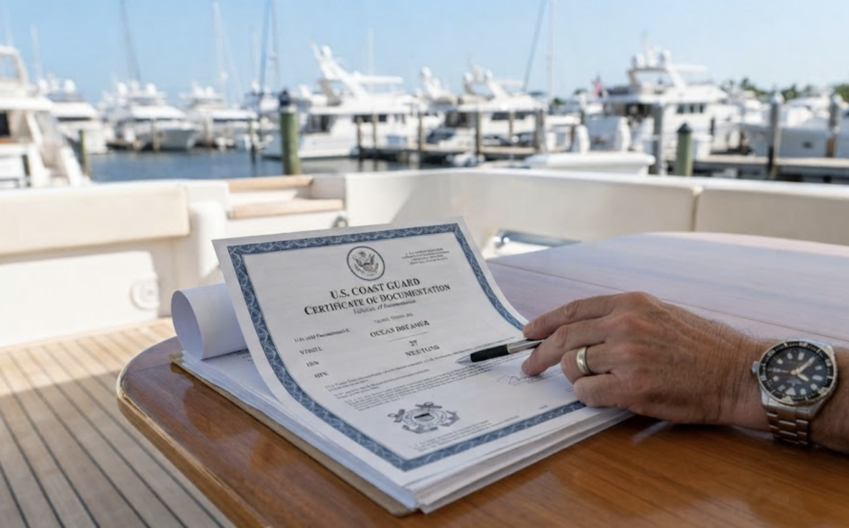
Federal documentation is a national form of registration administered by the Coast Guard for larger vessels. To be eligible, a boat generally must measure at least five net tons, a measure of enclosed volume rather than weight. As a rule of thumb, a monohull around 26 feet or longer will usually meet the five-net-ton threshold. Documentation provides a Certificate of Documentation, a nationally recognized record of ownership that does not need to be renewed through the state system, though state registration or use-tax requirements may still apply depending on where you keep the boat.
The Coast Guard describes the purpose plainly. According to the National Vessel Documentation Center, its mission is to facilitate maritime commerce and the availability of financing while protecting the economic privileges of United States citizens, and it allows owners to file mortgages and related instruments against their vessels. That financing angle is one of the biggest reasons owners of larger boats choose documentation.
The five-net-ton rule and why size drives the choice
Net tonnage is the gate. A vessel must measure at least five net tons to be eligible for federal documentation, and net tonnage reflects the boat’s internal volume, not how much it weighs. Because of that, many buyers are surprised to learn a fiberglass cruiser that feels heavy still qualifies based on its enclosed space rather than its heft. The 26-foot monohull guideline is a useful starting point, but the actual measurement is what governs eligibility.
If your boat falls below five net tons, federal documentation simply is not an option, and state titling is your path. If it meets or exceeds the threshold, you have a genuine choice to make, and the rest of your decision hinges on how you use and finance the vessel. That is why size is the first question to answer.
When federal documentation makes sense
Documentation shines for larger boats with certain plans. If you are financing a sizable vessel, many marine lenders prefer or require documentation because it enables a preferred ship mortgage, a security instrument recorded with the Coast Guard that gives the lender a strong, nationally recognized claim. For big-ticket boats, that structure can make financing easier to secure and sometimes more favorable. Lenders differ on whether they insist on it, so compare boat loan options before you commit to a vessel, because the lender you choose can effectively settle the registration question for you.
Documentation also helps if you travel. A Certificate of Documentation is recognized internationally and simplifies clearing customs when you cruise to foreign ports, which is why owners who take their boats abroad tend to document them. It offers a stable, national record of ownership that follows the boat regardless of which state waters it sits in, useful for vessels that move around or are kept far from the owner’s home state.
When state titling is the better fit
For most recreational boaters, state titling is the practical and cheaper choice. If your boat is under five net tons, trailerable, used on domestic waters, and financed conventionally, titling gives you clean ownership with far less complexity. There is no federal renewal to track and no tonnage measurement to obtain, just a familiar state process.
Even some eligible larger boats are titled at the state level when the owner has no international plans and finances through a lender that does not require documentation. The point is that documentation is a tool for specific situations, not a status symbol. Choosing it when you do not need it adds paperwork without adding value.
A quick way to decide
Ask yourself three questions. Is the boat at least five net tons, roughly 26 feet or more for a monohull? Do you plan to finance a large purchase or travel to foreign waters? Does your lender prefer or require documentation? If you answer yes to the size question and yes to at least one of the others, documentation is worth serious consideration. If not, state titling almost certainly serves you better.
Making the call
Federal documentation and state titling both prove you own your boat, but they are built for different vessels and different lives on the water. Documentation suits larger boats that need financing structured around a preferred ship mortgage or that travel internationally, while state titling covers the trailerable, domestically used boats that make up most of the market. Start with net tonnage, then weigh your financing and travel plans, and the right path becomes clear.
Whichever route fits, sort out the registration approach before you close, since it affects financing and how quickly you can get on the water. As you compare vessels and shop boats on Boatzon, keep the documentation question in mind for anything in the 26-foot-and-up range, because the answer shapes your paperwork from day one.
FAQ
What is the difference between federal documentation and state titling?
Federal documentation registers your boat nationally with the U.S. Coast Guard and issues a Certificate of Documentation, while state titling issues a title and registration through your state agency. Documentation suits larger vessels and supports financing and international travel, whereas titling is the simpler, cheaper path for most recreational boats.
What is the five-net-ton requirement for documentation?
To be eligible for federal documentation, a boat must measure at least five net tons, which is a measure of enclosed internal volume rather than weight. As a general guideline, a monohull about 26 feet or longer usually meets this threshold, though the actual tonnage measurement determines eligibility.
Do I still need state registration if my boat is documented?
Possibly. Federal documentation establishes ownership nationally, but many states still require documented vessels to register and pay any applicable use taxes if kept in state waters. Documentation replaces state titling for proof of ownership, but it does not always eliminate state registration or tax obligations.
Why do lenders prefer documentation for large boats?
Documentation allows a preferred ship mortgage, a security instrument recorded with the Coast Guard that gives lenders a strong, nationally recognized claim against the vessel. For high-value boats, this structure makes financing easier to secure, which is why many marine lenders prefer or require documentation on larger purchases.
Is federal documentation better for traveling internationally?
Yes. A Certificate of Documentation is recognized internationally and simplifies clearing customs when cruising to foreign ports. Owners who plan to take their boats abroad generally choose documentation for this reason, since it provides a stable, nationally recognized record of ownership that travels with the boat.
Can a small boat be federally documented?
No. Boats under five net tons are not eligible for federal documentation, so state titling is the only option for smaller vessels. Since most trailerable and compact boats fall below the threshold, state titling is the standard and appropriate choice for them.
Which option is cheaper?
State titling is generally cheaper and simpler, with local fees and no tonnage measurement or federal renewal. Federal documentation involves the Coast Guard process and periodic renewal, so it adds cost and complexity that only pays off for larger boats with financing or international travel needs.