
TL;DR: Hurricane season runs June 1 to November 30 in the Atlantic. The boat owners who make it through with minimal damage do three things before a storm shows up on the cone: confirm their insurance covers named storms with a deductible they can actually pay, decide in advance whether to dock down or haul out, and pre-stage the supplies that vanish from every chandlery 48 hours before landfall.
A hurricane season boat plan is the set of insurance, storage, and physical-prep decisions you make before a storm is in the forecast, so you're not improvising at the marina with everyone else when a name shows up on the National Hurricane Center map. Most boat damage from named storms is not catastrophic destruction. It's the slow, predictable kind that happens because someone left lines on the wrong cleat, didn't add chafe gear, or assumed their policy paid the same way for a tropical storm as for a hit-and-run. The owners who skate through usually had a plan written down in June. The ones who don't get a phone call from the marina in September.
This guide walks through what to do before, during, and after a storm, with a focus on the decisions that actually move outcomes rather than the obvious ones every marina memo already covers.
Confirm your insurance before the season opens
What “named storm” coverage actually means
Most boat policies handle a thunderstorm the same way they handle a fender-bender… you pay your standard deductible, the insurer pays the rest. Named storms are different. Once the National Hurricane Center assigns a name to a system, a separate clause in your policy usually kicks in: a named-storm or hurricane deductible, calculated as a percentage of the insured hull value rather than a flat dollar amount.
A 5% named-storm deductible on a $60,000 boat is $3,000. A 10% deductible on a $100,000 cruiser is $10,000. That’s the number you’d write a check for before the insurer pays a dime. Owners who skip this conversation discover the deductible after a claim, which is the worst possible time.
Call your agent in May or early June and ask three direct questions: what’s my named-storm deductible, what’s my hurricane haul-out reimbursement, and what’s the cutoff for moving the boat once a storm is named.
Hurricane haul-out reimbursement is real money
Many marine policies pay a portion of the cost to haul out and store the boat on land when a hurricane warning is issued for your area. Coverage is typically capped at $1,000 to $2,500 depending on the policy and the boat’s value. It’s a benefit owners forget about until the claim is over.
The mechanics matter: most policies require the boat to be in a named warning area, require a receipt from the yard, and require the move to happen before the storm hits. You can’t decide on day-of and expect reimbursement. Print the reimbursement details and tape them inside your float bag with the registration so you don’t have to remember the policy number under stress. If you don’t have current coverage or want to compare, you can get a boat insurance quote and ask specifically about named-storm clauses.
What policies typically exclude
Wind damage to a hauled boat sitting on jack stands is usually covered. Damage caused by the owner’s negligence, such as leaving the boat in the water against a marina order, thereby ignoring a mandatory evacuation, is usually not. Damage to personal property left aboard often falls under your homeowner’s policy, not your marine policy. Damage to a trailer is sometimes a separate endorsement. None of these are surprises if you read the policy in June. All of them are surprises in October.
Decide: dock down, dry stack, or haul out
The three options, plainly
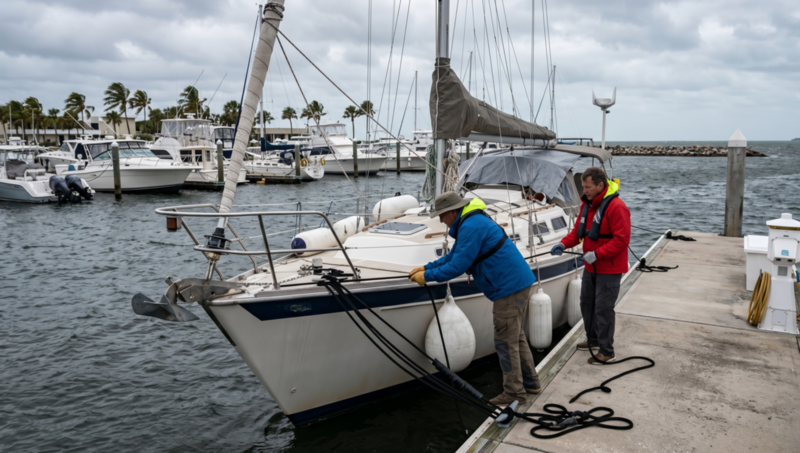
Dock down means leaving the boat in its slip with extra lines, fenders, and a careful mooring layout designed to handle the surge and rotation a storm produces. Works for protected basins with floating docks and reasonable surge protection. Fails in marinas with fixed docks where boats end up sitting on the piling at high tide.
Dry stack means having the marina lift the boat into a rack inside a covered storage building. Good for smaller boats under about 30 feet at marinas that offer the service. Capacity fills fast once a storm is named, so dry-stack reservations are something you make in June, not on Tuesday before a Saturday landfall.
Haul out means having the yard pull the boat from the water onto jack stands and tie-downs on land. Best survival rate in serious storms because the boat can’t get crushed against a piling or sunk by a sinking neighbor. Most expensive and requires booking the yard well before the line of customers forms.
How to choose for your boat
If your boat is under 30 feet and your marina has covered dry-stack space, that’s usually the safest option short of a yard haul-out. If you’re between 30 and 45 feet at a marina with floating docks in a protected basin, a well-prepared dock-down often works for a Category 1 or 2. Anything over 45 feet or any storm forecast at Category 3 or higher, you haul out if you can.
The honest test: would you trust the dock you’re on to survive eight to twelve hours of 80 mph wind with a four-foot surge? If you’ve never asked your marina that question, the dock isn’t a plan.
Book your yard slot in May
Hurricane haul-out yards along the Gulf Coast and Southeast fill up within hours of a storm being named. Most of them maintain a list of customers with standing reservations for the season. These are owners who pay a small holding fee in May or June and get a guaranteed slot if a storm comes in. If you live in a hurricane zone and don’t have a standing reservation, you’re competing with everyone else’s last-minute call.
For the cost of dinner out, you can lock in peace of mind for six months. Make the call now.
Build the 72-hour kit
Supplies that vanish 48 hours before landfall
Every chandlery on the coast sells out of the same six items as soon as a storm shows up on the cone: chafe gear, extra dock line in standard lengths, oversized fenders, fender boards, large-format zip ties, and snake-style sandbags. By Wednesday before a weekend landfall, you can’t find any of it within 200 miles.
Buy the season’s supply in early June and put it in a labeled tote on a shelf in the garage. Once you’ve done it one time, it costs about $400 to $700 and lasts five seasons.
A starter list
- Four extra dock lines in your boat’s preferred size (typically 5/8″ or 3/4″ three-strand nylon)
- Eight pieces of chafe gear (vinyl tubing or commercial chafe pads, not garden hose)
- Two oversized fenders beyond your normal complement
- A fender board sized for your beam
- A roll of heavy-duty electrical tape and 100 large zip ties
- A hand bilge pump in case the electric system fails
- A portable battery pack sized to run your bilge pump for 24 hours
- A waterproof document bag for registration, title, insurance card, and a printed copy of your policy summary
- A camera or phone dedicated to pre-storm documentation (every angle, every system, on a date-stamped video)
Document the boat before the storm
The single highest-value claim documentation is a walkaround video taken 24 to 72 hours before the storm, narrated with the date, the boat name, and pointed at every system. Show the engine room, the hull below the waterline if possible, the electronics, the safety equipment, and any specialty gear. Save it to cloud storage. Email it to yourself.
This 10-minute video is the difference between a paid claim and a six-month dispute about what was there before the water came in. It costs nothing.
The 72-hour countdown
Three days out
Confirm your haul-out slot or dock plan. Top off fuel tanks (a full tank is heavier and less prone to condensation; an empty tank floats). Charge every battery. Test the bilge pump. Pull the storm tote from the garage. Make the walkaround video. Review your policy summary.
Two days out
Strip the deck of anything that can become a projectile: cushions, antennas if removable, kayaks, fishing gear, life rings, anything bolted on that you’d rather have in the garage than at the bottom of the basin. Take down canvas. Remove sails if you have a sailboat. Lash down anything that can’t come off. Decide on a final mooring or haul-out time and tell someone other than your spouse what it is.
Twenty-four hours out
This is the cutoff window for most insurers and most marinas. If you’re hauling out, the boat needs to be on land. If you’re docking down, the extra lines, chafe gear, and fenders all go on now. Add a stern anchor if your basin allows it. Doubled-up lines run at angles, not parallel, so the boat can absorb rotation.
Power off shore power. Close all seacocks. Turn off the battery switch. Lock the cabin. Photograph the final state. Then leave. Riding out a hurricane on the boat is not a plan, regardless of what your uncle did in 1992.
After the storm
Don’t come back until the marina or yard tells you it’s safe. Storm surge keeps moving for hours after the wind drops. Downed power lines in flooded water are how people die. When you get there, photograph everything before you touch anything, including the dock area around the boat. Then call your insurer. The order matters: photos, then phone.
Geographic risk by region
Florida and the Gulf Coast
Highest exposure in the country, hands down. South Florida marinas often require hurricane plans on file as a slip condition. Tampa Bay and the Florida Panhandle face the highest historical surge risk in the state. If you keep your boat in Florida and don’t have a written plan, the marina almost certainly has an opinion about that.
Southeast Atlantic
The Carolinas, Georgia, and Virginia all see multiple hurricane threats per season. Boats in inland sounds and rivers often fare better than coastal marinas if those waterways have hurricane-rated docks and protected basins. Boats on the open coast usually need to come out of the water for any serious storm.
Northeast
Long Island and southern New England get hit less often but get hit hard when they do. The 2012 Sandy event and earlier storms like the 1938 hurricane both moved boats inland miles from their slips. Northeast owners tend to underestimate the risk because storms are rarer; that’s exactly the reason to have the plan written down.
Inland and Great Lakes
Hurricane risk is effectively zero, but derecho and severe thunderstorm winds can produce damaging gusts that affect boats on lifts and at exposed docks. The same pre-storm documentation habit pays off here too.
To compare options for your region, you can browse boats for sale by state and see what kind of inventory and dealer support exists where you keep your boat.
What to learn from this season
Even if no storm hits your area this year, run the drill once. Pull the boat, check the trailer, photograph everything, review the policy, restock the storm tote. The owners who treat hurricane prep as a routine June chore rather than a panic in September are the ones whose boats keep getting older without getting damaged. Authoritative reference: the BoatUS Hurricane Resource Center is the most comprehensive single source on hurricane preparation for boat owners.
FAQ
When does Atlantic hurricane season start?
The Atlantic hurricane season officially runs June 1 through November 30 each year. The peak window is mid-August through mid-October, when sea surface temperatures and atmospheric conditions are most favorable for major storms. Tropical storms can form outside the official window, but the majority of named storms develop within these six months.
Does standard boat insurance cover hurricane damage?
Most marine policies cover named-storm damage, but they apply a separate named-storm deductible that’s calculated as a percentage of hull value rather than a flat dollar amount. A 5% deductible on a $50,000 boat is $2,500. Confirm your specific deductible with your agent before the season, not after a claim.
Is it better to haul out or leave the boat in the slip?
For storms forecast at Category 1 or 2, a well-prepared boat in a protected basin with floating docks often survives in the water. For Category 3 or higher, hauling out has substantially better survival rates because the boat can’t be crushed against a piling or sunk by a neighbor’s boat coming loose. The decision should be made before the storm is named, not after.
Can I claim hurricane haul-out costs on insurance?
Most marine policies include a hurricane haul-out reimbursement benefit, typically capped between $1,000 and $2,500. Coverage requires the boat to be in a named warning area, requires a receipt from the yard, and requires the move to happen before the storm hits. Confirm the cap and the conditions with your agent before relying on the benefit.
What’s a named-storm deductible?
A separate deductible that applies only to damage from a named tropical storm or hurricane, calculated as a percentage of the insured hull value rather than the flat dollar amount used for normal claims. Typical ranges are 2% to 10% of hull value, and the deductible is something you pay before the insurer pays anything.
Should I ride out the storm on my boat?
No. Marinas and the Coast Guard universally advise against staying aboard during a hurricane. Boats can break loose, capsize, or sink, and a marina full of boats becomes a debris field once the wind hits a critical threshold. The plan is to secure the boat and leave, full stop.
How much chafe gear and dock line do I actually need?
Plan on at least double your normal dock lines and chafe protection at every point where a line crosses a chock, piling, or cleat. For a 35-foot boat in a slip, that typically means six to eight lines total and eight to twelve pieces of chafe gear. Buy in early June; supplies vanish 48 hours before a named landfall.
What if I can’t get a haul-out slot?
Call other yards in your region, including yards 50 to 100 miles inland if your trailer can travel. Some marinas maintain a waitlist for emergency haul-outs in extreme storms. If everything is full, the best fallback is a well-prepared dock-down with doubled lines, oversized fenders, and a stern anchor where allowed. Then book a standing reservation for next season.