
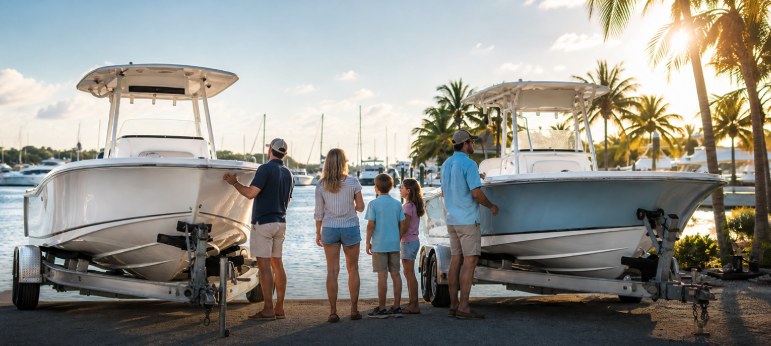
When a Florida family stands at the dock comparing a new center console to a five-year-old model priced $20,000 lower, the core question is simple: does that gap represent smart depreciation savings, or deferred repair costs? Understanding how fast do boats depreciate, and what makes that curve steeper or shallower, turns a gut decision into an informed one.
Key Takeaways
- Boats typically lose 10–15% of value in year one, around 20% cumulatively by year five, and 30–50% by year ten
- The depreciation curve is steepest early, after year five, condition and maintenance history drive value more than age.
- Florida has no fixed depreciation rate; saltwater exposure, UV wear, storm history, and documentation all affect an individual boat's resale value.
- A professional marine survey is essential for any used boat purchase in Florida, a personal inspection is not a substitute.
- New boats carry the highest early depreciation risk; used boats shift risk to condition, repairs, and resale liquidity.
- Pre-qualify for financing and compare insurance options alongside the purchase price before deciding what fits your budget.
How Fast Do Boats Depreciate? The Year-by-Year Benchmark
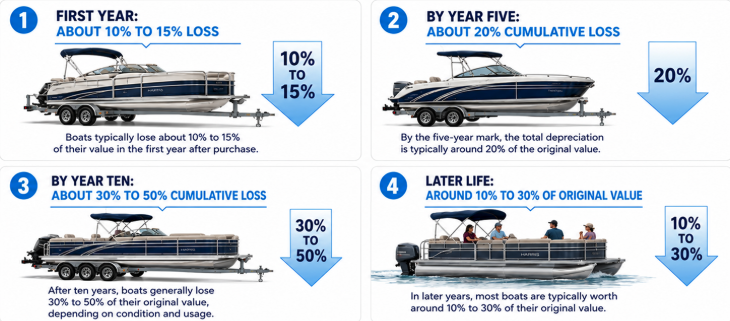
Boats generally lose value fastest in the first few years of ownership, after which the curve flattens and condition matters more than age. According to a BoatUS benchmark (April 2026), using selected dayboat-oriented examples measured from base price new versus average retail value at publication, the general depreciation pattern looks like this:
| Ownership Period | BoatUS Benchmark (April 2026) | Buyer Takeaway |
| First year | ~10–15% loss | New buyers absorb the steepest early drop |
| By year five | ~20% cumulative loss | Recent-used boats often offer meaningful savings |
| By year ten | ~30–50% cumulative loss | Condition increasingly separates comparable boats |
| Later life | ~10–30% of original value remaining | Age matters less than usability, records, and documentation |
The steepest decline almost always happens early. J.D. Power’s marine valuation research confirms that value declines are sharpest in the first few years and that condition and maintenance history become the primary value drivers after ten years.
One important note: boat depreciation per year does not reduce to a single annual percentage. The S-curve above shows year one looks nothing like year eight. Using one flat rate to estimate every boat’s value leads to poor comparisons.
Why Depreciation Estimates Conflict (and How to Read Them)
If you’ve compared boat depreciation figures online, you may have found two sources quoting completely different percentages, and both sounding confident. The reason: they’re often measuring different things.
Price basis is the starting figure used in the calculation. A new center console measured from MSRP, a used pontoon measured from its transaction price, and an older cruiser measured from current market listing, those three produce completely different percentages even if the boats are the same age.
J.D. Power identifies make, model, age, condition, type, equipment, upgrades, market trends, supply and demand, location, and seasonal demand as inputs into fair market value. BoatUS uses selected dayboat-oriented examples, not a universal fleet sample, which is useful for planning but won’t represent every boat category, length, or engine type.
When applying any depreciation estimate to a specific purchase, always normalize the comparison: same model year, same engine type, same equipment level, same storage conditions, and same geographic market.
Boat Depreciation in Florida: What Changes Here
Florida buyers face conditions no benchmark was built around. Saltwater exposure, UV intensity, hurricane history, and year-round use compress wear cycles that might take decades in a freshwater, covered-storage environment elsewhere. There is no fixed “Florida boat depreciation rate,” but these factors can materially separate two boats of the same year and model:
Saltwater and corrosion exposure. Running gear, anodes, trim tabs, and the hull below the waterline all degrade faster in saltwater. A boat with five years of saltwater use and no corrosion documentation is a different asset from one with five years of lift storage and annual service records.
UV and climate wear. Florida’s sun degrades upholstery, gel coat, and electronics faster than northern climates. Faded or cracked surfaces are visible depreciation; delamination and blisters are structural.
Storm history. Flood damage, submersion, or saltwater intrusion from a named storm is not always visible, and not always disclosed. Title history and hull identification number checks matter more here.
Maintenance documentation. A Florida buyer who can produce organized service records, engine hours, annual haul-outs, propulsion service, has a demonstrably different boat than an identical-looking one with no paper trail.
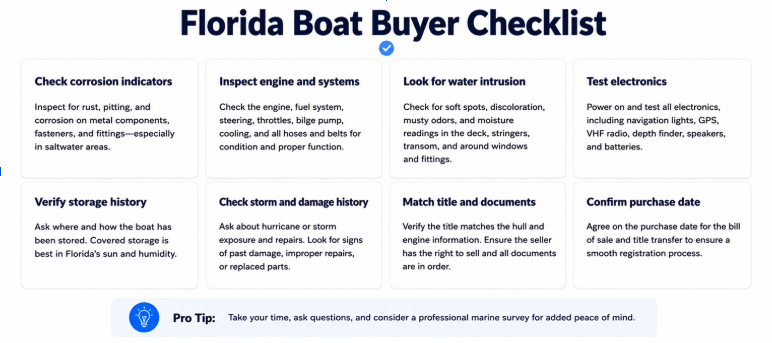
When shopping boats for sale in Florida, run this checklist before applying any general benchmark:
- Inspect corrosion indicators, anodes, running gear, and trim tabs
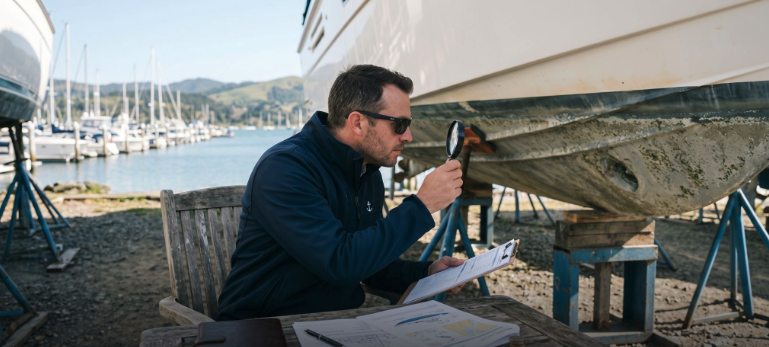
- Check the hull below the waterline for blisters, delamination, and past repairs
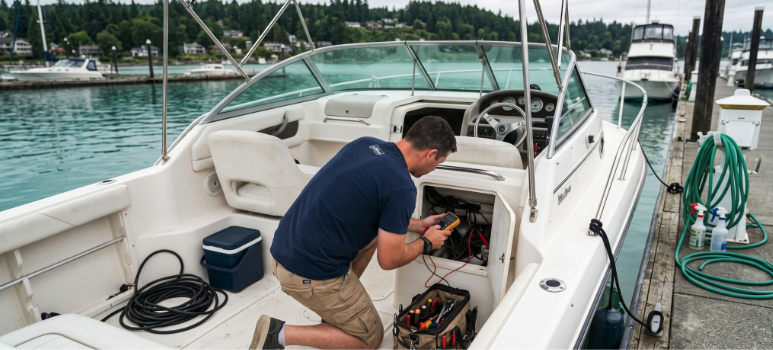
- Test engine operation: leaks, temperature, RPM, and full-capacity trial run
- Evaluate electronics, upholstery, and gel coat for UV damage
- Verify storage history, storm exposure, and damage records
- Match the title, hull identification number (HIN), and purchase documents
BoatUS notes that a buyer’s personal inspection is not a substitute for a professional marine survey. For any Florida used boat purchase, a survey is not optional, it is the difference between a price and a cost.
Do Boats Depreciate Faster Than Cars?
This is one of the most common “people also search for” questions, and the answer is nuanced. New boats and new cars both drop significantly in the first year, but boats often depreciate faster in absolute dollar terms on larger purchases, and the floor is more unpredictable. A car depreciates in a well-documented, heavily-researched market with millions of comparable transactions. The boat market is thinner, more regional, and more condition-sensitive.
According to Kelley Blue Book’s auto research, the average new car loses roughly 20% of its value in the first year and 60% by year five in some segments. Boats can follow a similar or steeper curve early, but condition divergence after year five is often more dramatic for boats, a well-maintained boat may hold value where a neglected one loses it rapidly.
The IRS, for depreciation-for-tax-purposes analysis, typically assigns boats a 5–7-year recovery period under MACRS for business use, which implies a faster scheduled write-down than many real-world resale comparisons show.
Boat Depreciation Life (IRS) and Tax Purposes
If you’re asking “boat depreciation life IRS” because you use your boat for business, charter, instruction, fishing guide, or other documented commercial use, the IRS generally classifies watercraft under the 5-year MACRS property category. The Modified Accelerated Cost Recovery System allows front-loaded depreciation, meaning you write off more in the early years. Section 179 spending may apply for qualifying business-use property.
This is not tax advice. Consult a qualified tax professional or CPA familiar with marine business use before claiming boat depreciation deductions. The rules around mixed personal/business use are specific and auditable.
Do Yachts Depreciate in Value?
Yes, but more slowly and less predictably than production powerboats. Yachts priced above roughly $500,000 behave more like specialized real estate than consumer goods. Factors like builder reputation, structural condition, refit history, electronics packages, and brokerage network coverage weigh heavily.
A well-maintained production motoryacht from a recognized builder can hold value through a full refit; a poorly maintained one can lose value faster than a used car. If you’re evaluating motoryachts or mega-yachts, the depreciation benchmark discussion shifts significantly, a professional broker and independent survey become essential, not optional.
What Makes a Boat Hold Its Value?
Across all boat types and markets, retained value comes down to the same ten factors:
- Documented maintenance history — service records, haul-out logs, engine hours
- Engine and propulsion condition — functional, freshly serviced, within manufacturer tolerances
- Hull and structural integrity — no blisters, delamination, or unresolved repairs
- Cosmetic condition — upholstery, gel coat, and hardware in marketable shape
- Storage history — lift or covered storage outperforms outdoor splash-and-leave
- Damage and repair history — disclosed, documented, and professionally completed
- Clear title and ownership records — no liens, no gaps, no HIN discrepancies
- Useful equipment and upgrades — electronics, safety gear, upgraded canvas that buyers want
- Make, model, and market demand — some types and brands command stronger resale in specific regions
- Comparable local inventory — fewer competing listings at similar price points help retain value
Owners can reduce avoidable depreciation by following manufacturer maintenance schedules, controlling corrosion proactively, using appropriate storage, repairing problems before they compound, and keeping all ownership documents organized. Choose upgrades based on buyer demand in your market, not personal preference, not every upgrade returns its cost at resale.
New vs. Used: Which Carries Less Depreciation Risk?
The used boat argument is that someone else absorbed the first-year drop. The new boat argument is that you know exactly what you’re getting. Neither is universally correct.
| Decision Point | New | Recent Used (3–6 years) | Older Used (10+ years) |
| Early depreciation | Highest exposure | Often partly absorbed | Typically slower percentage decline |
| Purchase price | Generally higher | Lower than equivalent new | Often lowest |
| Warranty | Verify written coverage | Check remaining/transferable coverage | Usually limited or none |
| Condition certainty | Less use history to evaluate | Inspect service and use history | Detailed inspection is critical |
| Unknown maintenance risk | Lower | Moderate | Potentially significant |
| Survey | Prudent | Strongly recommended | Essential |
| Resale horizon | Early curve matters most | Balance price and remaining age | Condition and liquidity risk |
For a 20-year-old boat, the checklist expands: professional marine survey of hull and propulsion, engine and systems inspection, full service record review, parts availability check, corrosion and storm history, title verification, and insurance availability confirmation. The depreciation percentage on a 20-year-old boat may be slow, but repair risk is real, and resale liquidity can be limited.
Whether you’re browsing center console boats, pontoons, or bowriders, comparing equivalent model years, engine types, equipment levels, and condition against real asking prices is how you measure depreciation practically, not by applying a published percentage.
How to Estimate Boat Value Before Making an Offer
A five-step process that keeps your estimate grounded:
- Define your price basis — are you starting from original MSRP, your target purchase price, or current market comparables? Label it clearly.
- Find current comparable listings — same model year, same engine, same storage region, similar equipment. Boatzon’s inventory lets you filter by type, year, and location for a real-market view.
- Apply the benchmark cautiously — use the BoatUS or J.D. Power ranges as planning ranges, not as formulas.
- Adjust for documented condition factors — subtract for undocumented history, add for complete records and recent service.
- Record the valuation date and assumptions — market conditions change, and your estimate is only as good as its inputs.
The result is a planning estimate, not an appraisal. For a financed purchase or a high-dollar used boat, a certified marine appraiser provides a defensible value opinion.
Boat Depreciation Calculator: What to Look For
If you’re searching for a “boat depreciation calculator,” be aware of two limitations. First, most online calculators apply a flat annual percentage (commonly 15–20%) across all years, which misrepresents the actual S-curve, too generous in year one, too harsh in year ten. Second, they can’t account for Florida-specific condition factors, regional market demand, or your specific boat’s documentation.
Use a calculator as a rough sanity check, not as the basis for an offer. Compare the output against actual asking prices on Boatzon for similar boats in your region. If the calculator says a boat is worth $35,000 but comparable Florida listings are at $28,000, the market is telling you something the formula isn’t.
How Boatzon Supports the Full Buying Decision
The discount on a used boat is only real value if the survey, title, insurance, and maintenance outlook are part of the analysis. Through Boatzon’s online marine marketplace, you can:
- Compare real new and used boat inventory by type, year, and location
- Pre-qualify for boat financing with no impact to your credit score
- Review boat financing options and compare terms alongside the purchase price
- Compare marine insurance quotes from multiple carriers
- Complete the buying journey online from search to purchase
Knowing what comparable boats are actually selling for in Florida gives you a real anchor for depreciation analysis, better than any published rate applied in a vacuum.
FAQ
How fast do boats depreciate per year?
Boats don’t depreciate at a flat annual rate. The curve is steepest in year one (roughly 10–15% by BoatUS benchmarks), moderates significantly by year five (around 20% cumulative), and flattens further after year ten. After the first few years, condition and maintenance history drive value more than age.
Is there a reliable boat depreciation rate calculator?
Online calculators can provide rough estimates, but they typically apply a flat percentage that overstates later-year depreciation and understates the first-year drop. Compare calculator outputs against actual comparable listings in your market, specifically Florida-area boats of the same type, year, and condition, for a more reliable picture.
Do boats depreciate faster than cars?
Both asset types drop significantly in year one. Boats can depreciate faster in dollar terms on large purchases, and the boat market is thinner and more condition-sensitive than the auto market, making the floor harder to predict. After year five, condition divergence between a well-maintained and neglected boat is often more dramatic than for cars.
How fast do boats depreciate in Florida specifically?
There is no fixed Florida rate. Saltwater use, UV wear, storm exposure, storage conditions, and maintenance documentation can significantly separate two boats of identical year and model. Always obtain a professional marine survey and review the full ownership history for Florida-used boats.
What is boat depreciation life for IRS and tax purposes?
The IRS generally assigns boats a 5-year MACRS recovery period for qualifying business use. Section 179 may apply. Mixed personal and business use rules are complex, consult a qualified tax professional before claiming boat depreciation deductions.
Do yachts depreciate in value?
Yes, but typically more slowly and less predictably than production powerboats. Builder reputation, refit history, structural condition, and brokerage market conditions all weigh heavily. A well-maintained production yacht can hold value through a refit; a neglected one may drop faster than expected.
How quickly do pontoons lose value?
Pontoons follow the same general pattern: steeper early depreciation that moderates over time. After the first few years, engine condition, upholstery quality, seating configuration, and the pontoon logs’ structural condition become the primary value drivers. Compare equivalent model years and engine hours rather than relying on a category-level rule.
What helps a boat hold its value?
Complete service records, consistent scheduled maintenance, proactive corrosion control, appropriate storage (lift or covered), prompt repairs, and organized title documents. Useful upgrades that buyers in your market actually want also help, but don’t assume every dollar spent on upgrades returns at resale.
Is buying a 20-year-old boat a bad idea?
Not automatically. The percentage depreciation may be slow, but the risk shifts entirely to condition and repair exposure. A professional marine survey, propulsion inspection, parts-availability check, corrosion history review, and confirmed insurance availability are essential before proceeding. The lower price is only attractive if the survey supports it.
Can I compare new and used boats on Boatzon?
Yes. Boatzon’s inventory includes new and used listings filterable by boat type, model year, location, and price range. Comparing real asking prices for similar boats in Florida gives you a grounded view of what depreciation actually looks like in the current market, not what a formula estimates it to be.
The Bottom Line: Compare the Boat, Not Just the Percentage
How fast do boats depreciate? Faster than most buyers expect in year one, slower than most fear after year five, and entirely dependent on condition, documentation, and market demand in between. A single published rate applied to every boat of every age and type produces a number, not an insight.
For Florida buyers, the percentage matters less than the survey findings, the service records, the storage history, the title documentation, and what comparable boats are actually selling for right now. Browse current inventory on Boatzon, pre-qualify with no credit impact, and review financing and insurance options before deciding what fits your family, and your budget. Questions? Call 1-833-262-8966.