
A period of missed payments or a difficult financial stretch can leave a Florida family wondering whether boat ownership is off the table. The worry is often twofold: can you get a boat loan with bad credit, and will checking make the credit situation worse?
The qualified answer is yes, financing may still be possible. But approval depends on the full picture a lender sees, not a single number. The practical first move is to understand what lenders actually review, set a realistic budget, and explore your options before committing to a boat.
Key Takeaways
- Bad credit does not automatically disqualify you from boat financing, approval depends on the full application, not the score alone.
- No universal credit score cutoff applies to every boat lender; a 500 or 600 is not an automatic denial.
- Lenders weigh income, existing debts, down payment, recent payment history, loan amount, and boat value alongside your credit score.
- A larger down payment reduces the amount financed and may strengthen your file; a cosigner adds legal repayment responsibility for that person.
- Florida buyers must budget for sales tax, title, registration, insurance, storage, maintenance, and fuel, not just the monthly loan payment.
- Boatzon's pre-qualification does not impact your credit score and is not final approval; final terms depend on lender review and underwriting.
- If a loan is declined, review the adverse-action notice for specific reasons before reapplying.
Can You Get a Boat Loan With Bad Credit in Florida?
For a Florida family concerned that damaged credit automatically puts boating out of reach, the direct answer is no, it doesn’t automatically disqualify you. You can get a boat loan with bad credit in some cases, though weaker credit may narrow available options or result in less favorable terms.
Bad credit refers to a credit profile that signals greater repayment risk: low scores, missed payments, high revolving balances, collections, or a thin credit history.
Lenders assess the score alongside income, recurring debts, recent payment history, employment stability, down payment, requested loan amount, supporting documents, and the boat’s value. No universal boat-loan approval cutoff applies to every lender, and Florida does not create a separate underwriting standard for these applications.
The score is one part of an application, not the whole decision. Establish a workable financing range first by exploring Boatzon’s pre-qualification, then compare boats for sale within that realistic range.
What Credit Score Do You Need for a Boat Loan?
A 600 on your screen doesn’t tell you whether a boat loan will be approved. Scores around 500 or 600 can make financing harder, but neither number creates an automatic approval or denial.
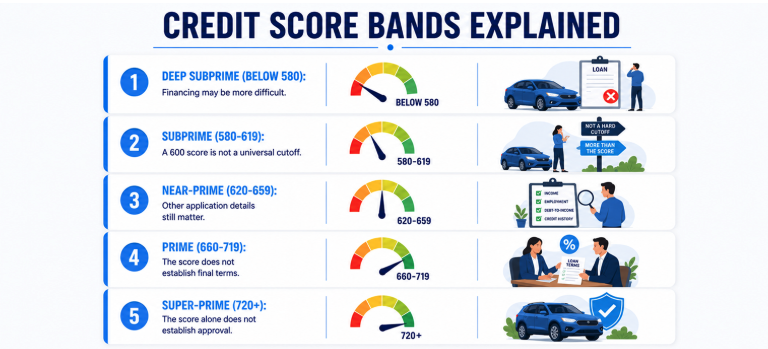
The Consumer Financial Protection Bureau (CFPB) uses the following borrower-risk profile bands for analytical purposes, these are not universal boat-loan cutoffs:
| CFPB Risk Band | Score Range | What It Means Here | Next Step |
| Deep subprime | Below 580 | Financing may be more difficult | Review the complete application and budget |
| Subprime | 580–619 | A 600 score is not a universal cutoff | Check possible options before selecting a boat |
| Near-prime | 620–659 | Other application details still matter | Organize income, debt, and boat information |
| Prime | 660–719 | The score does not establish final terms | Compare the complete offer |
| Super-prime | 720 or above | The score alone does not establish approval | Review costs and authorization language |
Loan amount, income, debt-to-income ratio, down payment, collateral, and boat value all remain relevant regardless of band. You can pre-qualify through Boatzon with no impact to your credit score, but that early check is not final approval.
What Lenders Review Beyond Your Credit Score
The central underwriting question is whether the household has room for a new monthly payment after meeting its existing obligations. A lender’s complete review may include:
- Income stability and gross monthly income
- Recurring monthly debts (car loans, credit cards, student loans)
- Recent payment history — trends matter, not just the score
- Employment information and length of time at your current job
- Requested loan amount and how it compares to the boat’s value
- Available down payment
- Boat age, condition, and appraised or market value
- Identification and supporting documents
Debt-to-income (DTI) ratio, monthly debt payments divided by gross monthly income, is one metric lenders use when assessing whether the household can take on another monthly obligation. Verify the lender’s own DTI requirement directly rather than relying on a generalized limit. You can read more about how DTI affects boat financing on the Boatzon blog.
A larger down payment reduces the amount financed, which may strengthen the application. A cosigner adds another person’s repayment obligation, and that person may be legally responsible if the primary borrower doesn’t pay. Neither option assures approval.
Choosing a lower-priced used boat may also reduce the loan amount needed, though condition and collateral value still factor into the lender’s review. See boats for sale under $20,000 if a budget-friendly starting point fits your plan.
How to Improve Your Chances of Getting a Boat Loan With Bad Credit
Preparation cannot guarantee an outcome, but a cleaner, more complete file gives the lender clearer information to work with. Work through this checklist before submitting an application:
- Obtain your credit reports: The FTC identifies AnnualCreditReport.com as the authorized source for free weekly reports from the three major bureaus.
- Dispute genuine errors: An incorrect balance, a collection that doesn’t belong to you, or a payment wrongly marked late can be disputed and corrected.
- Reduce revolving balances where practical: High credit-utilization ratios can lower scores even when payments are on time. Boatzon’s guide on how to raise your credit score walks through the basics.
- Avoid taking on new debt in the months before applying.
- Save a down payment, but don’t drain the reserve needed for Florida ownership costs (tax, registration, insurance, storage).
- Consider a qualified cosigner only after that person fully understands their legal repayment liability.
- Choose a realistic boat price and organize all required information upfront: identification, address, income and employment documents, debt summary, down-payment funds, and boat details.
The general sequence moves from pre-qualification → boat selection → full application → document verification → underwriting → decision → closing. As a low-pressure first step, explore your financing options before committing to a particular boat.
Pre-Qualification vs. a Full Boat Loan Application
If you want financing clarity before authorizing a full application, understanding the difference between the two stages matters:
| Feature | Pre-Qualification | Full Application |
| Purpose | Explore possible eligibility | Request a lending decision |
| Credit impact | Does not impact your credit score through Boatzon | Review the authorization language before submitting |
| Information reviewed | Early eligibility inputs | Full documentation for lender review |
| Outcome | Possible options or range | Approval or denial with final terms |
Pre-qualification is not final approval. Final approval and terms depend on lender review, verification, and underwriting. Before submitting a full application later, read the credit-authorization disclosure carefully, lender processes differ.
Shoppers ready to take the next step can apply for boat financing directly on Boatzon.
Florida Costs to Include Before You Choose a Boat
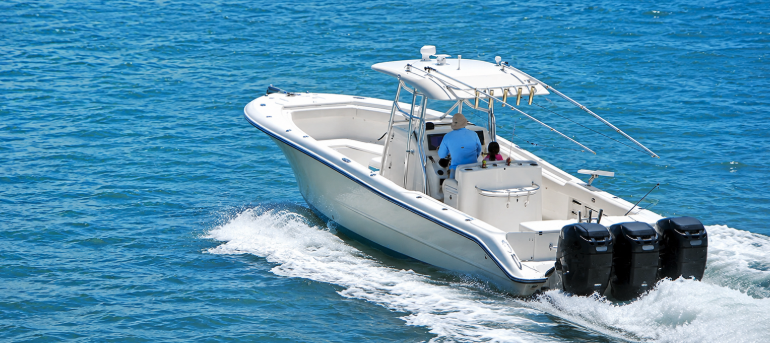
A planned loan payment may look manageable, until title work, sales tax, registration, insurance, marina storage, fuel, and maintenance enter the picture. Florida doesn’t change the need for lender review, but it does affect the total ownership budget significantly.
Florida vessel title and registration applications go through a county tax collector or license plate agent. Applicants must establish proof of ownership, and sales tax is due if not already paid at purchase. The Florida Fish and Wildlife Conservation Commission (FWC) is the state authority for vessel registration requirements.
Here’s a complete ownership cost checklist for Florida buyers:
| Cost Factor | What to Verify |
| Amount financed | Price after down payment and applicable costs |
| APR and term | Terms offered to the applicant after underwriting |
| Fees and taxes | Amounts included in financing or paid separately |
| Insurance | Quote and any lender-specific minimum coverage requirement |
| Registration | Florida title and registration fees via county tax collector |
| Storage | Home, trailer, dry stack, marina slip, or other arrangement |
| Maintenance and fuel | Household reserve for expected seasonal use |
| Boat age and collateral value | Effect on lender’s loan-to-value assessment |
A $15,000 financed amount doesn’t produce one accurate monthly payment without knowing the APR, term, fees, and taxes applied. Longer loan terms may lower the monthly payment while increasing total interest paid. For a more realistic estimate, use the Boatzon boat loan calculator.
You can also get an insurance quote through Boatzon to estimate that ownership line item before you commit. For more on what coverage looks like, see types of boat insurance policies.
Treat the boat as one complete ownership budget, not one monthly bill.
What to Do if Your Boat Loan Application Is Declined
Start with the denial notice and read the listed reasons before submitting another application anywhere.
Under CFPB Regulation B guidance, creditors generally must provide specific adverse-action reasons or explain your right to request them. An adverse-action notice is the document that communicates a credit denial and its reasons (or explains how to request those reasons).
Use the denial reason to determine your next step:
- Review the relevant credit report for inaccuracies; dispute errors
- Lower your target boat price to reduce the amount financed
- Build a larger down payment before reapplying
- Consider a qualified cosigner who understands the legal obligation
- Improve the credit profile over time, on-time payments and reduced balances move scores in the right direction
- Postpone the purchase until the financial picture improves
A decline is a signal to reset the plan, not an invitation to accept debt the household can’t comfortably repay. Avoid substituting high-cost unsecured debt or drawing on home equity without fully understanding that the home may secure the obligation.
Cash purchase or documented co-ownership arrangements are alternatives when financing isn’t accessible. Later, the family can revisit responsible marine financing paths or return for a no-impact pre-qualification.
How to Get Started with Boatzon
The practical next step is to learn what may fit before choosing a boat or authorizing a full application. Boatzon is an online marketplace where you can shop inventory, explore financing, compare marine insurance quotes, and buy boats, all in one place.
- Our pre-qualification does not impact your credit score
- Final approval and terms depend on lender review, verification, and underwriting
- Use the resulting range to compare real inventory and evaluate the broader ownership budget
- Browse boats for sale in Florida once you have a financing range in mind
For questions, call 1-833-262-8966.
FAQ
Can I get approved for a boat loan with bad credit?
Yes, approval may be possible. Bad credit can narrow the options or affect available terms, but the complete decision also reflects income, debt, down payment, requested loan amount, recent payment history, documentation, and collateral. Set a realistic budget and explore pre-qualification before selecting a boat.
Can I finance a boat with a 500 credit score?
Financing may be possible, but 500 is not a universal approval or denial threshold. The score falls within the CFPB’s below-580 analytical risk band, which is not a boat-loan cutoff. A lender may also review income, debts, down payment, loan amount, recent payment history, and boat value. Avoid any provider claiming guaranteed approval based solely on a score.
What is the monthly payment for a $15,000 boat loan?
There’s no single accurate payment without knowing the APR, term, down payment, fees, and applicable taxes. Changing any of those inputs changes the payment or the amount financed. The household budget should also include insurance, registration, storage, maintenance, and fuel. Use the boat loan calculator to model different scenarios.
Can I get a boat loan with a credit score of 600?
A 600 score may leave some financing possibilities open, but it is not a universal cutoff. The CFPB places 600 within the 580–619 subprime analytical band, not a boat-lender approval rule. Income, debt-to-income ratio, down payment, amount financed, collateral, and documentation can all affect the complete decision.
What bad credit boat loan options are available in Florida?
Florida buyers may compare banks, credit unions, marine-finance providers, and marketplace financing, each with their own eligibility requirements. Compare total borrowing cost, terms, and disclosures rather than choosing by proximity alone. Florida title, registration, proof-of-ownership, and sales tax requirements should also be included in your plan.
Are there bad credit boat loans with guaranteed approval?
No legitimate lender can guarantee approval before reviewing a complete application. Claims of “guaranteed approval” for bad credit boat loans are a common red flag. Any provider making that promise before seeing income, debt, and documentation details warrants extra scrutiny. Legitimate lenders review the full file before issuing any decision.
What is the debt-to-income ratio for a boat loan?
DTI is monthly debt payments divided by gross monthly income. A lender may consider it when assessing whether the household has room for another monthly obligation. Verify the lender’s own DTI limit before applying, it varies by lender and loan type.
Can you check boat financing options without hurting your credit?
Yes. Boatzon’s pre-qualification does not impact your credit score. It is an early eligibility check rather than final approval, and final terms depend on verification and lender underwriting. Review the credit-authorization language carefully before submitting a later full application.
Is a bigger down payment better than using a cosigner?
These two choices affect an application differently. A larger down payment reduces the amount financed. A cosigner assumes legal repayment responsibility if the primary borrower doesn’t pay. The right choice depends on available cash, lender requirements, and whether the cosigner fully understands and accepts the risk. Neither option assures approval.
How much down payment do you need for a boat loan with bad credit?
There’s no fixed percentage that applies to every lender. A larger down payment may strengthen the file by reducing the amount financed, but it can’t assure approval. Florida buyers should preserve enough cash for tax, registration, insurance, maintenance, fuel, and storage rather than putting every available dollar toward the purchase price.
Is Boatzon pre-qualification the same as final loan approval?
No. Pre-qualification through Boatzon does not impact your credit score, but it is not final approval. Final approval and terms depend on lender review, verification, and underwriting. Read the credit-authorization language before submitting a full application.
Build the Budget Before Choosing the Boat
A sound financing plan avoids unsupported score cutoffs, invented APRs or monthly payments, and the assumption that a loan payment equals the full cost of Florida boat ownership.
You can pre-qualify with no impact to your credit score, then compare boats within a realistic range. Pre-qualification is not final approval. Final approval and terms depend on lender review. For questions, call 1-833-262-8966.