
If you're weighing your next move on the water, understanding your boat trade in value is the first real step. Boatzon, the online marketplace connecting boat owners with dealers, financing, and insurance in one place, sees this question every day. Buyers want to know what a fair trade actually looks like before they ever walk into a showroom. This guide breaks down exactly how boat trade in value works, what pulls it up or down, and how to make sure you're not leaving money on the table.
Whether you're upgrading from a bowrider in Texas, a center console along the North Carolina coast, or a pontoon boat on a Michigan lake, the fundamentals stay the same. Dealers use real market data, not guesswork, to land on a number. Once you understand that process, you can walk into any negotiation with confidence.

Key Takeaways
- Boat trade in value is based on real sales data, not online asking prices.
- Tools like JD Power (formerly NADA) give you a strong starting baseline for boat trade in value calculator research.
- Dealers typically build in a 10% to 25% profit margin on used inventory.
- Pre-owned boats made up nearly 80% of all boat sales in 2025, so trade-in demand stays strong.
- Trading in can save you time, hassle, and in many states, sales tax.
- Boatzon’s marketplace connects sellers with dealer offers and financing without the private-sale grind.
Why Boat Trade In Value Isn’t the Same as Asking Price
Here’s the mistake most owners make. They search their boat model online, see a few listings, and assume that’s their number. It isn’t.
Private sellers list boats at all kinds of prices. The same 2019 pontoon boat might show up at $28,000 in one listing and $38,000 in another. Neither number reflects what it will actually sell for.
Dealers don’t work that way. They pull from completed sales data, auction results, and their own inventory history. That’s how they arrive at a realistic boat trade in value instead of a hopeful one.
This is exactly why a boat resale value and a boat trade in value can look so different. Resale value reflects what a private buyer might eventually pay after negotiation. Trade in value reflects what a dealer will pay you today, in cash or credit toward a new purchase, with none of the selling hassle.
The Used Boat Market in Numbers
The pre-owned market is where most boat trade in activity actually happens. The scale of that market helps explain why dealers have so much real sales data to work from.The pre-owned market is where most boat trade in activity actually happens, and its size explains why dealers have so much real sales data to draw from.
According to the National Marine Manufacturers Association’s 2025 U.S. Recreational Boating Statistical Abstract, pre-owned boat sales totaled 867,059 units with a market value of $10.8 billion last year. Pre-owned boats now account for close to 80% of every boat sold in the U.S., which means the vast majority of transactions dealers see, and price against, are trades and used-boat deals rather than new builds.
New boat sales tell a different story. NMMA’s monthly data summary shows new powerboat retail unit sales declined 8.8% year over year in 2025, totaling 215,237 units compared with 236,070 the year before. That softness in new sales actually reinforces the trade-in market’s importance: with fewer new boats moving and total U.S. recreational marine retail spending still reaching $54 billion, dealers rely even more heavily on accurately priced trade-ins to keep inventory fresh and affordable for buyers. (Source: NMMA, 2025 U.S. Recreational Boating Statistical Abstract)
The takeaway is simple. Pre-owned boat sales totaled 867,059 units with a market value of $10.8 billion in 2025, making trade-ins and used sales the backbone of the industry, not a side market. That gives dealers a deep pool of comparable sales to price your boat accurately.
How Dealers Calculate Boat Trade In Value
The process is more structured than most owners expect. Dealers typically follow four steps.
Step one: pull a baseline retail number. Most dealers start with JD Power boat values, still commonly called NADA guides by longtime boaters. You enter your make, model, year, and equipment. The tool returns a low retail and an average retail figure. You can check a baseline yourself at JD Power’s boat valuation tool.
Step two: adjust for real equipment. Many features listed as “options” were actually standard on your boat’s trim level. Only additions above the base model should raise your number. Overcounting standard features is one of the most common reasons owners overestimate their boat trade in.
Step three: factor in condition and mechanical needs. A boat needing a tune-up, new bellows, or drive work loses value fast. Dealers subtract realistic repair and reconditioning costs before making an offer.
Step four: apply dealer margin. Most dealers target 10% to 25% profit on a used boat resale, with 17% to 18% being a common industry average. That margin covers reconditioning, inventory risk, and the service or warranty support many dealers include with a used sale.
Example: How a $30,000 Boat Becomes a $20,000 Trade Offer
| Adjustment | Running Total |
| Starting market value | $30,000 |
| Negotiation room | -$1,000 → $29,000 |
| Needed repairs/maintenance | -$2,000 → $27,000 |
| Cleaning and reconditioning | -$1,000 → $26,000 |
| Title and paperwork costs | -$500 → $25,500 |
| Dealer profit margin | -~$5,000 → roughly $20,000 |
This kind of math is exactly why a $30,000 boat can reasonably trade for around $20,000 once every factor is applied. That’s not a lowball. It’s how math actually works.
What a Boat Trade In Calculator Can (and Can’t) Tell You
A boat trade in calculator is a useful first move. JD Power’s boat pricing tool remains the closest thing the marine industry has to an equivalent of Kelley Blue Book boat values, and it’s a good place to start your research before contacting a dealer.
Type in your year, make, model, and trailer status. You’ll get a listing price, a low retail figure, and an average retail figure. Most owners should focus on average retail as their realistic anchor point.
But calculators have limits. They can’t inspect your engine hours, hull condition, or upholstery wear. They also can’t fully account for regional demand swings, like a saltwater market in Florida versus a freshwater lake market in the Midwest.
That’s where a platform like Boatzon adds real value. Before you finalize a trade, it’s worth browsing current boats for sale in your area to see how similar models are actually priced today, not just what a calculator estimates.
Boat Trade In Value By VIN or HIN
Serious boat trade in value calculator tools increasingly ask for a Hull Identification Number, similar to a VIN on a car. This number confirms manufacture year, builder, and sometimes prior title history.
Using your HIN when researching value helps avoid mismatches between model years that look similar but carry different equipment packages. It’s a small step that prevents a lot of confusion later in the process.
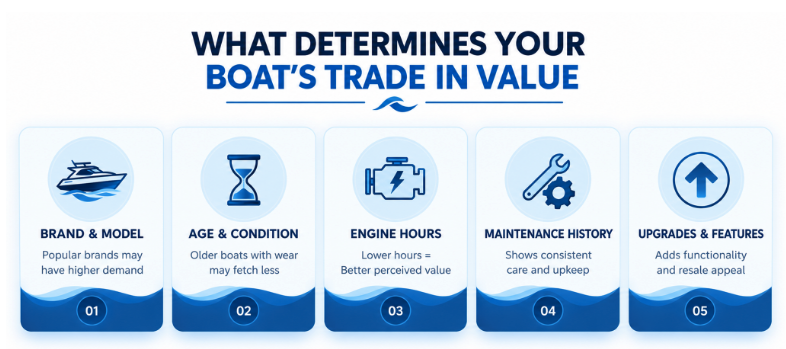
Used Boat Trade In Value: What Moves the Number
Several factors shift a used boat’s trade number up or down, sometimes significantly.
| Factor | Effect on Trade Value |
| Low engine hours relative to age | Raises value, often more than model year alone |
| Documented maintenance history | Speeds up appraisal, reduces surprise deductions |
| Season (spring vs. off-season) | Spring/early summer typically brings stronger offers |
| Trailer condition | Well-maintained trailers add measurable value |
| Cosmetic wear (upholstery, canvas, gelcoat) | Cracked or faded surfaces lower offers |
| Outdated electronics | Reduces value even on mechanically sound boats |
Most dealers try to resell used inventory within 90 days, so trade offers can shift depending on the season and current demand in your region, whether that’s the Great Lakes states, Gulf Coast markets, or inland lake communities.
Trade-In vs. Private Sale: The Real Trade-Offs
Selling privately can sometimes net a higher headline number. But it comes with real costs that don’t show up on a spreadsheet.
Private sellers handle their own advertising, buyer screening, and payment verification. That means fielding calls, scheduling showings, and worrying about fraudulent payments. It also means strangers know where you live and what boat you own.
Trading in removes all of that. You get one transaction, one appointment, and no ongoing liability once the deal closes.
There’s also a tax advantage in many states. In several regions, trading in reduces the taxable amount on your new purchase, since you only pay sales tax on the price difference between your old boat and your new one. That can offset a meaningful chunk of the gap between trade value and private resale value.
Dealers can also often sell used boats for slightly more than private sellers can, thanks to added warranty coverage, service backing, and financing options for the next buyer. That reputation premium is part of why trade-in remains the easier path for many owners.
How to Prepare Your Boat Before Getting a Trade Offer
A little prep work goes a long way toward protecting your boat trade in value.
Clean and detail the boat thoroughly, inside and out. First impressions still shape dealer offers, even when the mechanical inspection comes later.
Gather maintenance records, manuals, and any receipts for recent work. Documentation builds trust and can shorten the appraisal process.
Address small mechanical issues before the appraisal, if the cost is reasonable. A $150 fix that prevents a $600 deduction is worth doing.
Bring your HIN, title, and registration paperwork ready to go. Dealers move faster when the paperwork is already organized. If you’re financing your next boat as part of the trade, it also helps to understand how boat loan pre-approval works before you sit down with a dealer.
How Boatzon Helps Owners Understand Trade Value
Boatzon operates as a fully online boat marketplace, giving owners a way to browse listings, connect with dealer networks, and explore financing without the traditional back-and-forth of a lot visit. For owners researching a boat trade in, that means access to real dealer connections rather than guesswork from scattered online listings.
Boatzon works with a nationwide network of dealer partners, which is useful for owners across popular boating regions, including Texas, Georgia, North Carolina, Alabama, and Michigan. Instead of driving between multiple dealers for competing quotes, owners can start that comparison process online.
If your next boat will involve financing, Boatzon’s boat loan options and boat insurance quotes can be reviewed alongside your trade estimate, so the full cost of upgrading is clear before you commit. Owners weighing whether financing makes sense at all can also read Boatzon’s guide on used boat financing.
Realistic Timeframes to Expect
Getting a preliminary boat trade in value estimate online typically takes a few minutes using a calculator tool. A full dealer appraisal, including a physical inspection, usually takes 30 to 60 minutes depending on the boat’s size and complexity.
Most dealers aim to resell traded-in boats within 90 days, which is part of why they price trade offers conservatively. Owners planning a trade around a new purchase should budget one to two weeks between initial valuation, in-person appraisal, and final paperwork, especially during the busy spring buying season.
Final Thoughts on Boat Trade In Value
Understanding boat trade in value protects you from both overestimating and underselling your boat. Start with a reliable calculator baseline, understand the margin a dealer needs to stay in business, and weigh the real convenience and tax benefits trade-in offers against a private sale.
If you’re ready to see what your boat could be worth, explore Boatzon’s boat marketplace to compare dealer connections and get a clearer picture of your options before you commit to your next boat.
FAQ
What is NADA boat trade in value, and is it still used today?
NADA boat guides are now published under JD Power. Dealers still reference this data heavily when calculating a fair boat trade in value estimate.
How accurate is a used boat trade in value estimate online?
Online estimates give a solid baseline, but a full boat trade in value depends on condition, engine hours, and an in-person inspection.
Is there a reliable boat trade in value calculator by VIN or HIN?
Yes, entering your Hull Identification Number helps confirm model year and specs, improving the accuracy of any boat trade in value calculator.
Can I get a NADA boat Blue Book value for free?
Yes, JD Power’s boat pricing tool offers free lookups, giving a useful starting point before requesting a dealer’s boat trade in value.
How do Kelley Blue Book boat values compare to NADA and JD Power?
Kelley Blue Book doesn’t formally cover boats anymore, so most owners rely on JD Power for a dependable boat trade in value benchmark.