
TL;DR: Boat transport is priced mostly per mile, climbs when your boat is oversize, and goes smoothly when you hire a properly insured hauler and prep the boat before pickup.
Boat transport is the business of moving a boat over land from one place to another, usually on a specialized trailer pulled by a professional hauler. Buyers reach for it when the perfect boat sits several states away, when a seasonal move calls for relocating a vessel, or when a boat is simply too large to tow behind a personal truck. Understanding how transport works, what drives the cost, and how to choose a reputable carrier turns a stressful logistics problem into a routine step in owning the right boat, even if that boat happens to be far from home.
The good news is that a whole industry exists to do exactly this, and the pricing follows predictable patterns. Once you know the levers that move the cost and the questions that separate good haulers from risky ones, arranging transport becomes straightforward.
How much boat transport costs
Transport is priced primarily by distance, and the rate is usually quoted per mile. Boat transport generally runs between roughly $1.60 and $3.75 per mile, with a thousand-mile haul often landing somewhere around $2,000 to $3,000. Shorter trips tend to cost more per mile than long ones, because much of the expense is in the setup, loading, and the hauler’s fixed time rather than the miles themselves.
Distance is only the starting point. The size and weight of the boat, the time of year, and the specific route all move the final number. A light, trailerable boat moving in the off-season along an easy highway route sits at the low end, while a large, heavy boat traveling during peak season on a complicated route climbs quickly. Getting quotes from multiple carriers is the single best way to understand what your particular move should cost.
What drives the price up or down
Several factors decide where your quote lands:
- Distance, with longer hauls costing less per mile but more in total
- Boat size and weight, since bigger boats need bigger rigs and more fuel
- Season, with peak summer demand pushing rates higher
- Route difficulty, including tolls, mountain passes, and low-clearance obstacles
- Oversize dimensions, which can trigger permits and escort vehicles
When your boat is oversize
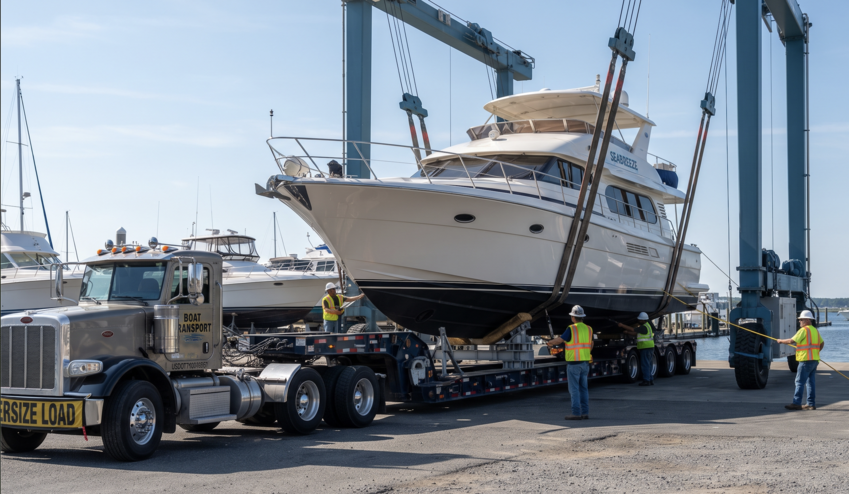
Beyond a certain size, a boat stops being a standard load and starts requiring special handling. A load is generally considered standard up to roughly 40 feet long, 8 feet high, and 8.5 feet wide, and boats beyond those dimensions typically need special permits to travel legally. The U.S. Department of Transportation caps legal vehicle width at 102 inches, or 8.5 feet, on the national highway network, so a beam wider than that is what tips a boat into oversize-permit territory. Wider or taller boats may also require pilot or escort vehicles, and the hauler must plan a route that avoids low bridges and tight restrictions.
These requirements add cost and lead time, so factor them in early if your boat is large. An experienced transporter handles the permitting and routing as part of the service, but that work shows up in the price. When you request quotes, be precise about your boat’s exact length, beam, and height on the trailer, because underreporting dimensions leads to surprise fees or a canceled pickup when the rig arrives and the numbers do not match.
Open versus enclosed transport
Most boats travel on open trailers, exposed to weather and road spray, which is the standard and most economical method. For high-value, delicate, or fully finished boats, enclosed transport protects the vessel from the elements and debris, though it costs more and is less widely available for larger hulls. For the majority of buyers moving a typical recreational boat, open transport with proper shrink wrap or a quality cover is perfectly adequate.
If you go the open route, protecting the boat for the journey matters. Shrink wrap, a well-fitted cover, and secured hardware reduce the chance of wind and road damage over hundreds of miles. You can pick up covers and tie-down gear along with other boat accessories so the boat is ready when the hauler arrives, rather than scrambling on pickup day.
Choosing a reliable hauler
The carrier you choose matters as much as the price. The most important question is insurance: a legitimate boat transporter carries cargo coverage specifically for the boats it hauls, and you should confirm the policy details and limits before booking. A quote that looks cheap from a hauler without proper coverage is a false economy, because a single incident on the road could leave you holding the loss.
Look for a transporter with verifiable experience moving boats similar to yours, real reviews, and clear communication about timing and process. Ask how they secure the boat, whether they handle permits for oversize loads, and what their coverage pays in the event of damage. It is also worth confirming your own boat insurance accounts for the vessel during transit, so there are no gaps between the hauler’s cargo coverage and your policy. Good carriers welcome these questions; evasive ones are telling you something.
A pre-shipment checklist
Before the hauler arrives, prepare the boat so nothing goes wrong on the road:
- Confirm the transporter’s cargo insurance and get the coverage in writing
- Remove or secure loose gear, electronics, and personal items
- Drain water systems and, in cold weather, winterize to prevent freeze damage
- Document the boat’s condition with dated photos before loading
- Shrink wrap or cover the boat and secure all hatches and canvas
- Provide accurate dimensions and any keys or access the hauler needs
Putting it all together
Boat transport is a normal, manageable part of buying the boat you actually want, even when it is not local. Budget around the per-mile rate, add for size and season, and expect oversize boats to carry permit and escort costs. Choose a hauler on insurance and experience rather than price alone, prep the boat properly, and document its condition before it leaves. Do those things and the boat shows up ready to launch, not ready to argue about.
Knowing that transport is straightforward frees you to shop the whole country instead of just your marina. When you find a boat on Boatzon, you can consider listings well beyond driving distance, factor a realistic transport quote into your total cost, and still come out ahead by buying the right boat rather than the nearest one.
FAQ
How much does it cost to transport a boat?
Boat transport is typically priced per mile, generally in the range of about $1.60 to $3.75 per mile, with a thousand-mile haul costing up to roughly $3,000. Shorter trips cost more per mile because of fixed setup and loading time, and the final price depends on the boat’s size, the season, and the route.
What size boat needs an oversize permit to transport?
A load is generally considered standard up to roughly 40 feet long, 8 feet high, and about 8 feet wide. Boats exceeding those dimensions usually require special permits, and wider or taller boats may also need pilot or escort vehicles, all of which add cost and lead time to the move.
What is the difference between open and enclosed boat transport?
Open transport carries the boat on an exposed trailer and is the standard, more economical method. Enclosed transport protects the boat from weather and debris inside a covered trailer, which costs more and is less available for large hulls. Most typical recreational boats travel fine on open trailers with a cover or shrink wrap.
How do I choose a reliable boat transporter?
Confirm the hauler carries cargo insurance specific to boats and get the coverage in writing, then look for verifiable experience with boats like yours, real reviews, and clear communication. Ask how they secure the boat and handle permits. Choose on insurance and track record rather than the lowest quote.
Should I insure my boat during transport?
Yes. A reputable hauler carries cargo coverage, but you should confirm exactly what it pays and make sure your own boat insurance accounts for the vessel in transit. Checking for gaps between the carrier’s coverage and your policy protects you if damage occurs on the road.
How do I prepare my boat for shipping?
Remove or secure loose gear and electronics, drain water systems and winterize in cold weather, document the boat’s condition with dated photos, shrink wrap or cover the boat, and secure all hatches and canvas. Provide the hauler with accurate dimensions and any needed keys or access.
Is it worth buying a boat from far away and shipping it?
Often yes. Shopping nationally rather than locally gives you far more choice, and a realistic transport quote added to the purchase price frequently still beats settling for a lesser boat nearby. The key is factoring transport cost into your total budget from the start so there are no surprises.