
- Finance
- Shopping Tools
- Dealer
Marine Loans: Fast, Flexible Boat Financing Solutions
We compare 20+ banks to find the best rate that’s right for you. We can deliver same day approvals and receive funding in as fast as 24 hours!
Get pre-qualified in 2 minutes with
no impact on your credit score
No Matter what boat, engine, or type of marine loan
you need...we’ll find the best lender for you.
No need to shop around. You’ll get the
most competitive rates in one place.
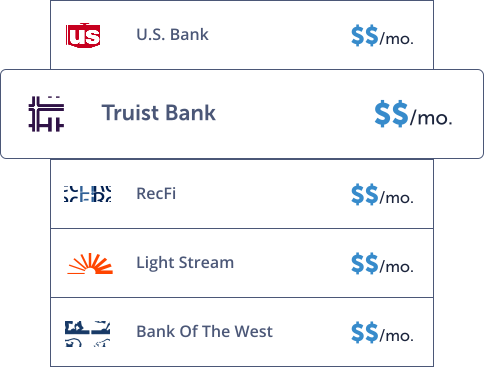
We’ll find the best rate for you and work
hard to get a same day approval.

You can bundle your insurance quote
with your financing in a few simple steps.
Boat loan news, tips, and tricks
How Long Can You Finance a Boat?
So do you want to own a boat? Boats are luxurious vessels you can use for various activities and occasions...
July 11, 2023

Refinancing a Boat Loan
Buying a boat is a great achievement for most people because you can unwind with loved ones on your nearest lake or river, go fishing and have fun on weekends or vacations...
November 7, 2023

Choosing the Right Boat Loan: A Comprehensive Comparison
Owning a boat is a lot of fun because of the ability to explore the water when you have free time...
October 24, 2023
Debt to Income Ratio
Lenders check several factors, including the debt to income ratio, to determine whether a person qualifies for a loan...
July 18, 2023

Why Are Boat Loan Rates High Now?
If your looking to jump into a boat loan now, you’ll quickly realize the interest rates are a little high and significantly higher than what we saw during the COVID-19 pandemic...
March 23, 2023

Secured vs Unsecured Boat Loans
Buying a boat can be more expensive than buying a car. Therefore, the loan for purchasing the watercraft can be bigger, and the duration of repaying it longer...
August 22, 2023
Boat Financing: Your Complete Guide
Deciding how to pay for a boat involves more than just calculating monthly payments. The financing structure you choose affects everything from how much boat you can afford to your long-term flexibility and total ownership costs. This guide walks you through the complete financing journey, from deciding whether to finance at all through closing on your loan and beyond.
Smart boat financing means understanding your options, knowing how to qualify for the best terms, and structuring your loan in ways that align with your financial goals. Whether you're a first-time buyer navigating marine loans or an experienced owner looking to optimize your financing strategy, the decisions you make upfront can save you thousands over the life of your loan.
Should You Finance or Pay Cash?
Paying cash eliminates interest costs and gives you full ownership immediately, but it's not always the smartest financial move. Tying up $75,000 in a boat means that money isn't available for emergencies, investments, or other opportunities. Many buyers with the cash to purchase outright still choose financing because they can earn better returns investing that money elsewhere.
Financing makes sense when you want to preserve liquidity, when interest rates are favorable (below 8-9%), or when you're buying a boat that will hold value well. Premium brands like Grady-White, Boston Whaler, or Viking often retain 70-80% of their value after five years, making them reasonable financing candidates even with longer terms.
Cash purchases work better for older boats (15+ years) that may not qualify for favorable loan terms, for buyers who strongly prefer being debt-free, or when you're purchasing a boat under $15,000 where loan costs make financing inefficient.
Consider a hybrid approach: finance 50-70% of the purchase price and pay the rest in cash. On a $60,000 boat, putting $30,000 down and financing $30,000 over 10 years at 7.5% creates a $356 monthly payment and limits total interest to about $12,700.
Types of Boat Loans
Secured Boat Loans
Secured loans use the boat itself as collateral, giving lenders confidence to offer better terms. These loans typically provide the longest terms (up to 240 months for new boats), the highest loan amounts (up to several million for luxury yachts), and the lowest interest rates (often 2-3 percentage points below unsecured options).
The trade-off: if you default on payments, the lender can repossess your boat. You'll also need to maintain insurance throughout the loan term with the lender listed as the loss payee. For most buyers purchasing boats over $25,000, secured loans offer substantially better economics than unsecured alternatives.
Secured loans work particularly well for new or nearly-new boats from established manufacturers. Lenders view these as predictable collateral with clear resale markets. A three-year-old Sea Ray or Bennington qualifies for better rates than an obscure brand with uncertain resale value.
Unsecured Personal Loans
Unsecured loans don't require collateral, which means you're not risking the boat if financial circumstances change. These loans typically cap out around $50,000-100,000, limit terms to 2-7 years, and carry higher interest rates (often 9-16% depending on credit).
Unsecured loans make sense for smaller purchases where the loan fees and insurance requirements of secured financing aren't worth the hassle, or when you're buying a boat that's too old to qualify for secured financing. The shorter terms mean higher monthly payments but substantially less total interest paid.
Home Equity Loans and HELOCs
Using home equity to finance a boat offers the lowest interest rates available (often 6-8% or less) and potential tax deductibility if the boat qualifies as a second home. The significant downside: you're putting your home at risk to finance a recreational purchase.
Home equity financing works best for high-value purchases where the rate savings are substantial. On a $100,000 boat, the difference between a 7% marine loan and a 6% home equity loan saves about $110 monthly and $26,000 over 20 years. For smaller amounts, the savings may not justify the risk to your home.
Understanding Interest Rates and Terms
What Affects Your Interest Rate
Beyond credit scores, several factors shape your rate. The boat itself matters significantly; new boats and late-model used boats (under 5 years old) from established manufacturers qualify for the lowest rates. A 2023 Boston Whaler might get you 6.99% while a 2010 boat of similar value gets 9.49%, even with identical credit and loan terms. Lenders know newer boats from quality manufacturers sell quickly if repossession becomes necessary.
Your loan-to-value ratio plays a role too. Larger down payments signal financial stability and reduce the lender's risk, often unlocking rates 0.5-1% lower than minimal down payment loans. Your debt-to-income ratio matters as well; if existing debts consume more than 40-43% of your gross income, lenders may increase your rate or reduce your approved amount even with excellent credit.
The type of boat influences rates beyond just age. Mainstream brands with strong resale values (like Sea Ray, Boston Whaler, or Grady-White) often qualify for better rates than obscure brands with uncertain resale markets. Lenders can recover their investment more easily if a recognizable boat needs to be repossessed and resold.
Choosing the Right Loan Term
The term length decision balances monthly affordability against long-term cost. A $50,000 loan at 7.5% costs $594 monthly over 10 years but only $403 monthly over 15 years. The 10-year loan accumulates about $21,300 in interest while the 15-year version totals $37,500. That $191 monthly savings costs you an extra $16,200 over the life of the loan.
Choose longer terms when you want maximum flexibility in your monthly budget and plan to keep the boat long-term. Shorter terms make sense when you can afford higher payments and want to minimize total interest, or when you're buying an older boat that may need replacement sooner. A 10-year-old boat financed over 10 years will be 20 years old when you pay it off, potentially with limited value remaining.
The Boat Financing Process
Step 1: Assess Your Financial Position
Start by calculating your realistic budget based on total monthly costs: loan payment, insurance ($50-200 monthly), slip or storage fees ($100-500 monthly), fuel, and maintenance. A good rule: total boat costs should not exceed 10-15% of your gross monthly income. This leaves room for other financial priorities and unexpected expenses.
Pull your credit report and check for errors that might be dragging down your score. Dispute any inaccuracies immediately, as corrections can take 30-60 days. If your score sits below 700, spending 3-6 months improving it before financing can save you thousands. Pay down credit card balances below 30% of your limits and make all payments on time.
Step 2: Get Pre-Qualified
Pre-qualification clarifies your purchasing power, strengthens your negotiating position with sellers, and lets you compare multiple lenders efficiently. Most marine lenders offer instant pre-qualification using a soft credit inquiry that doesn't affect your credit score.
Working with a marine finance specialist like Boatzon lets you submit one application and see offers from 20+ lending partners simultaneously. You'll see exactly what you qualify for across secured and unsecured options, allowing you to choose the loan structure that best fits your situation. Your pre-qualification remains valid for 30 days.
Step 3: Shop for Your Boat
Focus on boats within your approved amount, but leave buffer room for taxes, registration, insurance deposits, and initial supplies. If you're pre-qualified for $60,000, shop for boats in the $50,000-55,000 range to avoid surprises at closing.
Marine surveys are essential for used boats. A qualified surveyor examines the boat's structure, systems, and equipment, identifying problems that could cost thousands to repair. Most lenders require surveys for boats over $50,000-75,000. Even when not required, the $500-1,500 cost is worthwhile protection against buying a problematic vessel.
Step 4: Complete Your Application
Once you've found your boat, you'll move from pre-qualification to formal loan application. The lender will request documentation, including recent pay stubs or tax returns (proof of income), bank statements, photo ID, and details about the boat (make, model, year, hull identification number, purchase agreement).
The lender orders an appraisal or review of the boat's value to ensure the loan amount is appropriate. For used boats, they'll verify the title is clear with no existing liens. This process typically takes 1-3 business days for standard loans, though complex situations may take longer.
Step 5: Close and Take Delivery
At closing, you'll sign the loan agreement, provide proof of insurance listing the lender as loss payee, and pay any required down payment and closing costs. Expect closing costs of $1,000-2,500 on a typical loan, including documentation fees, title transfer, registration, and potentially origination fees.
Some lenders fund loans within 24-48 hours of approval, while others take 5-7 business days. Coordination is simpler when buying from a dealer; private party purchases require more attention to ensure a clean title transfer and secure funds transfer.
Improving Your Loan Terms
Timing Your Purchase
If your credit score sits just below a rate tier cutoff (like 719 when 720 unlocks better rates), waiting a few months to improve your score can save substantially more than any delay costs you. The difference between financing at 8.5% versus 7.5% saves thousands over a 15-year loan.
Market conditions matter too. When the Federal Reserve raises rates, marine loan rates typically follow within weeks or months. If rates are climbing and you're ready to buy, locking in sooner rather than later makes sense. Conversely, if rates are falling or expected to fall, you might refinance later to capture better terms.
Maximize Your Down Payment
Down payment strategy goes beyond just scraping together 10-20%. Think about the timing of major financial events in your life. If you're expecting a year-end bonus, tax refund, or proceeds from selling another asset, coordinating your boat purchase to leverage that influx can dramatically improve your loan structure without disrupting your monthly budget.
Some buyers also use portfolio financing strategically - taking a margin loan or portfolio line of credit at 5-6% to fund a larger down payment, then securing a boat loan at better terms because of the stronger equity position. The arbitrage only works if the rate improvement exceeds the cost of the bridge financing, but for high-value purchases where you're dropping from 10% to 25% down, the math can work in your favor.
The unconventional approach: if you're financing in the spring (peak buying season when competition for boats is fierce), having 25-30% down ready gives you negotiating leverage that often nets you a better purchase price - essentially getting paid back for your larger down payment through the deal itself rather than just through interest savings.
Shop Multiple Lenders Strategically
Lender specialization matters more than most buyers realize. Some marine lenders focus exclusively on premium boats over $100,000 and offer their best rates in that segment. Others specialize in older boats or buyers with credit challenges. A lender who views your profile as their sweet spot will offer noticeably better terms than one where you're on the margins of their criteria.
Credit unions frequently beat bank rates by 0.5-1%, but membership requirements vary widely. Some let you join for a nominal fee or donation; others require employment or residence connections. If you're military affiliated, Navy Federal and USAA often provide exceptionally competitive marine financing that's worth exploring before looking elsewhere.
Don't overlook regional marine lenders who focus on specific boating markets. A Florida-based marine lender might offer better terms on center consoles and offshore boats than a national bank, simply because they understand that market intimately and can price risk more accurately. Geography and boat type specialization can work in your favor when you find the right match.
Special Considerations
Financing Older Boats
Age restrictions vary dramatically between lenders, and knowing which lenders specialize in older vessels can open up options others miss. Some marine lenders won't touch anything over 15 years old, while specialty lenders routinely finance well-maintained classics from the 1980s and 1990s. Brand reputation matters enormously here; a 25-year-old Bertram or Hatteras may qualify for terms that a 12-year-old lesser-known brand won't.
The key decision point: if secured financing for your older boat comes with a 10-11% rate and requires a full survey plus premium insurance, compare that total cost against a 12-13% unsecured personal loan with no survey requirement and basic insurance. The total monthly cost, including insurance, sometimes favors the unsecured route, plus you maintain flexibility to sell without lien complications.
Buying from Private Sellers
Private purchases require you to essentially act as your own dealership for the financing process. The coordination burden isn't trivial; you'll manage the survey scheduling, title verification, insurance procurement, and fund transfer timing yourself. Budget an extra 7-10 days beyond what dealer purchases require, and don't commit to a closing date until your lender confirms they can fund by then.
The leverage advantage: private sellers are often more motivated than dealers and may be flexible on timing to accommodate your financing schedule. If your lender needs an extra week to process everything, most private sellers will wait when they know you're a serious buyer with pre-approval in hand. This flexibility can also work in your favor during price negotiations.
Including Accessories and Upgrades
Separating accessories from the base boat price can unlock negotiating leverage. A seller firm on $65,000 for a boat with included electronics might accept $63,000 for the boat alone, even though it's the same $2,000 concession. Psychologically, they feel they held firm on the boat's value. You then finance your own choice of electronics through the loan, getting exactly what you want rather than accepting their aging equipment.
Prioritize financing items that integrate permanently and increase resale value: upgraded electronics, T-tops or hardtops, fishing packages, premium sound systems. Skip financing easily swapped items like covers, fenders, or basic safety gear - these don't justify paying interest over 10-15 years.
When to Refinance
The refinancing decision often hinges on life changes rather than just rate movements. Major credit score improvements from paying off other debts, income increases that change your debt-to-income ratio, or even the boat aging into a different loan category can all trigger refinancing opportunities that weren't available at purchase.
Timing matters strategically. If you refinanced your mortgage recently and took a small credit score hit from the hard inquiry, wait 3-6 months before refinancing your boat loan so your score has recovered. Conversely, if you're planning other major financing (like a home purchase) within the next year, refinance your boat now to lock in savings before you need pristine credit elsewhere.
Watch for the equity crossover point. Once you've paid down enough principal that you're no longer underwater (owing more than the boat's worth), you have more refinancing options and leverage. Lenders view loans with solid equity cushions as lower risk, sometimes opening up better rate tiers that weren't accessible when you first financed with minimal down payment.
This guide provides general information about boat financing. Loan terms, rates, and requirements vary by lender and are subject to credit approval. Consult with qualified financial and tax professionals for advice specific to your situation.
Frequently Asked Questions
Your total monthly boat costs (loan payment, insurance, slip fees, fuel, maintenance) should not exceed 10-15% of your gross monthly income. If you earn $8,000 monthly, keep total boat costs under $800-1,200. This leaves room for other financial priorities and unexpected expenses. Remember that the loan payment is just one component; insurance, storage, and upkeep add substantially to your ongoing costs.
Both can be smart choices depending on your priorities. New boats qualify for the longest terms (up to 20 years), lowest rates (often 1-2 percentage points below used), and come with manufacturer warranties. Used boats cost less upfront and depreciate slower since the steepest depreciation happens in years 1-5. Consider your budget, how long you plan to keep the boat, and whether warranty coverage matters to your peace of mind.
Yes, though you'll need to provide more documentation than W-2 employees. Lenders typically want two years of personal tax returns showing stable or increasing income, and some may request business tax returns or profit/loss statements. Self-employed borrowers often need slightly higher credit scores (700+ vs 680+) and may see rates 0.5-1% higher because lenders view self-employment income as less predictable.
Pre-qualification uses basic information and a soft credit check to provide estimated rates and loan amounts without impacting your credit score. It takes just minutes and helps you understand your options. Pre-approval is more thorough; the lender verifies your income, reviews your complete credit profile, and commits to a specific loan amount and rate (subject to finding an acceptable boat). Pre-approval carries more weight with sellers who know you're a serious, ready buyer.
You can sell your boat anytime, but you must pay off the remaining loan balance from the sale proceeds. If you sell for more than you owe, you keep the difference. If you owe more than the sale price (you're "upside down"), you'll need to cover the difference with cash or potentially roll it into a new loan if you're buying another boat. Contact your lender for a payoff quote (the exact amount to close the loan) before finalizing any sale.
Boat loan interest may be tax-deductible if your boat qualifies as a second home under IRS rules. To qualify, the boat must have sleeping, cooking, and toilet facilities, and you must not rent it out for more than 14 days per year (or 10% of days it's rented at fair market value, whichever is greater). Consult a tax professional to determine if your situation qualifies; the rules are complex, and the IRS scrutinizes second-home deductions carefully.
Absolutely. Refinancing replaces your current loan with a new one at better terms. It makes sense when rates have dropped 1-2+ percentage points since you originally financed, when your credit has improved significantly, or when you want to adjust your loan term. Most boat loans have no prepayment penalties, making refinancing straightforward. You'll pay closing costs on the new loan ($500-1,500), so ensure your interest savings exceed these expenses within a reasonable timeframe.
All lenders require comprehensive insurance coverage that at least matches your loan amount, with the lender listed as the loss payee or lienholder. This protects their financial interest if the boat is damaged, stolen, or totaled. Most require both hull coverage (physical damage to the boat) and liability coverage (damage or injury you cause to others). Expect to pay $500-2,000+ annually, depending on the boat's value, your location, how you store it, and your claims history.
Yes, most boat loans allow you to finance the trailer, accessories, and electronics along with the boat itself. This is almost always smarter than putting these items on a credit card (18-25% interest) or financing them separately. The items must be purchased with or shortly after the boat; you generally can't add accessories to your loan years later. Everything financed becomes part of the collateral, so if you default, the lender can repossess the boat and all financed equipment.
Private sellers typically price boats 10-20% below dealer retail, but you lose the convenience of dealer financing coordination, warranty coverage, and the assumption that major issues have been addressed. You'll need to coordinate title transfers, ensure there are no existing liens, and handle registration yourself. Most lenders still finance private purchases but may require higher down payments, shorter terms, or mandatory surveys. Budget extra time for the process and strongly consider a marine survey even if not required.
Copyright © 2026 Boatzon™. All Rights Reserved