
TL;DR: A marine survey is a written condition-and-valuation report from a credentialed surveyor that lenders, insurers, and serious buyers use to confirm a boat is what the seller says it is. Knowing how to read one, including what the findings categories mean, which items are deal-breakers, and which are negotiation fodder, turns a several-hundred-dollar expense into the most useful document in the entire purchase.
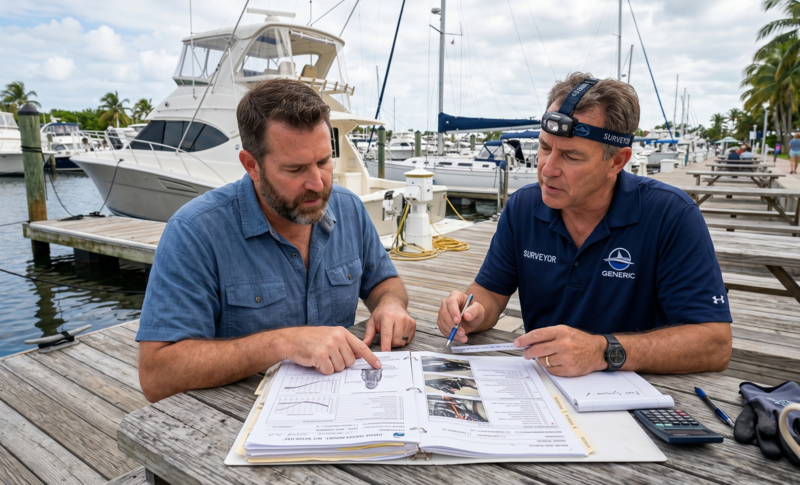
A marine survey report is the written deliverable from a marine surveyor who has spent four to six hours inspecting a boat in and out of the water. The report covers structure, mechanical systems, electrical, safety equipment, and a written valuation. Lenders use it to confirm the boat is worth what they're being asked to finance. Insurers use it to confirm the boat is in insurable condition. Buyers should use it to confirm they're not about to inherit problems the seller forgot to mention.
Most buyers receive the report, skim the deficiency list, and call it done. That's the wrong move. The structure of a marine survey is consistent across reputable surveyors, and once you understand the structure, the report tells you a great deal about the boat, the seller, and what the next 12 months of ownership are going to feel like.
What a marine survey actually is
Pre-purchase, condition and value, and insurance surveys
There are three common types of surveys, and they’re not interchangeable.
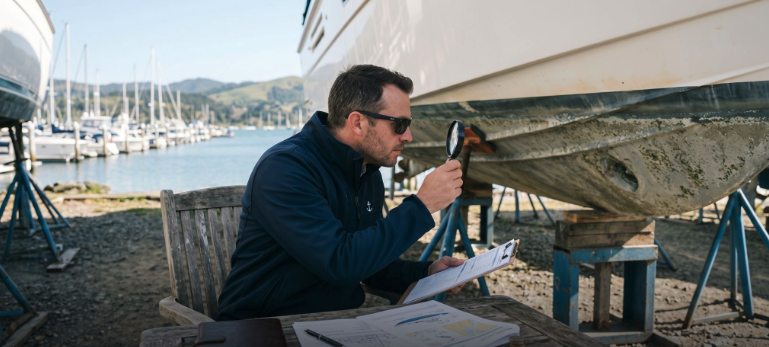
A pre-purchase survey is the most thorough. It includes a haul-out so the surveyor can inspect the hull below the waterline, a sea trial under load, mechanical inspection with the engines running, and a written report with deficiencies, a valuation, and recommendations. This is the survey a serious buyer wants and the survey lenders typically require.
A condition and value (C&V) survey is what insurers usually request when they’re underwriting a policy or renewing one on an older boat. It’s slightly less thorough than a pre-purchase survey because the buyer’s leverage to negotiate is already gone, but it still covers structure, safety, and current market value.
An insurance survey is a narrower version of a C&V, sometimes just an in-water inspection, focused on whether the boat is currently safe to insure. Don’t confuse this with a pre-purchase survey. They’re not the same document.
What it costs and who pays
Marine surveys run roughly $15 to $25 per foot of boat length, plus expenses if the surveyor has to travel. A 30-foot boat survey runs $450 to $750. Larger yachts can run $1,200 to $2,500. The buyer pays. That’s normal. The survey is your insurance against the boat’s hidden problems becoming your problems, and the surveyor works for you, not the seller.
If you’re financing the purchase, you can use Boatzon’s marine financing options; note that most marine lenders require a current survey for boats over 10 years old.
How to pick a surveyor
Credentials that matter
The two main credentialing bodies are the Society of Accredited Marine Surveyors (SAMS) and the National Association of Marine Surveyors (NAMS). A surveyor with a SAMS-AMS or NAMS-CMS designation has passed examinations, demonstrated experience, and is accountable to a continuing-education and ethics standard. That’s the credential to ask for.
A “marine surveyor” with no credential is sometimes still excellent, often through long boatyard experience. But for an insurance- or lender-acceptable report, the credential matters.
Independence is the most important variable
The surveyor must be independent of the seller, the brokerage, and the marina. If the seller recommends the surveyor, that’s a red flag. If the brokerage has an “in-house” surveyor, that’s a red flag too. The surveyor’s job is to find what’s wrong with the boat. A surveyor whose next referral depends on the broker’s good will has a structural conflict of interest. Pick your own.
Ask for a sample report
Reputable surveyors will share a redacted sample of a previous report so you can see what their deliverables look like. A good report runs 25 to 50 pages, with photographs of every system, dated and captioned, and a clear deficiency list organized by severity. A two-page checklist with no photos is not a survey.
The anatomy of a survey report
1. The cover page and scope of work
The first page identifies the surveyor, the credential, the date, the boat (year, make, model, HIN, length, beam, hull and engine serial numbers), and the scope of work, which specifically tells you whether this was a pre-purchase, C&V, or insurance survey. Confirm the scope matches what you ordered.
2. The vessel description
A factual description of the boat: dimensions, displacement, engine make and horsepower, propulsion, fuel and water capacities, year of construction, country of origin, last bottom paint. This sounds basic but matters for valuation; if the surveyor lists a different displacement or different engine than what’s on the listing, you’ve already learned something.
3. Structural findings
This is where the surveyor reports on the hull, deck, transom, stringers, bulkheads, and superstructure. Look for these specific words:
- No structural deficiencies noted: you want this
- Cosmetic blistering observed: usually fine, cosmetic only
- Soft spots observed in [location]: water intrusion, expensive
- Stringer separation observed: structural, very expensive
- Transom soundness compromised: a deal-breaker on most boats
Every structural finding should be accompanied by a moisture meter reading and a photograph. If the surveyor mentions softness or moisture without numbers and pictures, ask why.
4. Mechanical findings
Engine, drive train, fuel, exhaust, steering, controls. The surveyor should note engine hours, the date of last service if known, and run the engine under load during the sea trial. Compression numbers should appear if a compression test was done. If the report says “engine performance appears acceptable” but doesn’t include hours, oil analysis, or compression numbers, the mechanical portion is thin.
For older boats and complex engines, a separate engine survey by a marine mechanic is often worth the additional $300 to $500. The hull surveyor and the engine specialist are not always the same person.
5. Electrical findings
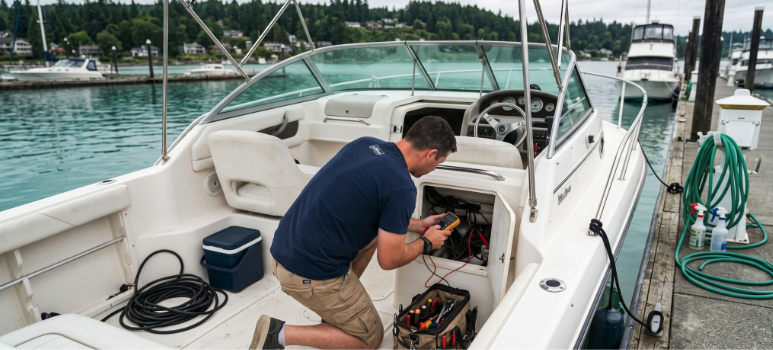
Battery condition, wiring quality, panel function, electronics presence and condition, navigation lights, bilge pumps. A good electrical section will note AC and DC systems separately and call out any non-marine wiring (automotive wire, household receptacles) that’s been substituted into the boat. Non-marine wiring is a fire risk and an insurance issue.
6. Safety equipment
Coast Guard requirements, fire extinguishers and their dates, life jackets, throwable PFDs, sound signals, navigation lights. This section often looks routine, but if multiple items are out of date or missing, it tells you the previous owner didn’t sweat the small stuff, which usually correlates with how they treated the larger systems.
7. The deficiency list
This is the section everyone reads. Reputable surveyors organize deficiencies by severity, usually:
- Recommendation 1, Safety / Required for Coast Guard compliance: must be corrected immediately
- Recommendation 2, Required for proper function: should be corrected before extended use
- Recommendation 3, Recommended for long-term reliability: cosmetic or future maintenance
A boat with 4 to 8 items in Recommendation 1 is in rough shape. A boat with 1 or 2 in Recommendation 1 and 10 to 15 in Recommendations 2 and 3 is normal for a used boat that’s been in service. A boat with zero deficiencies almost doesn’t exist; if you see that, ask why.
8. The valuation
The final section is the surveyor’s opinion of fair market value. This is what the lender and the insurer rely on. The surveyor uses comparable sales, condition adjustments, and replacement-cost calculations to arrive at a number, usually expressed as both market value (what the boat would sell for today) and replacement cost (what a new equivalent boat costs to buy).
If the survey valuation comes in significantly below the seller’s asking price, that’s a powerful negotiation tool. If it comes in above, that’s reassuring but also unusual.
How lenders and insurers actually use the report
Lender view
A marine lender uses the survey to confirm:
- The boat exists and matches the description
- The market value supports the loan-to-value ratio
- The condition is acceptable for the term of the loan
- There are no safety or structural issues that would make the boat uninsurable
If the survey valuation is below the purchase price, the lender will only finance up to the surveyed value, which means the buyer needs to bring more cash or renegotiate the deal. This is the most common reason a deal falls apart after the survey.
You can model what the financed portion looks like at different valuations using the Boatzon boat loan calculator before the survey results come in.
Insurer view
The insurer uses the survey to confirm:
- The boat is currently in insurable condition
- Stated value is reasonable for the underwriting class
- Safety equipment is present and current
- No deferred maintenance items require correction before binding coverage
Insurers will often issue conditional coverage that requires specific deficiencies to be corrected within a window (commonly 30 to 60 days) for the policy to remain in force. Read those conditions; many buyers miss them and the policy lapses for a reason they didn’t track.
If you’re shopping coverage to go with a purchase, a boat insurance quote at the time of the survey gives you something to compare against.
How to use the survey to negotiate
Translate findings into dollars
Every Recommendation 2 and 3 item has a repair cost. Get an estimate from a marine mechanic or yard for each one before the conversation with the seller. A list of $4,200 in needed repairs is much more persuasive than a sentence saying “there’s stuff to fix.”
Lead with the structural and safety items
Recommendation 1 items aren’t optional. If the surveyor flagged a transom soft spot, a corroded through-hull, or a failed steering system, those are dollar-for-dollar adjustments from the asking price or deal-breakers depending on severity. Don’t get distracted by 15 cosmetic items and miss the two structural ones that matter.
When to walk away
Walk away when:
- The transom or stringers are compromised and the seller won’t reduce significantly
- Multiple safety-related Recommendation 1 items exist and the seller refuses to address them
- The surveyor’s market valuation is more than 20% below asking and the seller won’t move
- The seller pressures you to skip findings or refuses to give time to negotiate
A good deal isn’t a deal if the boat isn’t actually sound. Walking away is part of the process.
What the report doesn’t cover
Surveys are point-in-time documents. They don’t predict mechanical failures that develop after the survey. They don’t guarantee the boat won’t need future repairs. They don’t bind the surveyor to a warranty on what they didn’t find.
What they do is document the best professional judgment of a credentialed person at the moment they were aboard. That’s enormously valuable, and it’s also a limit. Don’t expect the surveyor to be liable for everything that goes wrong in year three.
For the canonical view from surveyors themselves about what buyers most often miss, the BoatUS guide on what marine surveyors want you to know is worth reading before you order the survey.
FAQ
Do I really need a marine survey for a used boat?
For any boat over about $20,000, any financed purchase, and any boat older than 10 years for insurance purposes, yes. Lenders and insurers usually require one. Even for cash purchases of cheaper boats, a survey often pays for itself by catching one or two problems the buyer would have missed.
How much does a marine survey cost?
Typically $15 to $25 per foot of boat length, plus haul-out fees and travel expenses if applicable. A 30-foot pre-purchase survey runs $450 to $750. Larger yachts can run $1,200 to $2,500.
How long does a marine survey take?
Plan on four to six hours on-site for the inspection plus the sea trial. The written report typically arrives three to seven business days later. Rush turnarounds are possible for additional cost.
Who pays for the survey?
The buyer. The surveyor works for the buyer; that’s what guarantees the report is honest. If the seller is paying, the surveyor has a conflict of interest.
What’s the difference between a marine survey and an inspection?
An inspection is the buyer’s own walk-through, useful for a first-pass evaluation. A marine survey is a written report by a credentialed surveyor that lenders and insurers will accept as a formal valuation and condition document.
Can a survey result in the deal being cancelled?
Yes. Most purchase agreements include a survey contingency that allows the buyer to renegotiate or walk away based on survey findings. This is standard and not adversarial; experienced sellers expect it.
What’s a “Recommendation 1” finding?
The most severe category in a typical marine survey, usually involving safety equipment, Coast Guard compliance, or structural soundness. Recommendation 1 items must be addressed before the boat is used; insurers often require them to be corrected before binding coverage.
What if I disagree with the survey valuation?
You can request a second survey from a different credentialed surveyor. Marine surveyors disagree on valuation sometimes; both opinions are professional judgments. The lender and insurer will typically accept the lower of two valuations, so a second opinion only helps if it confirms a higher value with documented comparables.