
Most boat buyers budget carefully for the purchase price, financing, and insurance, then get blindsided at the DMV window. The tax bill on a used boat is real, it varies dramatically by state, and in some cases it runs into thousands of dollars you weren't expecting.
So: do you pay sales tax on a used boat? The answer, in nearly every U.S. state, is yes. But the rate, who collects it, when you pay it, and how much you actually owe depend entirely on where you live and how the deal is structured.
Pre-owned boat sales represent approximately 80% of total annual unit sales in the U.S. market, which means the majority of buyers at any given moment are navigating exactly this question.
The recreational boating industry generates $230 billion in annual economic impact and supports more than 812,000 American jobs, and a meaningful portion of state revenue tied to that activity comes from sales and use tax collected at the point of purchase or registration. Understanding what you owe before you sign is one of the most practical things you can do as a buyer.
Boatzon connects buyers and sellers across the country, from the Gulf Coast to the Great Lakes, with one of the largest selections of new and used boat listings online. This blog breaks down exactly how boat sales tax works, which states are buyer-friendly, and what smart buyers do to keep their tax bill as low as legally possible.
Key Takeaways
- Sales or use tax applies to used boat purchases in most U.S. states, whether bought from a dealer or a private seller.
- Tax rates range from 0% in six states to over 8% in California and Michigan.
- Several major boating states, Florida, Virginia, North Carolina, New Jersey, cap the maximum tax regardless of purchase price.
- Private-party sales don’t avoid tax; you pay “use tax” directly to your state DMV at registration.
- Trade-ins reduce the taxable purchase price in most states, often significantly.
- Where and how you take possession of the boat can affect whether and where tax is owed.
- Laws change annually, always verify rates with your state’s revenue or DMV office before closing.
Sales Tax vs. Use Tax: The Distinction That Catches Buyers Off Guard
Here’s where most buyers go wrong. They assume “sales tax” only applies when buying from a dealership, and that a private-party purchase is tax-free. That’s not how it works.
When you buy from a licensed dealer, the dealer collects sales tax at closing and remits it to the state on your behalf. When you buy from a private individual, which is extremely common in the used boat market, no one collects it upfront. Instead, you owe what’s called use tax, which you pay directly to your state’s DMV or department of revenue when you register the vessel.
The rate is almost always identical. The only difference is the mechanism. In Washington state, for example, use tax applies to every private vessel purchase, and buyers who don’t account for it show up at the DMV expecting a registration fee and walk out having paid a four-figure tax bill. This is a recurring surprise noted across boating communities, including Reddit threads in the Seattle and Pacific Northwest boating circles.
The practical rule: Do you have to pay taxes on a used boat bought privately? In nearly every state, yes. Document the sale price properly, get a signed bill of sale, and check your state’s requirements before you take delivery.
States With Zero Boat Sales Tax
Six states impose no general sales tax, which means used boat purchases there carry no state-level tax obligation:
| State | Sales Tax Rate | Notes |
| Alaska | 0% | No state sales tax; some local/borough taxes may apply |
| Oregon | 0% | No sales tax of any kind statewide |
| Delaware | 0% | No sales tax; buyers may still owe home-state use tax |
| Montana | 0% | No sales tax; popular for LLC registrations |
| New Hampshire | 0% | No general sales tax |
| Rhode Island | 0% | No sales tax on boats |
One important caveat: buying in a tax-free state doesn’t exempt you from your home state’s use tax. Most states with use tax assess it based on where you intend to primarily use and store the boat, not where you purchased it. A Florida resident who buys a boat in Oregon still owes Florida use tax when they bring it home and register it.
States That Cap the Maximum Tax You’ll Ever Owe
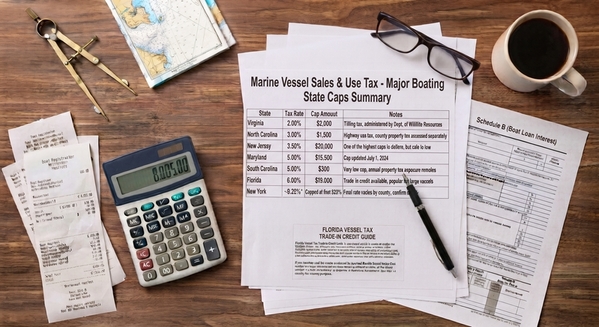
Tax caps are one of the most buyer-friendly features in marine taxation. They set a ceiling on how much you’ll pay regardless of purchase price, which is enormously valuable on high-dollar boats. Here’s how the major boating states stack up:
| State | Tax Rate | Cap Amount | Notes |
| Virginia | 2.00% | $2,000 | Titling tax; administered by Dept. of Wildlife Resources |
| North Carolina | 3.00% | $1,500 | Highway use tax; county property tax assessed separately after purchase |
| New Jersey | 3.50% | $20,000 | One of the highest caps in dollars, but rate is low |
| Maryland | 5.00% | $15,900 | Cap updated July 1, 2024 |
| South Carolina | 5.00% | $500 | Very low cap; but annual property tax on vessels is a separate exposure |
| Florida | 6.00% | $18,000 | Trade-in credit available; popular for large vessel registrations |
| New York | ~8.25% local rate | Capped at first $230,000 of purchase price | Final rate varies by county; complex — confirm locally |
Virginia’s $2,000 cap is particularly notable. On any boat priced above $100,000, you’ll never pay more than $2,000 in state tax. That’s one of the lowest effective rates in the country on high-value purchases, which is why it draws yacht registrations from buyers up and down the East Coast.
Florida’s cap of $18,000 is relevant at the top of the market. On a $400,000 offshore sportfisher, you’d owe $18,000, not $24,000 at the uncapped 6% rate. The savings are real. Florida is consistently the top boating economy in the nation, with $6.1 billion in new powerboat, engine, trailer, and accessories sales in 2024, and a tax structure that makes it attractive for buyers across the Southeast and beyond.
How Tax Works in High-Rate, No-Cap States
Not every state is this buyer-friendly. Understanding the full range matters when you’re shopping nationally on a platform like Boatzon.
California applies a base rate of approximately 8.25% plus local county taxes that push the effective rate higher in some jurisdictions. There is no cap. On a $200,000 vessel, you could owe $16,500 or more, before local add-ons. California also distinguishes carefully between sales tax and use tax based on where possession is taken and whether the boat enters state waters during the first 12 months of ownership. The state actively monitors social media for evidence of California use, and the burden of proof to claim an out-of-state exemption falls entirely on the buyer.
Massachusetts applies a flat 6.25% sales and use tax on boats with no cap. The commonwealth’s rules are relatively straightforward, but buyers searching for Massachusetts boat sales tax relief won’t find a ceiling. The full purchase price is taxable regardless of how large the transaction is.
Michigan charges 8% with no cap and is the third-largest boating state by market size.
Texas applies 6.25% with local add-ons up to an additional 2%, making Gulf Coast purchases in Galveston, Houston, or Corpus Christi potentially more expensive than buyers anticipate.
Minnesota, home to a significant freshwater boating market, charges 8.125% on boat purchases, with trailers taxed separately at 6.875%. Out-of-state residents buying from a Minnesota dealer may pay Minnesota’s rate upfront and receive credit toward their home state’s rate at registration, depending on inter-state tax agreements.
The Private Sale Question: Do You Pay Tax on a Private Boat Sale?
This is one of the most searched questions in the boating world, and the answer is almost always yes.
When you register a boat purchased from a private individual, your state’s DMV will ask for a bill of sale showing the purchase price. Use tax is then calculated and collected on that figure. Some states cross-reference private-party prices against published valuation guides like NADA. If your bill of sale looks significantly below market value, the state may assess tax on the higher of the two.
A few narrow exceptions exist. Arkansas historically handled non-dealer vessel transactions differently, and Act 1019 (effective October 2025) updated the process so that buyers now pay sales tax directly to the state Department of Finance and Administration at registration, with trade-in credit applied, rather than through the dealer.
Illinois exempts vessels under 16 feet sold in non-dealer transactions from state sales tax. These are highly specific and state-dependent; they are not broadly applicable rules.
The bottom line on private sales: get a properly executed bill of sale, record the actual transaction price, and contact your state DMV before closing to confirm what documentation they require.
Trade-Ins: One of the Most Effective Ways to Reduce What You Owe
The trade-in reduction is available in most states and is one of the most underused tax strategies in boat buying. When you trade in your existing boat as part of a dealer purchase, the state typically calculates tax on the net purchase price, the difference between what you’re buying and the trade-in credit, rather than the full price of the new boat.
The math is straightforward. On a $50,000 boat with a $30,000 trade-in, you’re taxed on $20,000. At a 6% rate, that’s $1,200 instead of $3,000. The $1,800 in tax savings frequently offsets the slightly lower trade value a dealer offers compared to a private sale, making the dealer route financially competitive in high-tax states.
Arkansas’s Act 1019 formalized this benefit in 2025: buyers now receive a credit for the full value of their trade-in, reducing taxable purchase price dollar-for-dollar. Florida’s dealer trade-in credit works the same way, and it stacks with the state’s $18,000 cap to create meaningful savings on mid-range and larger vessels.
If you’re considering a trade-in alongside a used boat purchase, ask the dealer to itemize the trade credit explicitly on the sales contract. That line item is what legally reduces your taxable basis in most states.
Buying Across State Lines: What Happens When the Boat and the Buyer Are in Different States
Pre-owned unit sales reached nearly 860,000 in 2024, and a significant share of those transactions involve buyers and sellers in different states, a natural consequence of shopping nationally. On Boatzon, listings span every major boating market, from the Florida Keys to Lake Michigan, from the Pacific Northwest to the Chesapeake Bay. Cross-state purchases add complexity.
The general rule is that tax is owed in the state where you register and primarily use the boat. If the seller’s state collects tax at the point of sale, your home state will typically credit that amount against what you owe. You pay the difference if your home state’s rate is higher, not both taxes in full.
The location and manner of taking possession also matter in many states. California, for example, has specific rules about boats entering state waters within the first 12 months of ownership. Taking possession out of state doesn’t automatically create a California exemption if the boat is subsequently moored, used, or stored in California during that period. Other states with aggressive use tax enforcement include Washington and New York.
For buyers in low- or no-tax states purchasing from higher-tax states, the seller’s state may or may not collect tax depending on residency and delivery circumstances. When in doubt, check with your state department of revenue, not just a general CPA, since marine use tax rules often differ from income tax residency rules.
Complete Rate Reference by State
For buyers shopping across markets, here is a consolidated view of state-level boat sales and use tax rates, organized by tax rate range:
| Tax Rate Range | States |
| 0% (no sales tax) | Alaska, Oregon, Delaware, Montana, New Hampshire, Rhode Island |
| 2.0%–3.5% (low rate or capped) | Virginia (2%, $2,000 cap), North Carolina (3%, $1,500 cap), New Jersey (3.5%, $20,000 cap) |
| 4.0%–5.0% | Alabama (2% + local up to 3.83%), Louisiana (4%), Georgia (4%), Wyoming (4%), South Carolina (5%, $500 cap), Maryland (5%, $15,900 cap) |
| 5.5%–6.25% | Ohio (5.5%), Maine (5.5%), Connecticut (2.99% reduced marine rate), Massachusetts (6.25%), Texas (6.25%), Florida (6%, $18,000 cap), Pennsylvania (6%), Kentucky (6%) |
| 6.5%–7.0% | Washington (6.5% + local up to 4.15%), Illinois (6.5%), Arizona (6.6%), Indiana (7%), Tennessee (7%), Mississippi (7%) |
| 7.875%–8.25%+ | Minnesota (8.125%), Michigan (8%), California (8.25% + local) |
Rates reflect state-level figures and are subject to change. Local taxes may apply. Verify current rates with your state’s department of revenue before closing.
Practical Steps Before You Sign Anything
Step one: Confirm your state’s current rate on vessel purchases. Rates and caps change, Maryland updated its cap in 2024, Arkansas rewrote its collection process in 2025, and information even a year old may be outdated.
Step two: Document everything. The bill of sale, the purchase price, the date of transfer, and the location where you physically took possession. These details determine where tax is owed and how much.
Step three: If you’re trading in a boat through a dealer, make sure the trade-in credit is explicitly line-itemed on your purchase agreement. That is the legal basis for your reduced taxable price in most states.
Step four: For private purchases, especially cross-state ones, confirm with your state DMV what documentation they require at registration. Most want a signed bill of sale with a purchase price, photo ID, and sometimes a completed use tax form.
Step five: Consult your state’s department of revenue directly if your purchase involves unusual structure, an LLC acquisition, a federally-documented vessel, a boat taken offshore, or a transaction structured with a leased slip included in the price.
Do You Pay Sales Tax on a Used Boat? Here’s the Honest Summary
The answer is yes, in the overwhelming majority of cases. An estimated 84.54 million Americans go boating each year, and the vast majority who buy used boats, whether from dealers or private sellers, owe sales or use tax at or before registration. The rate ranges from nothing in six states to more than 8% in others. Several major boating markets have caps that meaningfully limit exposure on high-value purchases.
The tax is real, but it’s also manageable when you know the rules going in. Trade-ins reduce your taxable base. Caps eliminate runaway liability on expensive boats. State credits prevent double taxation on cross-state purchases. And a proper bill of sale protects you from being assessed on a value the state decides rather than the price you actually paid.
Boatzon gives buyers across Florida, Texas, Michigan, North Carolina, and every other major boating market access to one of the country’s broadest used boat inventories, with the transparency to compare prices, locations, and listings before you ever call a seller. Start your search knowing what you’ll owe, and shop accordingly.
Browse used boat listings on Boatzon and find your next vessel today.
FAQ
Do you pay sales tax on a used boat purchased from a private seller?
Yes, in most U.S. states, you do have to pay taxes on a used boat even when buying from a private party. It’s collected as “use tax” directly by your state DMV when you register the vessel, not by the seller at the time of sale.
Which states charge no sales tax on a used boat purchase?
Six states have no state-level sales tax on used boat purchases: Alaska, Oregon, Delaware, Montana, New Hampshire, and Rhode Island. However, if you live in a different state and bring the boat home, your home state’s use tax likely still applies.
Does it matter if you buy a used boat from a dealer vs. a private party for tax purposes?
Yes, the mechanism differs. Dealers collect sales tax at the point of sale. On a private party boat sale, you pay use tax yourself at your state DMV when registering. The tax rate is usually the same either way.
What is the Massachusetts boat sales tax rate, and is there a cap?
Massachusetts charges a flat 6.25% sales and use tax on used boat purchases with no cap. The full purchase price is taxable regardless of the vessel’s value, payable to the Massachusetts Department of Revenue.
How does NC boat property tax work, and is it separate from purchase tax?
In North Carolina, buyers pay a 3% highway use tax capped at $1,500 at the time of purchase. After that, counties assess an annual property tax on registered vessels independently; rates and valuation methods vary by county and are separate from the one-time purchase tax.