
Boat owners in California face a confusing patchwork of forms, fees, and deadlines that trip up even experienced buyers. Missing a single step in the process can mean fines on the water, a stalled sale, or a registration that quietly lapses without anyone noticing.
Boatzon, the online marketplace built for boat buyers and sellers across the country, works with owners in California and other coastal and lake-heavy states every day, and confusion around California boat registration requirements is one of the most common questions we hear.
This blog breaks the process down step by step, using real DMV rules, official state data, and the questions boaters actually ask. Whether you just bought a used fishing boat in San Diego or you're renewing registration on a family runabout near Lake Tahoe, the rules follow the same basic path once you know where to look.
Key Takeaways
- California requires registration for nearly all motorized boats and sailboats over 8 feet, handled through the DMV, not a county tax office.
- Registration numbers start with “CF,” which is different from the boat’s Hull Identification Number (HIN).
- Original registration typically runs $29 to $49 for residents depending on the year, with renewal around $20 every two years.
- Anyone operating a powered vessel needs a California Boater Card, a separate requirement phased in through 2025.
- Boatzon helps buyers and sellers in California and other active markets move through listings and paperwork with less friction.
Why California Handles Boats Through the DMV
Unlike many states that register boats through a fish and wildlife agency or a natural resources department, California routes vessel registration through the Department of Motor Vehicles. This surprises a lot of first-time boat owners.
The DMV issues both registration and, in most cases, title documents for vessels. It also tracks liens, ownership transfers, and renewal cycles. If a boat is documented federally with the U.S. Coast Guard instead, security interests get recorded with the National Vessel Documentation Center rather than the DMV.
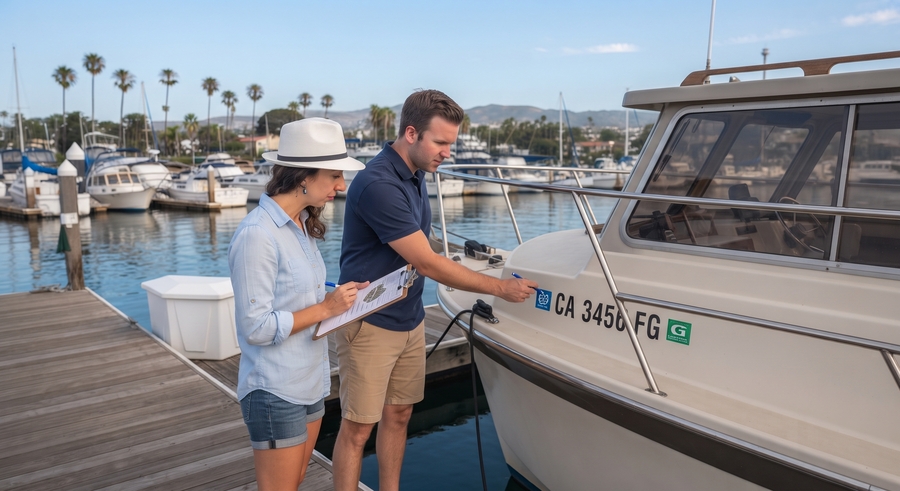
Every registered boat in California receives a number that starts with the letters “CF,” followed by four digits and two letters, such as CF 4252 AF. This must be displayed on both sides of the bow in contrasting block letters at least 3 inches tall. It’s easy to confuse this with the Hull Identification Number, but they serve different purposes.
The HIN is a permanent 12-character code assigned at manufacture, while the CF number is issued by the state and can change with ownership or documentation status.
How California Compares Nationally
California’s boating community is one of the largest in the country, which is part of why the state treats registration so seriously. According to U.S. Coast Guard recreational boating statistics, California had 645,951 registered recreational vessels, ranking fourth nationally behind Florida, Minnesota, and Michigan, out of more than 11.8 million registered recreational vessels counted nationwide that same year.
The California Division of Boating and Waterways, the state agency that sets safety policy and works alongside the DMV, estimates the state has roughly 2.6 million recreational boats overall and more than 4 million recreational boaters, a figure that includes unregistered craft like paddleboards and canoes.
That gap between total boats and registered boats is exactly why the rules matter. A boat can sit unused in a driveway for years, but the moment it touches public water, registration requirements apply.
Which Boats Actually Need Registration
Not every vessel on California waters needs a CF number, but most do. Generally, any motor-driven vessel, regardless of length, and any sail-powered vessel over 8 feet must be registered if it’s used on public waterways in the state.
Jet skis, aluminum fishing boats, pontoon boats, and sailboats with auxiliary motors all fall under these rules. Canoes, rowboats, paddleboards, and sailboats 8 feet or shorter without motors are typically exempt, along with ship’s lifeboats and public vessels owned by government agencies.
Vessels already documented with the U.S. Coast Guard don’t need DMV registration in the same way, but they still need to display valid documentation and may still owe use tax. If you’re unsure whether your specific boat qualifies, the DMV’s vessel owner guide is the most reliable starting point.
| Vessel Type | Registration Required? |
| Motorboat, any length | Yes |
| Sailboat over 8 feet | Yes |
| Sailboat 8 feet or shorter, no motor | No |
| Canoe, kayak, or rowboat (unpowered) | No |
| Jet ski / personal watercraft | Yes |
| U.S. Coast Guard-documented vessel | No DMV registration, documentation required instead |
Step-by-Step: How to Register a Boat in California
Getting a new-to-you boat registered isn’t complicated once you know the order of operations. Here’s how the process generally works for a private-party purchase.
First, gather your documents. You’ll need proof of ownership, usually a signed bill of sale or the previous owner’s title, along with the Hull Identification Number and a lien release if applicable.
Second, complete the Application for Vessel Registration Number, commonly known as REG 156. Note that the CF number itself is not a title. Some vessels require a separate title depending on size and use, and the DMV can clarify which applies to your boat.
Third, pay the registration fees. Original registration for California residents generally runs $29 in even-numbered years and $49 in odd-numbered years, based on the state’s staggered fee schedule. A title fee, transfer fee, and a Quagga and Zebra Mussel prevention fee for freshwater vessels may also apply.
Fourth, submit your application by mail or in person at a DMV field office. Processing typically takes a few weeks once everything is submitted correctly, though in-person applications can sometimes move faster.
Once approved, you’ll receive your CF numbers and a registration card. Keep the card on board whenever the boat is in use, since law enforcement can request it during a routine check.
| Registration Step | What You’ll Need | Typical Timeframe |
| Gather documents | Bill of sale, HIN, lien release if any | Same day |
| Complete REG 156 application | Owner and vessel details | 15–30 minutes |
| Pay fees | $29–$49 original fee, plus title/transfer fees | Same day |
| Submit to DMV | Mail or in-person field office visit | 1 day to submit |
| Receive CF number and card | Mailed by DMV | 2–6 weeks |
Registration Renewal, and Why the Odd-Year Cycle Confuses People
California boat registration renewal runs on a two-year cycle, and this is where a lot of owners get tripped up. Registrations expire and renew in odd-numbered years, with a due date of December 31, even if the boat was originally registered in an even year.
Renewal notices typically arrive by mail about 60 days before expiration. Renewal fees tend to run lower than original registration, generally around $20, plus any applicable mussel prevention fee for freshwater use. If a renewal notice never arrives, the safest move is to check directly through the DMV rather than assume the boat is still covered.
Letting registration lapse doesn’t just risk a fine. It can also complicate a future sale, since buyers and marinas expect current documentation. If you’re planning to list a boat on Boatzon, having an active vessel registration on hand makes the listing process smoother from the first message.
The California Boater Card: A Separate but Related Requirement
Registration gets a boat on the water legally, but operating it legally is a different requirement entirely. California phased in the Boater Card over several years, and current rules cover operators of motorized vessels across a widening range of ages.
To get the card, an operator needs to complete a NASBLA-approved boating safety course and pay a modest state fee, generally around $10. Courses run online or in person, usually take a few hours, and end with an exam. Passing scores lead to a certificate, which then gets submitted with the Boater Card application.
This card is easy to confuse with vessel registration since both involve the state and both are required to legally operate a boat. New owners buying through Boatzon in California should plan for both pieces, not just the registration paperwork, before heading out on the water.
Liens, Titles, and What Buyers Should Check Before Purchase
California does issue titles for many vessels, and any lien against a boat gets recorded with the DMV. If the vessel is Coast Guard-documented instead, liens are tracked through the National Vessel Documentation Center. The DMV also requires notification within 15 days whenever a registered boat is stolen, lost, abandoned, or changes owners or address, so records tend to stay current for active boats.
Before completing a private sale, it’s worth confirming there’s no outstanding lien and that the seller’s name matches the registration. A basic ownership or history check can catch stolen-vessel flags, unresolved liens, or prior accident reports before money changes hands.
Buyers working through Boatzon in states like Florida, Texas, or the Carolinas run into similar lien and title questions, even though the specific agency and paperwork differ from state to state.
How Boatzon Fits Into the Process
Boatzon exists to make boat buying and selling more straightforward, whether that’s a first-time buyer working through California boat registration requirements or a longtime owner listing a boat near a lake in the Southeast.
While Boatzon doesn’t file DMV paperwork on an owner’s behalf, its platform is built around helping sellers present accurate, complete listings and helping buyers understand what documentation to expect before closing a deal.
For sellers, that means being upfront about registration status, CF numbers, and any liens before listing. For buyers, it means knowing what to ask for so the registration transfer goes smoothly once a boat changes hands.
In markets where Boatzon is active, from California’s coastline to inland lake communities elsewhere, this kind of transparency tends to shorten the time between “interested” and “sold.”
Common Mistakes That Slow Down Registration
A few recurring issues show up again and again in boater forums and DMV help lines. Missing bills of sale top the list, especially for older boats bought informally years ago. Without one, owners may need to pursue a bonded title or other workaround, which adds real time to the process.
Confusing the CF number with the HIN is another frequent mix-up, especially when filling out forms that ask for both. Double-checking which number goes where prevents processing delays.
Finally, assuming a renewal notice equals guaranteed delivery is a mistake worth avoiding. Mail gets lost, and addresses change. If you moved recently, updating your address with the DMV before your next renewal cycle is a small step that saves real hassle later.
Wrapping Up: Staying Compliant Without the Headache
California boat registration requirements aren’t especially complicated once broken into steps, but the details matter. Knowing which vessels need registration, understanding the odd-year renewal cycle, and separating the Boater Card requirement from registration itself will keep most owners out of trouble.
If you’re getting ready to buy or sell a boat in California, or in one of the other regions Boatzon actively serves, having your registration and title paperwork organized in advance makes the entire transaction faster.
Boatzon’s marketplace is built to support that process, connecting buyers and sellers while keeping the focus on clear, honest listings. Start browsing or list your boat on Boatzon today, and make your next step on the water a straightforward one.
FAQ
What are the current California boat registration requirements for a used boat?
You’ll need a signed bill of sale, the Hull Identification Number, and a completed DMV REG 156 application. Payment of applicable registration and title fees is required, and a lien release is needed if the previous owner financed the vessel.
How do I renew my CA DMV boat registration?
Renewal happens every two years in odd-numbered years, using the notice the DMV mails about 60 days before expiration. You can also confirm your registration status directly with the DMV if a notice never arrives or your address has changed.
Can I do a California boat registration lookup online?
Owners can access their own records through the DMV’s official site using their account credentials. Full public search access is limited due to privacy rules, so many buyers turn to third-party vessel history services for pre-purchase checks.
Does AAA handle boat registration in California?
Some AAA offices assist members with certain California DMV transactions, including specific boat registration tasks. Availability varies by branch and membership type, so it’s worth calling ahead before visiting.
What is the BOAT 101 CA DMV course, and is it required?
BOAT 101 refers to the boater safety education needed to obtain a California Boater Card. It’s a separate requirement from vessel registration itself, but both are necessary to legally operate a powered boat.