
TL;DR: A HIN is a 12-character code that identifies your boat's builder, serial number, and build date. Learn to read it and you can verify any used boat before you buy.
A hull identification number, or HIN, is the 12-character code that acts as a boat's fingerprint. It tells you who built the hull, its unique serial number, and when it was made, all packed into a single string of letters and numbers stamped into the transom. Every recreational boat built or imported in the United States since November 1, 1972 is required to carry one, which makes the HIN one of the most useful tools a buyer has. Learn to read it and you can confirm a boat's identity, catch inconsistencies, and match paperwork to the hull in front of you.
Think of the HIN the way you would think of a car's VIN. It is how the boat is titled, registered, insured, and tracked through recalls. When the number on the hull does not match the number on the documents, that is a signal worth stopping for, and knowing how to decode it turns a meaningless string into real information. It is the first thing worth checking on anything you find as you shop the Boatzon boat marketplace, because a clean HIN is what separates a boat you can verify from one you are taking on faith.
Where to find the HIN
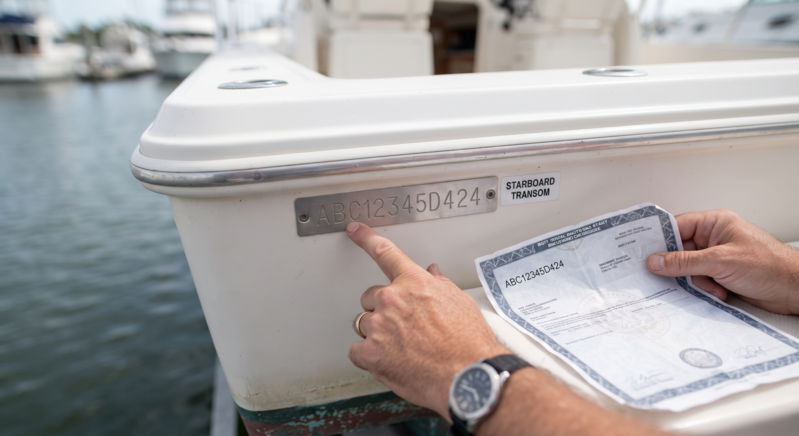
The primary HIN is stamped or attached on the starboard (right) side of the transom, the flat surface at the very back of the boat, usually within a couple of inches of the top edge. Manufacturers are required to place it there so it is easy to locate and hard to alter without leaving evidence. Many builders also hide a duplicate HIN in a second, unmarked location somewhere on the boat as a theft deterrent, though only the manufacturer knows exactly where.
When you inspect a used boat, always find the transom HIN and compare it character by character against the title, registration, and bill of sale. Look closely at the plate or stamping itself. Signs of tampering such as mismatched fonts, filled and re-stamped characters, a plate that looks newer than the boat, or numbers that do not line up are all reasons to walk away or dig deeper. On a legitimate boat, everything matches and nothing looks disturbed.
Decoding the 12 characters
The 12 characters follow a fixed structure defined by federal regulation, and once you know the pattern you can read any HIN at a glance. Each segment carries a specific piece of information.
Characters 1 to 3: the manufacturer identification code
The first three characters are the Manufacturer Identification Code, or MIC, a unique code the U.S. Coast Guard assigns to each boat builder. This is where the HIN starts telling its story, because those three letters point to a specific company. The Coast Guard maintains an official, searchable registry of every MIC, and you can look up any code on the U.S. Coast Guard’s manufacturer identification database to confirm which builder it belongs to. If the MIC does not resolve to a real manufacturer, or points to a company that never built a boat like the one you are looking at, something is wrong.
Characters 4 to 8: the serial number
The next five characters are the hull’s serial number, assigned by the manufacturer to make each boat unique. These can be numbers, letters, or a mix, but the letters I, O, and Q are never used because they are too easily confused with the numbers one and zero. If you see one of those three letters in a serial number, the HIN is not legitimate.
Character 9: the month of certification
The ninth character is a letter representing the month the boat was certified or built, using A for January through L for December. It is a quick way to place the boat in the calendar year and, combined with the following characters, to pin down its exact model year.
Characters 10 to 12: the year
The tenth character indicates the year of certification or manufacture, and the final characters denote the model year. Together they tell you how old the boat actually is, which is essential for valuation, insurance, and spotting a listing that fudges the age. A model year that contradicts the HIN is a red flag worth resolving before money changes hands.
Why the HIN matters when you buy
The HIN is your verification tool, and a used boat purchase is where it earns its keep. Matching the transom number to every document confirms you are buying the boat the paperwork describes, not a lookalike or a boat with a clouded history. It also lets you run the number through recall databases to see whether the model was ever subject to a safety defect that may or may not have been addressed.
Beyond verification, the HIN is the number the rest of ownership runs on. You will need it to title and register the boat in your state, to bind insurance, and to secure financing. Lenders ask for it on the application, so having the number confirmed before you explore loan options keeps the paperwork moving instead of stalling on a mismatch. Confirming a clean, consistent HIN on any boat you are serious about is one of the simplest ways to protect yourself before you commit.
A quick pre-purchase HIN checklist
Run through these before you buy any used boat:
- Locate the HIN on the starboard transom and confirm it is present and legible
- Compare it character by character against the title, registration, and bill of sale
- Verify the MIC resolves to the correct manufacturer in the Coast Guard registry
- Confirm no I, O, or Q appears in the serial number section
- Check that the decoded build year matches the listing’s stated age
- Inspect the plate for signs of tampering, refinishing, or replacement
Putting the HIN to work
Reading a HIN is a five-minute skill that pays off every time you look at a used boat. The characters are not random; they spell out the builder, the serial number, and the age, and any inconsistency is information. A buyer who checks the HIN carefully avoids stolen boats, misrepresented ages, and title problems that surface long after the sale.
Once you have confirmed the number is clean, the HIN keeps working for you through registration, coverage, and financing. Line up a boat insurance quote with the HIN in hand, since insurers rely on that number to identify the exact hull they are covering and a transposed digit is enough to hold up a policy. Small habit, big payoff.
FAQ
What is a HIN on a boat?
A HIN, or hull identification number, is a 12-character code that uniquely identifies a boat. It encodes the manufacturer, a serial number, and the build date, functioning much like a car’s VIN. Every recreational boat built or imported in the United States since November 1, 1972 is required to have one.
Where is the HIN located on a boat?
The primary HIN is stamped or attached on the starboard side of the transom, near the top edge at the back of the boat. Many manufacturers also place a hidden duplicate HIN in an unmarked second location as a theft deterrent, though only the builder knows where that one is.
How do I decode a 12-character HIN?
The first three characters are the manufacturer’s code, characters four through eight are the serial number, the ninth character is the month of certification, and the final characters indicate the year and model year. Reading them in that order tells you who built the boat, its unique serial number, and how old it is.
What do the letters in a HIN mean?
The first three letters are the Manufacturer Identification Code assigned by the Coast Guard, and the ninth character is a letter A through L representing the month of certification. The letters I, O, and Q are never used anywhere in a HIN because they can be mistaken for numbers.
How can I use a HIN to check a used boat?
Compare the transom HIN against the title, registration, and bill of sale to confirm they all match, verify the manufacturer code in the Coast Guard registry, and run the number through recall databases. Any mismatch or sign of tampering is a reason to pause before buying.
What does it mean if the HIN does not match the paperwork?
A mismatch between the hull’s HIN and the documents is a serious warning sign. It can indicate a clerical error, a replaced transom, or in the worst case a stolen or misrepresented boat. Resolve any discrepancy fully before completing a purchase or transferring money.
Do I need the HIN to register and insure my boat?
Yes. The HIN is the number used to title and register a boat with your state, to bind an insurance policy, and to secure financing. Having a clean, verified HIN in hand makes each of those steps straightforward and confirms you are covering the correct vessel.