"It was in the late 40's that the IYRU (now ISAF) instigated a new modern 2-man international dinghy, the Tornado. She was not a success as there was no leap forward compared to the existing pre-war classes.
The Royal Loosdrecht Yacht Club, Conrad Gulcher's club, obtained half a dozen Tornados and found them very uninspiring to say the least! Conrad had always been very interested in dinghy sailing and had collected any documentation connected with it. Pre-war he had enjoyed some international sailing in Germany and the UK and he had made many friends in the dinghy sailing scene. He imagined that with modern construction methods, moulded ply, a better boat could be constructed.
Being an Insurance Broker and not a designer he enlisted the help of Uus Van Essen, a naval architect and measurer for the Dutch Yacht Federation. They made a preliminary design and early in September 1951 it was sent to 30 top class helmsmen in Europe including Bossom (Z - SUI), John Cahmier (K -GBR), Charles Curry (K - GBR), Manfried Curry (G - GER), Ferry Laagwater (H - NED),Stewart Morris (K - GBR), Morits Skaugen (N - NOR) and Shorty Trimingham (KZB - BER), with the request to comment within two weeks.
The measurements were similar to the 15m2 Wanderjolle of mid-European lakes and popular Flying Fifteen. By the end of September 23 responses had been returned with sufficient new and sound ideas to redesign the boat.
Mr. Loeff, chairman of the CBC, was prepared to discuss the boat at the November meeting of the IYRU, only when he had seen her sail! This was hardly feasible but Conrad had the mould and hull built in one week and the boat finished in another! Complete with the Tornado rig it took to the water against the 12m2 Sharpie and Tornado at Loosdrecht one week before the IYRU meetings and Mr Loeff took the plans to the IYRU for discussion.
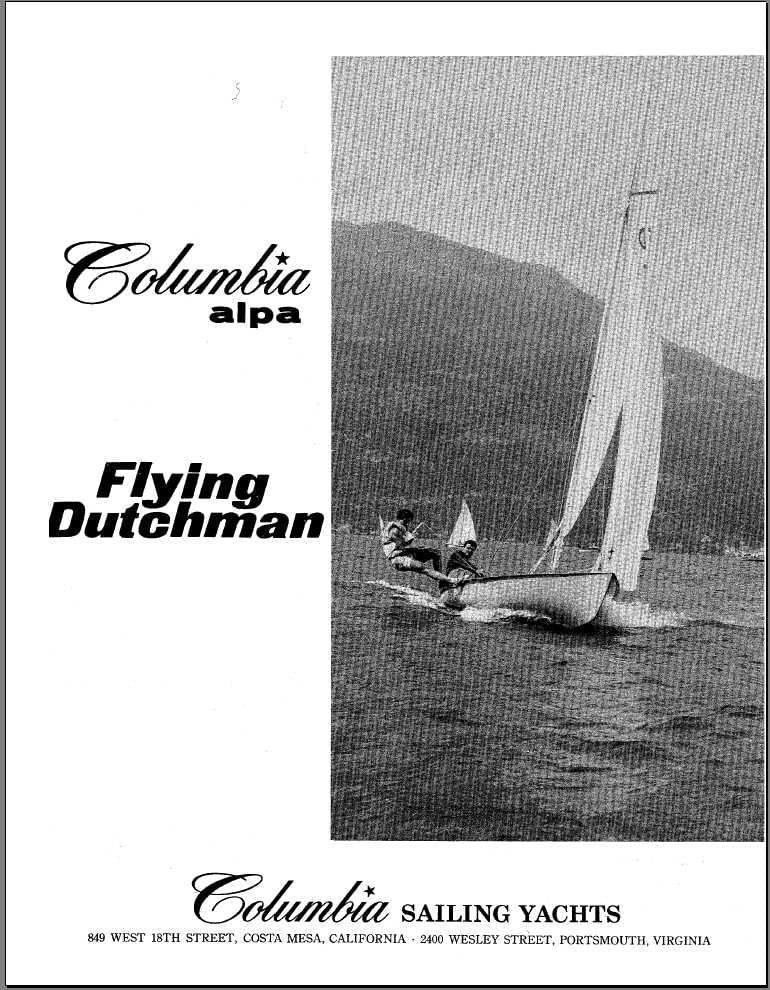
Then it was decided to hold trials in the summer of 1952 in Holland and the name the ""Flying Dutchman"" was born, suggested by Sir Peter Scott, the then president of the IYRU.
The trials were held on the Loodrecht lakes and on the open water of the Zuiderzee at Muiden. 17 boats participated, some especially designed like the Osprey and Typhoon, others were existing classes including Hornet, Caneton, Thistle, Sharpie, Rennjolle etc."