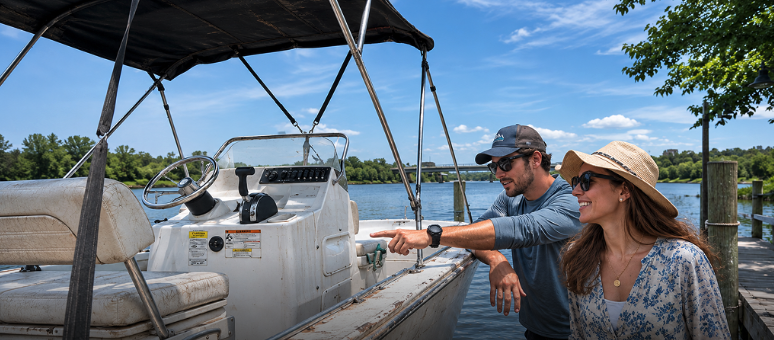

You spot the perfect boat online. It’s three hours away, but you make the trip. When you arrive, it looks nothing like the listing. At Boatzon, we hear versions of this story from buyers in Texas, California, North Carolina, and beyond. Most of that wasted time disappears when you know the right questions to ask when buying a used boat before you leave home.
A used boat can be a smart buy. It can also be someone else’s headache with a fresh coat of wax. This blog covers what to ask the seller, what to confirm in person, and what to settle before money changes hands. It draws on input from marine technicians, longtime owners, federal safety data, and real buyer conversations.
Key Takeaways
- Confirm the model year of the boat, engine, and trailer first. Mismatches can reveal a repower or a misleading listing.
- Engine hours matter at both extremes. Too many signal wear, while too few can mean long idle periods.
- Missing service records is one of the biggest red flags in any used boat sale.
- Ask directly whether the boat has ever sunk, and watch how the seller answers.
- A seller who refuses a sea trial or marine survey is a seller to walk away from.
- Verify the title, liens, and exactly what’s included before you pay.
Why the Right Questions Matter More Than Ever
The used boat market is big and busy. States registered 11,674,073 recreational vessels in 2024, a 1.1% increase over the prior year. That means plenty of choice, but also plenty of boats with unknown histories.
Buying a boat isn’t like buying a car. There’s no single report that catches everything. Hulls hide water damage. Engines hide past rebuilds. Trailers hide rusted brakes.
Your phone call with the seller is your first filter. A 15-minute conversation can rule out a boat that would cost you half a day to see. The goal isn’t to find a flawless boat. Almost every used boat has some issues. The goal is to know what you’re getting into, so you can budget and negotiate honestly.
The Phone Screen: Questions to Ask Before Buying a Used Boat
Start with the basics. These answers tell you whether the listing is honest and whether a visit is worth it.
1. What are the model years of the boat, engine, and trailer?
This confirms the listing is accurate. It also tells you if the boat has been repowered. A 2008 hull with a 2019 outboard isn’t a bad thing. But you want to know why the original engine was replaced. You can also cross-check the hull identification number (HIN) on the U.S. Coast Guard’s boating safety site.
2. How long have you owned it, and why are you selling?
A short ownership period can be a warning sign. Maybe it wasn’t the right fit. Or maybe it had problems. The reason for selling also reveals motivation. A seller moving up to a bigger boat negotiates differently than one facing a financial squeeze.
3. How many hours are on the engine?
Hours are the boat world’s version of mileage. A well-maintained outboard can often run 1,500 to 2,000 hours, depending on brand and care. Low hours aren’t automatically good, though. Engines that sit for years develop dried seals, varnished fuel, and corrosion. If there’s no hour meter, ask whether a dealer can pull engine data with a diagnostic tool.
4. Where was it used, and where was it stored?
Saltwater is hard on boats. Coastal boats along the Texas Gulf or the Carolina coast need more maintenance than freshwater lake boats. Ask directly: “Has this boat ever been in saltwater?” Storage matters too. A boat kept covered or indoors ages far slower than one left outside under the Southern California sun.
Here’s a quick way to read the answers you get.
| Question | Good Sign | Warning Sign |
| Model years match listing? | Yes, or repower explained with receipts | Vague or changing answers |
| Length of ownership | Several seasons | Bought recently, selling fast |
| Engine hours | Moderate hours with regular use | Very high, very low, or unknown |
| Water and storage | Freshwater, covered storage | Saltwater use, outdoor storage, no rinse routine |
Questions to Ask About a Used Boat’s Condition and History
This is where phrasing makes a huge difference. If you only ask, “Any problems?” you’ll usually hear, “Nope, run great.” Instead, split your questions into present conditions and past history.
5. What is the current condition of the hull, engine, and trailer?
Ask about each one separately. Then ask about soft spots in the floor, gelcoat cracks, or anything that doesn’t work.
6. What problems have you had with it in the past?
Most buyers skip this question. A seller may have fixed a blown powerhead two seasons ago. The boat might run fine today. You’d still want to know. Ask the same question for the engine and the trailer.
7. Is there anything quirky about this boat?
Experienced buyers swear by this one. Owners get used to odd habits. Maybe the engine needs a special starting routine. Maybe something vibrates at a certain RPM. To the seller, it’s normal. To you, it could point to a deeper problem.
8. Has the boat ever sunk or been in an accident?
Ask this flat out. A clear “no” is reassuring. A vague “well, it didn’t really sink” is a red flag. Accidents happen more often than many buyers assume. In 2024, the Coast Guard verified 3,887 incidents involving about $88 million in property damage. Sunk or damaged boats can be cleaned up to look fine, but electrical and engine issues often surface later.
Maintenance Questions When Buying a Used Boat
Maintenance history is one of the best predictors of reliability. A clean, documented history also supports resale value later.
9. Do you have service records?
Ask for every record available, not just the latest invoice. A thick folder going back years is a great sign. No records at all suggest the boat may not have been cared for properly.
10. Who did the maintenance, and how often?
Annual service is usually fine for freshwater boats. Saltwater boats often need more. Work done by a certified technician is generally more trustworthy than DIY work without receipts.
Also ask what “recently serviced” actually means. To one owner, it’s a full impeller, oil, and gear lube service. To another, it’s a bottle of fuel treatment. Get specifics on the water pump impeller, lower unit gear lube, fuel filters, battery age, and steering components.
11. How old are the trailer tires?
Trailer tires usually fail from age, not tread wear. If they’re older than about five years, budget for replacements. Ask about bearings, brakes, and lights too. One Reddit owner who bought a $10,000 Sea Ray reported spending another $2,000 right away, including new trailer brakes on both axles. If the trailer is beyond saving, you can browse boat trailers for sale separately.
Things to Ask When Buying a Used Boat About Paperwork
12. Is the title available, and whose names are on it?
Every owner listed on the title must sign it over. Divorce, estates, or co-ownership can delay a transfer for weeks. Find out early.
13. Are there any liens on the boat?
If a lender holds a lien, it must be paid off before you can legally own the boat. Rules vary by state. Check with your titling agency, such as Texas Parks and Wildlife or California State Parks Division of Boating and Waterways.
14. What exactly is included in the sale?
Don’t assume anything. Electronics, canvas covers, life jackets, cushions, and even the trailer may or may not be included. Make a written list. Once you pay, it’s very hard to recover a missing cover or fish finder.
Safety gear deserves special attention. Coast Guard data shows 87 percent of people involved in boating fatalities were not wearing a life jacket. If the boat doesn’t come with properly sized, Coast Guard-approved life jackets, add them to your budget on day one.
15. When can we do a sea trial and survey?
This is the most important question. If the seller refuses a sea trial, walk away. It doesn’t matter if it’s a dealer, a broker, or a private seller.
During the trial, run the boat at least 20 minutes, including time on plane. Watch for overheating, fuel smells, steering issues, and slow throttle response. On I/O boats, listen for a high-pitched growl from the gimbal bearing when you turn or trim.
Here’s what each inspection step typically involves. Costs vary by region and boat size, so treat these as general ranges.
| Step | Typical Time | Approximate Cost | Best For |
| Seller phone screen | 15–30 minutes | Free | Every listing |
| In-person walkaround | 1–2 hours | Free | Every serious candidate |
| Mechanic inspection / compression test | 1–3 hours | 150–400 | Older engines, private sales |
| Sea trial | 20–60 minutes | Fuel only | Every purchase |
| Marine survey | Half day to full day | Roughly 20–30 per foot | Larger boats, financed or insured purchases |
Lenders and insurers often require a survey on larger or older boats anyway. The Coast Guard Auxiliary also offers a free Vessel Safety Check once you own the boat.
Adjusting Your Questions for Pontoons, Sailboats, and Aluminum Boats
The core questions apply to every boat. Some types deserve extra attention.
| Boat Type | Extra Questions to Ask | What to Inspect |
| Pontoon | Any tube dents, leaks, or welded repairs? | Tubes, deck softness, railing mounts |
| Sailboat | When was standing rigging last replaced? Any groundings? | Rigging, sails, keel bolts, chainplates |
| Aluminum fishing boat | Any rivet leaks or corrosion repairs? | Rivets, welds, transom, livewell plumbing |
| I/O runabout | When were bellows and gimbal bearing serviced? | Bellows, gimbal, outdrive gear oil color |
When it comes to questions to ask when buying a used pontoon boat, the tubes come first. Pontoons are hugely popular on lakes across Texas and the Midwest. You can compare used pontoon boats in Texas or pontoons in California to get a feel for pricing.
For questions to ask when buying a used sailboat, focus on rigging, sails, and keel history. Many experts suggest replacing standing rigging roughly every 10 years. Browse sailboats on Boatzon to see how condition affects price.
If you’re eyeing an aluminum fishing boat, check the transom carefully. Even aluminum boats can have wooden transoms that rot.
Buying From a Private Seller vs. a Dealer
Private sellers often offer lower prices. You take on more work, though. That means verifying the title, checking liens, and arranging inspections yourself.
Dealers usually handle paperwork and may offer limited warranties. Either way, the same questions apply. A trustworthy seller won’t mind answering them.
This is where a marketplace helps. On Boatzon, you can browse used boats from dealers and private sellers in one place. You can even filter by brand, like Sea Ray boats in Texas. Detailed listings give you a head start on your questions before you pick up the phone.
Plan Your Budget Beyond the Purchase Price
Experienced owners often set aside 10% to 20% of the purchase price for immediate needs. Think safety gear, registration, dock lines, a new battery, or trailer work.
Ongoing costs add up too. Plan for insurance, storage, fuel, and annual maintenance. Coastal owners may need hurricane-season storage plans. Lake owners in colder areas may need winterization.
Boatzon can help here. You can explore boat loans and request a boat insurance quote alongside your search. That way, the full cost picture is clear before you commit. If the engine turns out to be the weak link, boat engines for sale can help you price a repower.
A Note on Safety Training
Buying the boat is only the first step. Roughly 70% of 2024 boating fatalities occurred on vessels operated by people without boating safety instruction. If you’re a first-time owner, a certified boating safety course is one of the smartest investments you can make. Many states require one anyway.
Final Thoughts: Ask First, Buy Smart
The best boat purchases rarely happen on impulse. They happen when buyers ask good questions, listen carefully, and walk away when something feels off.
Use these questions to ask when buying a used boat on every listing you consider. Write down the seller’s answers. Compare them with what you see in person and during the sea trial. If the stories match, you’ve likely found a boat worth buying.
Ready to start? Browse used boats on Boatzon, explore financing and insurance options, and find the right boat for your next season on the water.
FAQs
What are the most important questions to ask when buying a used boat?
Ask about engine hours, service records, saltwater use, past problems, accident history, title status, and whether a sea trial is allowed.
How many engine hours are too many when buying a used boat?
It depends on maintenance. Well-kept outboards often reach 1,500–2,000 hours, while very low hours may mean the boat sat unused.
Should I get a marine survey when buying a used boat?
Yes, especially for larger boats. A survey uncovers hidden hull, engine, and electrical issues, and lenders or insurers often require one.
What questions should I ask a private seller when buying a used boat?
Ask why they’re selling, who’s on the title, whether liens exist, what’s included, and if a sea trial is allowed.
Is it a red flag if a used boat has no service records?
Yes. Missing records suggest inconsistent maintenance. Ask detailed questions, get an inspection, and factor potential repairs into your offer.