
Buying a boat should feel exciting, not stressful. Yet for buyers in Florida, Texas, California, and beyond, the price talk is often the hardest part. At Boatzon, buyers can browse new and pre-owned boats, compare real listings, and arrange financing in one place. That gives us a clear view of how deals actually come together.
This blog explains how to negotiate a boat price using dealer pricing math, current market data, and tactics that industry veterans and real buyers rely on.
Boats aren’t cars. There’s no universal invoice sheet, and pricing varies widely by dealer. That’s why preparation matters more than bravado.
Key Takeaways
- Research market value first. Use J.D. Power Marine values and live Boatzon listings to find a realistic price range.
- Dealer cost on new boats usually runs about 70–80% of MSRP. A fair dealer margin often falls between 10% and 20%.
- Opening offers slightly under fair value work better than lowballing, which often ends the conversation.
- Today’s softer market gives buyers more leverage, especially late in the season and at winter boat shows.
- Use the marine survey to renegotiate used boats, and question freight, PDI, and admin fees.
- Budget 1,000–2,000 for first-year repairs on a used boat, even after a clean survey.
Why Buyers Have More Leverage Right Now
Market conditions shape every negotiation. Right now, they lean in the buyer’s favor.
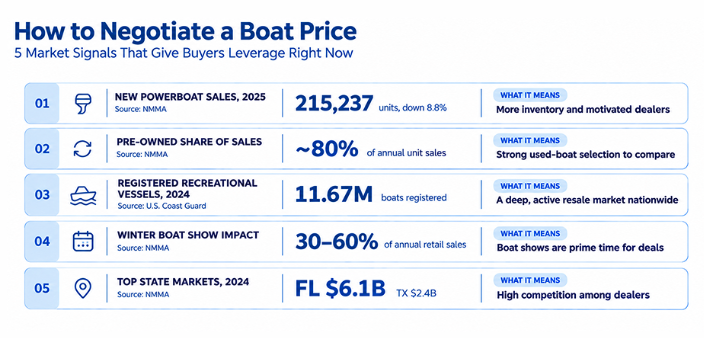
According to the National Marine Manufacturers Association (NMMA), new powerboat retail unit sales fell 8.8% year over year in 2025, reaching 215,237 units compared with 236,070 in 2024. NMMA’s Monthly Industry Data Summary also notes that even as the federal funds rate eased, interest-sensitive purchases like boats continued to be weighed down by financing costs. Slower sales mean more inventory and more motivated dealers. wftvmarinadockage
Used boats dominate the market too. NMMA’s U.S. Recreational Boating Statistical Abstract data shows pre-owned boat sales represent approximately 80% of total annual unit sales. That means most buyers are negotiating with private sellers or used-boat dealers, not just new-boat showrooms. Cbinsights.
The used market is huge. The 11,674,073 recreational vessels registered by the states in 2024 represent a 1.1% increase from the prior year, according to the U.S. Coast Guard’s 2024 Recreational Boating Statistics and its official press release. More boats on the water means more comparable listings for you. watercraftjournal
Looking ahead, NMMA reports that new powerboat unit sales in 2026 are expected to be on par to slightly up from last year. That suggests the buyer’s window is open, but it won’t last forever. cbinsights
Start With Real Market Value, Not the Asking Price
Every strong negotiation begins with numbers. If you don’t know what a boat is worth, you can’t judge a deal.
For used boats, start with J.D. Power Marine, formerly NADA Guides. Lenders use these values when approving loans. The figure reflects an average boat with typical hours, condition, and options. A spotless, low-hour boat justifies paying more. A rough project boat deserves less, or a polite walk-away.
Avoid “double dipping” when adding options. Most boats already include a stereo and canvas cover, so adding them inflates value. The items that genuinely move price include a trailer, horsepower upgrades, electronics, T-tops, and wake towers. A trailer alone can add several thousand dollars, so check comparable boat trailers for sale if one isn’t included.
Next, compare live listings. Browse similar models on Boatzon’s Texas pontoon listings or California pontoon listings, for example. Watch the market for two to four weeks. You’ll quickly see which boats sell fast and which sit. That knowledge is real leverage when learning how to negotiate a boat price.
How to Negotiate a New Boat Price Using Dealer Math
New boats follow different rules. Manufacturers typically use one of two pricing models, and each calls for a different approach.
| Pricing Model | How to Spot It | Typical Dealer Cost | Room to Negotiate |
| MSRP Pricing | “List price,” “suggested price,” “MSRP” | About 70–80% of MSRP | Moderate to significant |
| Nationally Advertised Price (NAP) | “No haggle,” “one price,” NAP | About 84–88% of price | Limited or none |
With MSRP pricing, the final price is negotiated, often well below sticker. With NAP pricing, the manufacturer sets an aggressive price with a slim built-in margin. Value brands like Tracker boats often fall here, leaving little wiggle room.
Calculating a Fair Price Range
Dealers need healthy margins to cover staff, facilities, boat shows, and service. A fair gross margin typically lands between 10% and 20%. To understand the difference between margin and markup, see this plain-English explainer from the U.S. Small Business Administration. Here’s the formula boating veterans use:
Fair price = (MSRP × dealer cost %) ÷ (1 − target margin)
| Step | Example: Cobalt Bowrider at Boat Show |
| MSRP | $184,058 |
| Estimated dealer cost (68%) | About $125,000 |
| Fair price at 10% margin | About $139,000 |
| Fair price at 20% margin | About $156,000 |
| Boat show offer | $145,246 (about a 14% margin) |
| Verdict | Fair deal, at the lower end of the range |
This framework sits at the core of how to negotiate a new boat price. If a dealer’s “best price” lands well above your range, they’re anchoring high. If it lands inside the range, counter near the low end and expect to meet in the middle. Browse Cobalt listings in Texas to practice the math on real boats.
Timing Your Offer for Maximum Leverage
When you buy can matter as much as how you negotiate. Dealers face real financial pressures, and smart buyers time offers around them.
Floor plan financing is a big one. Manufacturers often cover a dealer’s interest for a set period. Once that ends, every extra month costs the dealer money. A boat that has sat for months is a prime candidate.
Boat shows are another sweet spot. Industry data compiled by NMMA indicates winter shows can drive an estimated 30% to 60% of annual retail sales. Dealers spend heavily to attend and often push prior-year models hard. Find upcoming events through NMMA’s Discover Boating show calendar. tackletradeworld
Geography matters too. Florida leads the nation in boating spend. Per NMMA state sales data, Florida recorded $6.1 billion in new powerboat, engine, trailer and accessory sales in 2024, followed by Texas at $2.4 billion. In year-round markets like Miami, Tampa, Houston, and Galveston, seasonal discounts are milder, but dealer competition is fierce. In California, coastal demand stays steady, while inland lake markets often soften after Labor Day. cbinsights
How to Negotiate Used Boat Price With Private Sellers and Dealers
Used boats offer the most flexibility, but your approach should shift by seller type.
With a dealer, stay friendly. Their value includes service relationships and expertise you’ll want later. With a private seller, it’s a one-time deal, so you can be more assertive. Brokers commonly suggest opening 10–20% below asking, depending on seller motivation.
Never lowball, though. A boat listed at $50,000 with an average retail of $42,000 invites a $40,000 opening. A $30,000 offer signals you aren’t serious, and many sellers simply stop responding. Also, skip nitpicking every scuff in front of the owner. It rarely lowers the price and often ends the conversation.
Use the Survey as Your Second Negotiation
Always make your offer contingent on a marine survey and sea trial. Surveys typically take a few hours to a full day, depending on boat size. Look for an accredited surveyor through the Society of Accredited Marine Surveyors (SAMS) or NAMS.
If the survey reveals real issues, renegotiate using documented repair estimates. Worn standing rigging, failing outdrive bellows, or tired engine components are fair grounds for a credit. Compare replacement costs on boat engines for sale to support your numbers. Sometimes sellers cover the full amount. Often you’ll split the difference.
Proven Phrases That Actually Work
Knowing how to negotiate a boat price also means knowing what to say. The best tactics are calm and conversational.
Let the dealer move first. Ask for a written quote with their best price. Sometimes it beats what you planned to offer.
Then try a simple question: “Can you do any better than that?” Sellers often price high expecting this moment, so it frequently earns a concession. If the counter still feels high, ask: “How am I supposed to do that?” This calibrated question comes from former FBI hostage negotiator Chris Voss and The Black Swan Group. It invites the seller to solve your problem. One boating educator reports buyers often trimming about $2,500 with it.
You can also ask for add-ons instead of cash. Dealers usually have better margins on service and accessories. Free winterization, a full tank of fuel, or upgraded gear can deliver more value than a small price cut.
Watch the Fees and Protect Your Leverage
The sticker price is only part of the deal. Experienced dealers acknowledge several places where profit hides.
Freight and pre-delivery inspection (PDI) charges vary widely. Good dealers pass through actual costs, while others pad them. Admin and documentation fees can range from about $100 to $800, so request an itemized breakdown. Prepaid service packages deserve scrutiny too, especially refund terms. The Federal Trade Commission offers buyer guidance on add-ons and extended service contracts that applies well to boat purchases.
Protect your information as well. Don’t reveal how you’ll pay until you have a quote. Hold back your trade-in until the price is set, since some dealers cushion the boat price to offset trade value.
This is where preparation pays off. Exploring boat loans through Boatzon before you shop helps you know your budget and rate upfront. The Consumer Financial Protection Bureau also explains how loan terms affect total cost. That keeps the conversation focused on the boat’s price, not monthly payments.
Don’t Forget the Real Cost of Ownership
Winning on price means little if you buy the wrong boat. Many veterans would gladly pay $1,000 more for a well-maintained boat with clean records.
Every used boat has hidden wear. Plan for $1,000 to $2,000 in first-year repairs, even after a solid survey. Batteries, bilge pumps, trailer bearings, upholstery, and canvas all wear out. Marine labor in major markets often runs $150 to $250 per hour, and specialized technicians in South Florida and coastal California can charge more. Before closing, also confirm there are no open safety recalls using the U.S. Coast Guard recall database.
Coverage helps soften those surprises. Buyers can request a boat insurance quote through Boatzon to price protection before closing the deal.
Conclusion: Master How to Negotiate a Boat Price and Buy With Confidence
Learning how to negotiate a boat price comes down to preparation, timing, and respect. Know the market value. Understand dealer margins. Time your offer, and use the survey to your advantage. Stay friendly, but stay firm.
Whether you’re shopping on Lake Travis, the Florida Intracoastal, or a California reservoir, today’s market rewards informed buyers. Ready to put these steps into action? Browse new and used boats on Boatzon, compare real listings, line up financing, and negotiate fully prepared. Learn more about Boatzon.
FAQs
How much can you negotiate off a new boat price?
Typically 10–20% off MSRP, depending on brand, timing, and inventory. No-haggle NAP brands usually allow very little negotiation.
How to negotiate a used boat price without insulting the seller?
Open slightly below fair market value, stay respectful, skip nitpicking flaws, and use documented survey findings to justify adjustments.
When is the best time to negotiate a boat price?
Late season, winter boat shows, and prior-model-year clearances offer strong leverage, especially when dealers carry aging, floor-planned inventory.
How to negotiate a boat price in Texas or California?
Compare local listings, check J.D. Power values, and target slower months when inland lake demand drops after peak summer.
What does Reddit say about how to negotiate a boat price?
Reddit boaters recommend waiting for January boat shows, getting written quotes, and asking dealers to include extras instead of discounts.