
Florida leads every U.S. state in recreational boat registrations 1.2 million registered vessels as of 2024, representing 10% of all U.S. registrations. With that many boats on the water, the used market is enormous, and so is the risk of buying the wrong one.
Certain brand names, model years, and construction eras do come up repeatedly in USCG recall records and owner forums. But a familiar badge, good or bad, doesn't tell you whether the individual boat in front of you was maintained, repaired correctly, or stored safely through a Florida hurricane season.
This blog gives you both: the brands and model patterns worth flagging, and the hands-on checklist every Florida buyer should run before making an offer.
Which Boat Brands Come Up Most Often as Ones to Avoid?
Bayliner (older models), Kingfisher, Luhr/Luhrs, and certain Monterey configurations generate the most documented complaints in USCG recall data and owner communities. That does not mean every boat carrying those names is unsafe, it means those flags demand a closer look.
Here’s what the documented record actually shows:
Bayliner: High Recall Volume, Especially Pre-2000 Models
Bayliner is the brand that comes up most consistently. Since 1976, the USCG recall database records more than 3,200 Bayliner boats recalled across multiple model years. Documented issues include fuel-filler pipes that were not properly grounded (a fire risk), insufficient engine compartment ventilation, and stability problems on models like the 2750 Victoria Command. A 2014 recall alone covered 873 units of the 195 Discovery model.
Resale value is also a practical concern: because Bayliners are widely available, they depreciate faster than comparable brands, reducing your recovery if you need to sell.
What this means for buyers: A well-maintained Bayliner from the mid-2000s forward, with clean service records and a clear survey, can be a fine value boat. But older Bayliners warrant extra scrutiny on the fuel system, electrical connections, and battery placement before any offer.
Kingfisher: Noise and Hull Construction Complaints
Kingfisher aluminum hull boats generate recurring complaints about operational noise (a byproduct of aluminum construction versus fiberglass) and low freeboard on some models, an issue on rougher Florida coastal water. These are design characteristics rather than safety recalls, but they matter for family use on the Gulf or Atlantic side.
Luhr/Luhrs: Discontinued, Parts Difficult to Source
Luhrs stopped production years ago, meaning no factory parts pipeline, no dealer support, and no warranty of any kind. A Luhrs hull in good condition with a current engine can still be a workable buy, but you must verify local service availability for every major system before committing.
Monterey: Specific Hardware and Fiberglass QC Reports
Monterey has generated owner reports around latch hardware reliability and fiberglass lamination consistency on certain model years. These are not across-the-board disqualifiers, Monterey produces serviceable boats, but they reinforce why a moisture meter reading and full structural survey matter on any used purchase.
The Broader Truth: Model Year and Condition Beat Brand Name
A pre-2000 Sea Ray with deferred maintenance and missing service records is a riskier buy than a 2015 Bayliner with complete documentation and a passing survey. Boatzon’s own center console buyer’s guide notes that even well-regarded Contender boats built before 2005 can require aluminum fuel tank replacements costing $8,000–$15,000. The brand on the bow doesn’t tell the whole story.
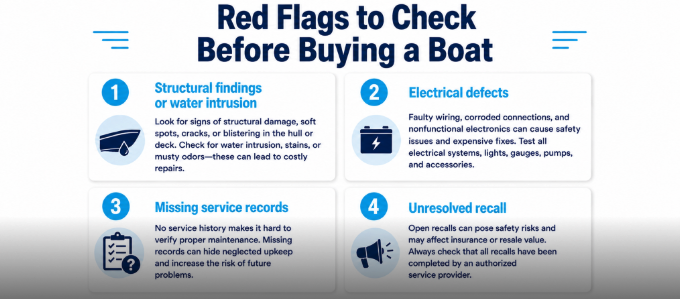
Red Flags That Matter More Than Brand Reputation
Before you trust any forum opinion, including this one, run these checks against the actual boat:
| Red flag | Why it matters | What to request |
| Structural findings or water intrusion | May indicate delamination or hidden damage | Independent marine survey, moisture meter readings |
| Unresolved USCG recall | Repair may be outstanding | Recall search by company + model + year at uscgboating.org |
| Missing or inconsistent service records | Leaves maintenance history unknown | Engine logs, service invoices, storage records |
| Title or HIN mismatch | Raises ownership or identity concerns | Title, registration, physical HIN photos, bill of sale |
| Corroded terminals or wiring | Common in Florida’s salt and UV environment | Survey findings plus marine electrician estimate |
| No local service or parts access | Complicates future ownership | Written confirmation from a local shop |
| AI-image hero photos in the listing | Listing may be misrepresenting the boat | Request in-person viewing before any deposit |
What Florida Adds to Every Boat-Buying Equation
Florida’s boating environment is genuinely demanding. Year-round UV exposure, salt air, high humidity, and hurricane-season storage conditions accelerate wear in ways that don’t apply in the Midwest or Pacific Northwest. A boat that spent three seasons in Minnesota freshwater has had a very different life from one docked in Tampa Bay.
When inspecting a Florida boat, pay specific attention to:
- UV degradation on upholstery, gel coat, and canvas, look for cracking, chalking, and faded non-skid surfaces
- Corrosion on accessible hardware, terminals, through-hulls, and transom fittings, not just surface rust but pitting in aluminum or bronze
- Bilge and drain condition standing water accelerates mold and wood rot in composite structures
- Storm and flood history ask directly; request documentation; have a surveyor look for high-water staining in the bilge and electrical boxes
- Engine flushing records boats used in salt water that weren’t consistently flushed accumulate internal corrosion faster than spec suggests
A covered, freshwater-washed boat with documented storage history is worth more than a salt-docked boat with no records, regardless of brand.
The 8-Step Pre-Purchase Checklist for Florida Buyers
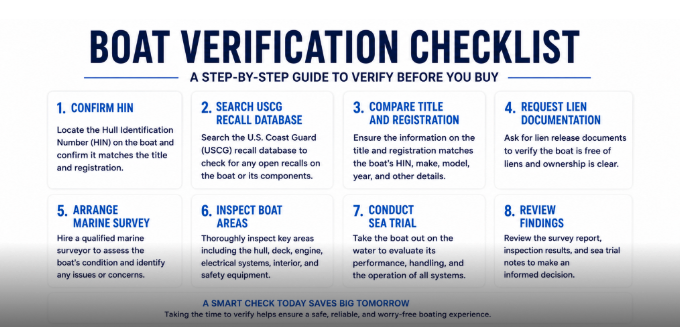
Follow this sequence on every serious candidate in this order:
- Confirm the HIN and manufacturer: The Hull Identification Number (HIN) is a 12-character code. Check it against the title and registration. If they don’t match, stop. Use the USCG Manufacturer Identification Code database to verify the builder.
- Search the USCG recall database: Search by company, model, and year. Download the result. If a recall exists, ask the seller for the repair completion certificate.
- Review title, registration, and lien documentation: Florida requires titling and registration within 30 days of purchase. For boats from non-title states, FLHSMV requires a detailed bill of sale that includes the HIN. Confirm there are no outstanding liens before any money changes hands.
- Request all service and ownership records: Engine logs, impeller replacement dates, winterization records (if applicable), haul-out history, and any repair invoices. Gaps are not automatic disqualifiers, but they are negotiating points.
- Hire an independent marine surveyor: In Florida, pre-purchase survey rates typically run $20–$30 per foot for a condition-and-value inspection, with Fort Lauderdale surveyors often quoting $25–$40 per foot for more complex vessels. A haul-out adds approximately $10–$15 per foot at most boatyards. Budget accordingly, a 25-foot boat survey in South Florida commonly runs $600–$1,000 before haul-out fees. This cost is almost always worth it.
- Inspect accessible systems yourself before the survey: Look at the bilge, wiring runs, upholstery, non-skid, engine compartment cleanliness, and visible hardware. Anything that would make you walk away at a glance saves you a survey fee.
- Run a cold start and sea trial: Cold starts reveal issues that warm engines hide. The sea trial should include a range of RPMs, a course change under power, and observation of any vibration, smoke, or steering resistance.
- Check financing and insurance feasibility before making an offer: Vessel age, survey findings, HIN status, and intended use all affect insurability. Pre-qualify and explore insurance options before you’re emotionally committed to a specific boat. At Boatzon, pre-qualification does not affect your credit score.
Can Discontinued Brands Still Be a Good Buy?
Yes, with conditions. A discontinued brand (Luhrs, Maxum, Renken, and others) raises a specific question: can you actually own this boat for the next decade? Before committing, confirm:
- Parts availability for proprietary components (not just generic marine parts)
- At least one local shop willing to service it in writing
- Current survey findings that indicate the hull and systems are sound
- Resale realistic scenario, some discontinued brands have limited buyer pools
A sound hull with a repowered engine from a common manufacturer (Mercury, Yamaha, Honda) is a different situation from a boat with a discontinued engine that requires a specialist.
Boat Types That Suit Florida Best, and What to Check
| Use case | Best boat type | Key checks for Florida conditions |
| Inshore fishing (bays, flats, ICW) | Bay boat, flats boat, poling skiff | Draft, draft, draft, plus anti-corrosion treatment on hardware |
| Offshore fishing | Center console, walkaround | Hull construction quality, scupper drainage, transom integrity |
| Family cruising (ICW, coastal) | Bowrider, deck boat, pontoon | UV protection on upholstery; shade and cover; bilge pump condition |
| Watersports (lakes, rivers) | Wake boat, ski boat | Engine hours, ballast system condition, tower hardware |
| Sailing / liveaboard | Sailboat, catamaran | Standing rigging inspection, thru-hull condition, keel-to-hull joint |
Match the boat to the water you’ll actually use, then apply the same 8-step checklist to each candidate.
What is the 1/3 Rule in Boating?
The 1/3 rule is a fuel-planning guideline: use one-third of your fuel for the outbound leg, reserve one-third for the return trip, and keep one-third as an emergency reserve. It applies to any vessel on any water and is especially relevant for Florida boaters venturing offshore or into remote Gulf waters where fuel stops are scarce.
The rule is a starting point, not a safety promise. Headwinds, current, and load all affect actual burn rate. Know your boat’s specific consumption at cruising RPM before relying on any guideline.
How Boatzon Can Help You Move from Checklist to Closing
Boatzon, the online boat marketplace from MarineMax, the largest U.S. recreational boat retailer, lets shoppers compare real inventory, pre-qualify for financing (no credit score impact), explore boat loans, and compare marine insurance quotes in one place. You can shop, finance, insure, and buy entirely online, or connect with a Florida specialist for in-person support.
These tools don’t replace vessel-specific verification, no online platform can certify the condition of an individual boat, but they help you move efficiently from shortlist to offer with the financial and insurance picture already in focus.
Browse boats for sale on Boatzon or call 1-833-262-8966 to speak with a team member.
FAQ
Are there specific boat brands Florida buyers should avoid?
Bayliner (particularly pre-2000 models), Kingfisher, Luhr/Luhrs, and certain Monterey configurations come up most often in USCG recall records and owner communities. That said, the condition of the individual boat, its service history, and its survey results matter more than brand reputation alone. A well-maintained older Bayliner often outperforms a neglected newer boat from a premium brand.
What is the most reliable boat brand for Florida use?
Boston Whaler, Grady-White, Everglades, and Contender consistently rank highest for durability in Florida’s saltwater environment. All use foam-filled or high-quality fiberglass construction, maintain strong dealer support networks in Florida, and hold resale value well. That said, no brand is immune to poor maintenance, always verify service records and commission a pre-purchase survey.
How much does a boat survey cost in Florida?
A pre-purchase marine survey in Florida typically costs $20–$30 per foot for a condition-and-value inspection, with South Florida surveyors (Fort Lauderdale, Miami) often at the higher end of the range at $25–$40 per foot. A haul-out, where the boat is removed from water for hull inspection, adds approximately $10–$15 per foot at most Florida boatyards. Budget $600–$1,200 for a 25–30 foot boat before haul-out.
What does the 1/3 rule mean in boating?
The 1/3 rule is a fuel management guideline: one-third of fuel for the outbound trip, one-third for the return, one-third held in reserve for emergencies. It is especially important for Florida boaters heading offshore or into areas with limited fuel access.
How many boats are registered in Florida?
Florida leads all U.S. states with 1.2 million registered recreational vessels as of 2024, representing 10% of all U.S. registrations, according to the National Marine Manufacturers Association. This makes Florida the most active recreational boating market in the country and drives a large, competitive used-boat market.
Can a discontinued boat brand still be a good buy?
Yes, if the specific boat is structurally sound, documented, and supported by available parts and a local service shop. Verify parts availability for any proprietary systems, get a written commitment from a local marine technician, and factor in realistic resale before committing to a discontinued brand.
What should I check when buying a used boat in Florida specifically?
Beyond the standard pre-purchase checklist, Florida-specific checks include: UV degradation on gel coat and upholstery, corrosion on hardware and electrical terminals, storm or flood exposure history, engine flushing records for salt-water use, and whether the boat was covered and stored appropriately between uses.
Does Boatzon pre-qualification affect my credit score?
No. Boatzon’s pre-qualification process does not impact your credit score. Pre-qualification is an early feasibility check and does not constitute final loan approval or guarantee a specific rate, term, or amount.
How do I search for boat recalls by brand?
Visit the USCG boat recall database at uscgboating.org</a> and search by company name, model, and model year. The search is free and publicly available. Download the results for any brand and year you’re considering before requesting a survey.
Are boat prices going down in Florida in 2026?
Used boat inventory in Florida has expanded as post-pandemic demand normalized. Whether prices continue to soften depends on interest rates, regional hurricane activity, and fuel costs, factors that shift faster than any published forecast. Evaluate each boat on its documented condition, survey findings, and comparable recent sales rather than waiting for a market prediction.
The Right Process Protects You More Than Any Brand List
A blacklist of brand names is a starting point for research, not a buying decision. The boat that matters is the one you’re standing in front of, and whether its HIN matches its title, its survey comes back clean, its service records hold up, and its ownership path is practical for the Florida waters you’ll use it on.
Run the checklist. Get the survey. Check the USCG database. And compare real inventory before you decide.
Browse boats for sale on Boatzon, pre-qualify with no credit impact, compare marine insurance, and buy online, or call 1-833-262-8966 for support.