
TL;DR: Good boat ramp etiquette comes down to prepping in the staging area, keeping your time on the ramp short, and reading the flow so nobody waits on you.
Boat ramp etiquette is the set of unwritten rules that keep a launch site moving smoothly when several boaters need the same few lanes. It covers where you prep your boat, how long you occupy the ramp, and how you handle the line on a busy Saturday morning. None of it is complicated, and most of it boils down to a single idea: do your work before and after the ramp, not on it. Get that part right and you will look like you have done this a hundred times, even if it is your first season on the water.
The ramp is where confidence gets tested in public. Everyone remembers the truck that sat sideways across two lanes while a family loaded coolers one at a time. You do not want to be that story. The good news is that the fixes are easy, and they start well before your trailer touches the water.
Why the staging area is your best friend
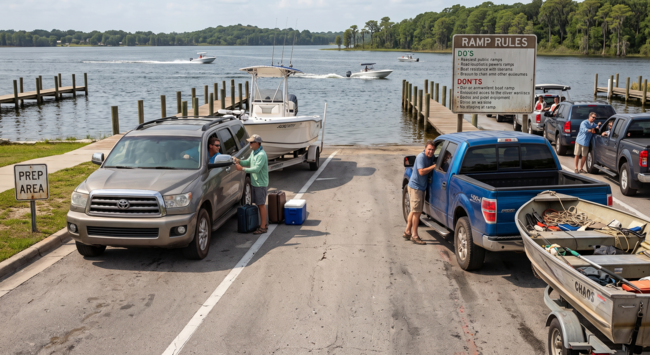
Every decent launch site has a staging area, a pull-off spot near the ramp where you get the boat ready without blocking anyone. Use it fully. According to BoatUS, you should take about 10 minutes in the staging area to load your gear, attach lines to the bow and stern, check that the drain plug is in, remove the tie-downs, put the key in the ignition, and unplug the trailer lights. When you finally back down the ramp, the only job left is to float the boat off the trailer.
Skipping this step is the single most common ramp mistake. People pull straight into the launch lane, then start hunting for life jackets and threading dock lines while a line forms behind them. Every minute you spend prepping on the ramp is a minute stolen from everyone waiting. Do it in the staging area and you turn a ten-minute ordeal into a ninety-second launch. Keeping a dedicated set of boating accessories on Boatzon stowed aboard, spare lines, fenders, and a bailer, means you are never digging through the truck while the ramp waits.
A quick staging checklist
Before you leave the staging area, run through these:
- Drain plug installed and snug
- Bow and stern lines attached and coiled where you can reach them
- All coolers, rods, tubes, and bags loaded aboard
- Tie-down straps removed (people forget these and try to launch a strapped-down boat)
- Motor tilted to clear the ramp, key in the ignition, battery on
- Fenders ready if you plan to tie up at the courtesy dock
Reading a busy ramp
On a crowded morning, half of ramp etiquette is just paying attention. Watch which lanes are for launching and which are for retrieving, because mixing them up creates gridlock fast. If there is a courtesy dock, use it to hold your boat while you park the truck, but do not leave your boat tied there for twenty minutes while you grab breakfast. That dock is shared space, not a private slip.
Have a plan with your crew before you back down. One person drives the tow vehicle, one handles the boat, and everyone knows the signal for stop. Long-distance shouting across a parking lot never works, so agree on hand signals or keep it simple with a phone call. When you launch solo, tie a long line to the bow so the boat drifts toward the dock instead of into the middle of the channel while you park.
Backing a trailer is where nerves show. If reversing straight down a ramp still makes you sweat, practice in an empty parking lot on a weekday. Ten minutes with some cones will save you real embarrassment on a packed weekend, and it beats learning the hard way with six trucks watching.
The retrieve is half the job
Launching gets all the attention, but retrieving a boat trips up just as many people. The same rule applies in reverse: get off the ramp fast, then do the rest in the staging area. Pull the boat onto the trailer, secure it with the winch strap and a safety chain, and drive up and out. Do not stand at the top of the ramp draining livewells, wiping down seats, and rolling up covers while a line of tired boaters waits behind you.
If your trailer setup needs attention, whether that means fresh bunk carpet, working lights, or better tie-downs, it is worth handling before the season gets busy. You can shop boat trailers and trailer parts to keep loading quick and predictable, which matters more than people expect. A trailer that guides the boat on straight the first time is the difference between a clean retrieve and three re-tries.
Common retrieve mistakes
A few habits create most of the ramp-day frustration:
- Driving off with straps unhooked, then stopping halfway up to fix it
- Power-loading so hard it digs a hole at the base of the ramp
- Forgetting to raise the motor before pulling up the incline
- Blocking the wash-down station instead of moving to a parking spot first
Little courtesies that go a long way
Ramp culture rewards awareness. Leave your headlights off or dimmed when idling near other boaters at a dark morning launch, since high beams in the mirror are miserable. Keep dogs and kids clear of the water’s edge while trailers are moving. If you see someone struggling, a calm offer to spot their trailer often does more good than advice shouted from a distance.
Bring your own gear so you are not borrowing from strangers. A few dock lines, fenders, a bailer, and a basic tool kit cover most surprises, and having them aboard before you arrive is what keeps a small problem from becoming everyone’s problem. Preparation is the quiet skill that separates smooth boaters from stressful ones.
Finally, remember that everybody was new once. The boater who looks effortless today has almost certainly backed a trailer into a piling or forgotten a drain plug at some point. Etiquette is not about being perfect; it is about being considerate and efficient so the shared space works for everyone. Master that, and the ramp stops being the scary part of the day.
Ready for the water
If you are still shopping for the right rig, it pays to think about how easy a boat is to launch and retrieve before you buy. Trailerable boats with well-matched trailers make ramp days painless, while oversized or poorly balanced setups turn every launch into a project. Browse Boatzon’s inventory with launching in mind, and you will set yourself up for smoother mornings all season.
FAQ
What is the staging area at a boat ramp?
The staging area is a pull-off zone or section of parking lot near the launch lanes where you prepare your boat before backing down. You use it to load gear, attach lines, remove tie-downs, and check the drain plug so your actual time on the ramp is as short as possible. Doing your prep here instead of on the ramp is the core of good etiquette.
How long should launching a boat take?
Once you have prepped in the staging area, the launch itself should take only a minute or two. You back down, float the boat off the trailer, move it to the courtesy dock or hold it on a line, and pull the trailer clear. Anything longer usually means prep that should have happened before you reached the ramp.
How do I launch a boat by myself?
Do all your prep in the staging area, then attach a long dock line to the bow before backing in. As the boat floats free, walk it to the courtesy dock using that line and tie it off. Park the tow vehicle, then return to your boat. A bow line long enough to reach the dock is the key piece that makes solo launching manageable.
What are the biggest boat ramp etiquette mistakes?
The most common mistakes are prepping on the ramp instead of in the staging area, leaving a boat tied to the courtesy dock for a long time, mixing up launch and retrieve lanes, and stopping halfway up the ramp to secure straps. Almost every one of them comes from doing ramp-side work that belongs in the staging lot.
Should I practice backing up my trailer?
Yes, especially if you are new to trailering. Practicing in an empty parking lot with a few cones builds the muscle memory to reverse straight down a ramp without over-correcting. Ten minutes of practice on a quiet day prevents the stress of learning in front of a line of waiting boaters.
What gear should I keep on board for ramp days?
Carry dock lines, fenders, a bailer, a basic tool kit, and spare tie-down straps. This covers most of the small surprises that otherwise send you borrowing from strangers or holding up the line. Keeping your own kit stocked is a simple way to stay self-sufficient and considerate at the ramp.
Is power-loading a boat onto the trailer acceptable?
Light throttle to seat the boat on the bunks is common, but heavy power-loading is discouraged and banned at many ramps because it digs a hole at the base of the ramp and erodes the structure over time. Crank the boat on with the winch as much as possible, and use only gentle throttle to finish.