



- Boats

- Shop
- Finance
- Boatability
- Shopping Tools
- Dealer

Down Payment For Boat Loans: How Much Do You Need?
Compare how different down payments change your rate, your monthly payment and your total interest, then see what you actually qualify for.
Get Pre-Qualified
Your down payment shapes nearly every aspect of your boat financing: the interest rate you qualify for, your monthly payment, how quickly you build equity, and whether you owe more than the boat is worth during those early years.
Most lenders require 10 to 20 percent down on a boat purchase, though this varies with your credit profile, the boat's age and value, and the individual lender. The right amount depends on what you are optimising for: monthly affordability, total interest paid, or future flexibility.
This guide covers standard requirements, how each down payment tier changes your rate, where the money can come from, and when going higher or lower makes sense.
Down payment at a glance
| Secured | Unsecured | |
|---|---|---|
| Down payment | Loan-to-value | What it means |
| 0 to 5% | 95 to 100% | Available to buyers with 750+ credit. Rates run 0.5 to 1.5% higher. Underwater from day one |
| 10% | 90% | The common minimum. Demonstrates commitment and creates a basic equity cushion |
| 15% | 85% | Middle tier at many lenders. Better terms than 10% without needing the full 20% |
| 20% | 80% | The sweet spot. Unlocks preferential rate tiers, often saving 0.5 to 1% versus 10% down |
| 25 to 30%+ | 70 to 75% | Minimises borrowing costs and provides negotiating leverage, particularly with private sellers |
What you need on a typical boat
| Secured | Unsecured | |
|---|---|---|
| Boat price | 10% down | 15% down |
| $25,000 | $2,500 | $3,750 |
| $50,000 | $5,000 | $7,500 |
| $75,000 | $7,500 | $11,250 |
| $100,000 | $10,000 | $15,000 |
| $150,000 | $15,000 | $22,500 |
Down payment calculator
Enter your boat price and see how each down payment changes your monthly cost.
This calculator is for general estimation only and is not an offer of credit or an application. Your actual rate, payment and approval depend on your credit profile, the boat, and the lender. Boatzon is not a lender.
Used boats available with financing
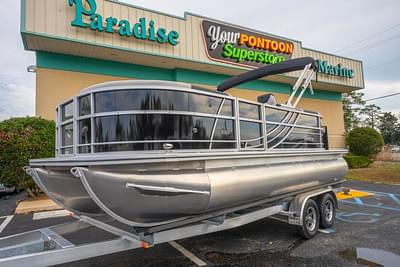
South Bay 220RS LE Rear Seating 275 2025

Monterey 278SS 2025
Pre-Qualify in minutes with no impact to your credit
See personalized rates and terms in minutes
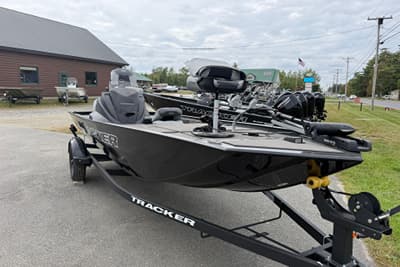
Tracker Pro 170 2027
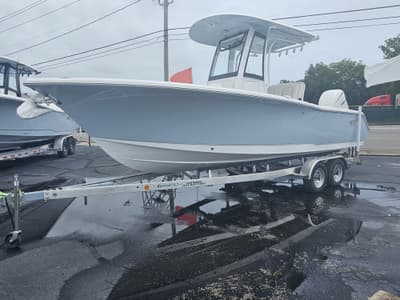
Sea Hunt 245 SE 2027
Pre-Qualify in minutes with no impact to your credit
See personalized rates and terms in minutes
Standard down payment requirements
The 10 to 20 percent range
The vast majority of boat loans fall within this band.
Lenders view 10 percent as the minimum that demonstrates financial commitment and creates a basic equity cushion. A $50,000 boat requires $5,000 down at 10 percent, which is accessible for many buyers without depleting emergency savings.
Twenty percent is the sweet spot where lenders offer their best terms. It reduces their risk substantially: if they need to repossess and sell, they can absorb typical depreciation and transaction costs while still recovering the full loan amount. The 80 percent loan-to-value ratio that comes with 20 percent down unlocks preferential rate tiers at most lenders, often saving 0.5 to 1 percent in interest compared with 10 percent down.
Fifteen percent splits the difference and works well for buyers who can stretch beyond 10 percent but have not reached 20. Some lenders have a rate tier at 15 percent, offering better terms than 10 percent without requiring the full amount. On a $60,000 boat, that means finding $9,000 rather than $6,000 or $12,000.
Zero and low down payment programs
Some lenders offer programs requiring 5 percent down or even zero down, typically reserved for buyers with credit scores above 750 and strong income documentation. These come with trade-offs: interest rates run 0.5 to 1.5 percent higher than standard programs, and you may face stricter debt-to-income requirements or lower maximum loan amounts.
The risk is that you are underwater from day one. If circumstances change and you need to sell within the first few years, you will owe more than the boat is worth and have to cover the gap from other funds. This matters less if you are confident you will keep the boat long term.
Higher down payments of 25 to 30 percent or more
Some buyers put down significantly more than required to minimise their loan or secure the best available rate. On a $75,000 boat, putting $22,500 down at 30 percent instead of $15,000 at 20 percent reduces the financed amount by $7,500, saving roughly $30 to $40 monthly and $6,000 to $8,000 in interest over a typical 15 year loan.
Larger down payments also provide negotiating leverage, particularly in private party transactions. A seller who knows you have substantial money down and solid financing is more likely to accept your offer over competing buyers with shakier positioning.
How your down payment affects your rate
Most lenders structure rates in tiers based on loan-to-value ratio, creating threshold effects where crossing from 85 percent LTV to 80 percent LTV unlocks a noticeably better rate.
A buyer with a 720 credit score financing a new boat might see this progression:
| Secured | Unsecured | |
|---|---|---|
| Down payment | Loan-to-value | Example APR |
| 10% | 90% | 8.0% |
| 15% | 85% | 7.5% |
| 20% | 80% | 7.0% |
The APR figures above are illustrative examples, not quoted rates. Your actual rate depends on your full profile.
That is a 0.5 percent improvement at each tier. On a $60,000 loan over 15 years, each 0.5 percent reduction saves approximately $20 to $25 monthly and $3,500 to $4,500 in total interest. Moving from 10 percent to 20 percent down, which costs $6,000 more upfront, saves roughly $50 monthly and $9,000 across the loan term.Individual lenders structure these tiers differently, and your credit profile influences how dramatic the improvements are. Buyers with marginal credit in the 680 to 700 range often see larger jumps between tiers, because lenders view additional equity as particularly valuable when the credit history shows some blemishes.
Where your down payment can come from
Cash savings
The most straightforward approach. Set a target of 15 to 20 percent of your expected purchase price, then work backward to a monthly savings figure. If you are 12 months from buying a $50,000 boat and want 20 percent down, you need $10,000 saved, or roughly $835 monthly. If that is too aggressive, extend your timeline, reduce your target price, or plan for a smaller down payment and accept the financing trade-offs.
Trade-in equity
Your current boat's trade-in value functions exactly like a cash down payment. A boat worth $15,000 applied to a $60,000 purchase means financing $45,000 plus taxes and fees, which is effectively 25 percent down without additional cash. The key is maximising that value. Get quotes from multiple dealers if trading in, or consider selling privately for typically 10 to 20 percent more than trade-in offers. Private sales take more effort, including listing, showing the boat, negotiating and coordinating title transfer with your lender, but the extra money often justifies it on higher-value boats.
Gifted funds
Many lenders allow down payments funded partly or fully by gifts from family, typically requiring a gift letter stating the money is a gift rather than a loan. The gift letter exists because lenders need to know your true debt obligations. If your parents gift you $10,000 but actually expect repayment, that is a hidden debt affecting your ability to afford the boat payment. Legitimate gifts pose no such concern.
Calculating your ideal down payment
Start with your budget
Work out what you can allocate without depleting emergency savings, ideally 3 to 6 months of expenses, disrupting retirement contributions, or leaving yourself cash-poor after purchase. You need liquidity remaining for insurance, registration, initial maintenance and normal life.
A useful framework: calculate 20 percent of your target boat price, then assess whether you can reach it while keeping that cushion. If yes, aim for 20. If not, work out what you can reach and understand the implications.
Factor in the other upfront costs
Your down payment is not the only cash you need at closing.
| Cost | Typical range |
|---|---|
| Sales tax | 6 to 8% in states that charge it |
| Registration and titling | $100 to $500+ depending on state |
| Dealer documentation fees | $300 to $800 |
| Marine survey (used boats) | $500 to $1,500 |
| First year insurance | Often due at closing |
On a $50,000 boat, these can total $3,500 to $5,000. If you have saved $10,000 for a 20 percent down payment and assumed it covers everything, you will be short. Either save the down payment plus anticipated closing costs, or reduce the percentage to keep total cash outlay manageable.
Consider opportunity cost
Money in a down payment cannot be used elsewhere. If you carry high-interest debt such as credit cards at 18 to 22 percent, clearing that before saving for a larger down payment usually makes more sense. The guaranteed return from eliminating 20 percent interest debt exceeds the interest saved on a slightly larger boat deposit.
Similarly, if you are not capturing your full employer 401(k) match, typically a 50 to 100 percent return on your contribution, that should take priority.
When a larger down payment makes sense
Buyers with cash available who want to minimise total borrowing costs benefit most. With $30,000 in savings earmarked for a $75,000 boat, putting all $30,000 down at 40 percent creates a $45,000 loan instead of $60,000 at 20 percent. Over 15 years that saves roughly $100 monthly and $18,000 in total interest.
Larger deposits also help buyers with borderline credit in the 680 to 700 range compensate for the rate premium they would otherwise face. Adding equity upfront demonstrates stability and often unlocks better rates than the credit score alone would justify.
Buyers purchasing boats that depreciate quickly or have uncertain resale value benefit too. Obscure brands, outdated features or deferred maintenance all accelerate value loss. Starting with 25 to 30 percent equity helps ensure you can sell without bringing cash to closing if circumstances change.
When a smaller down payment makes sense
Buyers confident in their income who value liquidity over minimising interest often choose smaller deposits. Keeping $10,000 to $15,000 in reserves after purchase provides flexibility for unexpected expenses, investment opportunities, or peace of mind.
Younger buyers benefit from preserving capital for other priorities such as a home deposit, starting a family, or building emergency reserves. Ten percent instead of 20 on an $80,000 boat keeps $8,000 to $10,000 available, which may matter more at that stage than slightly higher interest over 15 years.
Buyers expecting significant income growth within three to five years can start with a minimal deposit and comfortable payments, then refinance or make large principal payments once earnings increase. This maximises current cash flow while planning to accelerate payoff later.
See what you qualify for
20+ marine lenders · No credit score impact · Same day approval · All 50 states
Frequently asked questions
Most lenders require 10 percent down as a minimum, though some programs for buyers with excellent credit of 750 or above offer 5 percent or even zero down. These low-down-payment programs typically carry interest rates 0.5 to 1.5 percent higher and may have stricter income or debt-to-income requirements. The boat's age and value also influence minimums, as older boats often require larger deposits.


Copyright © 2026 Boatzon™. All Rights Reserved