




Boat Loan Interest Rates
What Affects Your Rate

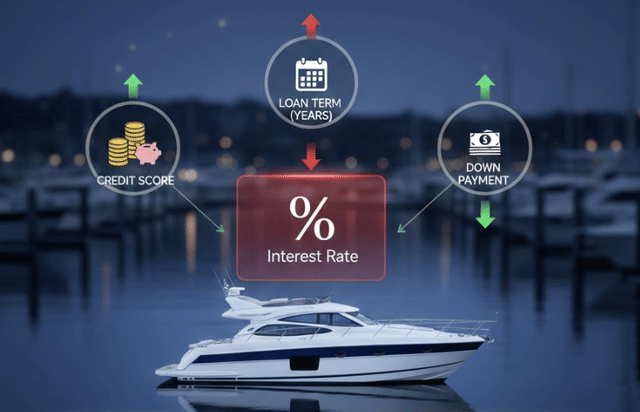
What Affects Your Rate
Your interest rate determines how much you'll actually pay for your boat beyond the sticker price. A seemingly small difference of 1-2 percentage points translates to thousands of dollars over a typical loan term, making your rate one of the most consequential aspects of boat financing. Understanding what drives your rate helps you position yourself for the best possible terms and avoid paying more than necessary.
Boat loan rates typically range from 6% to 12% depending on multiple factors, with the strongest borrowers accessing rates in the low-to-mid single digits and those with credit challenges facing double-digit rates. Unlike mortgage rates that get extensive media coverage, boat loan rates vary significantly between lenders and are often negotiable based on your complete financial profile.
How Boat Loan Interest Rates Work
Your interest rate represents the annual cost of borrowing money, expressed as a percentage of your loan amount. On a $50,000 loan at 7.5%, you're paying $3,750 in interest during the first year (though this decreases as you pay down principal). That 7.5% gets divided across your monthly payments, with early payments heavily weighted toward interest and later payments increasingly going toward principal.
The APR (annual percentage rate) differs slightly from your interest rate because it includes certain fees rolled into the loan, giving you a more complete picture of your true borrowing cost. When comparing loan offers, always look at APR rather than just the interest rate.
Most boat loans use fixed rates, which remain constant throughout your loan term and provide predictable payments that never change. Variable rates fluctuate with market conditions but are uncommon for boat loans because buyers prefer payment certainty over 10-20 year terms.
Credit Score: The Primary Rate Driver
Your credit score has the single biggest impact on your interest rate. Lenders use your score as a shorthand assessment of how reliably you repay debts, and that perceived risk directly shapes what they'll charge you to borrow.
Borrowers with scores above 760 typically access the best available rates, often in the 6-7.5% range for new boats with secured financing. Those in the 700-740 range see rates roughly 0.5-1% higher. Scores between 680-699 face another 1-1.5% premium. Below 680, rates climb steeply, often reaching 10-12% or higher.
The math matters substantially. On a $60,000 loan over 15 years, the difference between a 7% rate (excellent credit) and a 10% rate (fair credit) is $122 per month, or nearly $22,000 in additional interest over the loan's life. Run these numbers in our boat loan calculator to see how rate differences affect your specific situation. That single factor determines whether you pay $82,000 or $104,000 total for the same boat.
Lenders don't just look at your score's number; they examine what's behind it. Someone with a 720 score built over 15 years of perfect payment history gets better consideration than someone with a 720 score that recently recovered from serious delinquencies.
The Boat Itself: Age, Value, and Brand
New boats command the lowest interest rates because they're predictable collateral with established values and ready resale markets. The latest model from a major manufacturer might qualify for rates 1-2 percentage points below a comparable loan on a 10-year-old boat.
As boats age, rates increase incrementally. A 3-year-old boat might add 0.5% to your rate compared to new. A 7-year-old boat adds another 0.5-1%. By the time boats reach 12-15 years old, rates often sit 2-3 percentage points higher than new boat financing.
Brand reputation plays a surprisingly large role. Premium manufacturers known for quality construction and strong resale values, such as Grady-White, Boston Whaler, Pursuit, Viking, and Hatteras, qualify for better rates than lesser-known brands at identical price points and ages. A 5-year-old Grady-White might get you 7.5% while a same-age off-brand boat gets 9%, simply because lenders have data showing Grady-Whites hold value more predictably.
The boat's purchase price relative to typical values also matters. If you're paying $45,000 for a boat that similar models sell for $50,000-55,000, lenders view that favorably; you're getting a deal, which creates a built-in equity cushion. Conversely, paying $55,000 for boats that typically sell around $45,000 may result in higher rates or stricter terms.
Loan Structure and Down Payment
Your down payment directly influences your rate through the loan-to-value (LTV) ratio. Putting 20% down creates an 80% LTV, which typically unlocks a lender's best rate tier. Dropping to 10% down (90% LTV) might cost you 0.5-1% in rate. Zero-down financing, when available, usually carries another 0.5-1% premium.
The math works because down payments reduce lender risk. If you default on a loan where you put 20% down, the lender can likely sell the boat and recover their full investment even after accounting for repossession costs. With only 10% down, that margin shrinks considerably, and lenders price that risk into your rate.
Secured loans almost always offer better rates than unsecured loans, typically 2-4 percentage points lower. A secured loan at 7.5% might require an unsecured equivalent at 11-12% because the lender has no collateral to recover if you default. This gap widens for buyers with less-than-perfect credit.
Income, Employment, and Debt-to-Income Ratio
Lenders evaluate your income stability as carefully as your credit score. W-2 employees with multi-year tenure at stable companies get preferential consideration over recently hired employees or those with frequent job changes. Self-employed borrowers face slightly higher rates (typically 0.5-1% more) because lenders view self-employment income as less predictable, even when tax returns show strong, consistent earnings.
Your debt-to-income (DTI) ratio measures your monthly debt payments against your gross monthly income. Lenders typically prefer DTI below 40-43% including your new boat payment. If you're at 35% DTI, you qualify for standard rates. If you're at 45% DTI, you may face a rate premium of 0.5-1% because you represent elevated risk.
Large cash reserves can sometimes compensate for borderline DTI or income concerns. If you have $100,000+ in liquid assets available beyond your down payment, lenders view you as lower risk even if your income is modest or irregular. That financial cushion may unlock better rates despite other factors that would typically increase your cost.
Market Conditions and Economic Factors
Boat loan rates don't exist in a vacuum; they correlate with broader interest rate trends. When the Federal Reserve raises rates to combat inflation, boat loan rates typically follow within weeks or months. When rates drop, marine financing costs decline accordingly, though often with a lag.
This creates timing considerations for boat buyers. If the Fed has signaled rate increases are coming, locking in financing sooner rather than later makes sense. If rates are falling or expected to fall, you might finance now and plan to refinance in 12-18 months once rates stabilize lower.
Lender competition in your region matters too. Areas with strong boating cultures (Florida, coastal regions, lake-heavy states) tend to have more marine lenders competing for business, which creates downward pressure on rates. Buyers in these markets might see rates 0.25-0.5% lower than comparable borrowers in regions where boat financing is less common.
Improving Your Interest Rate
The most impactful improvement comes from boosting your credit score before you apply. Even a 20-30 point increase can drop you into a better rate tier. Pay down credit card balances below 30% of your limits (ideally below 10%), make all payments on time for at least six months, and dispute any errors on your credit reports.
Increasing your down payment from 10% to 20% often unlocks meaningfully better rates. If you're a few months away from having 20% saved versus 15% available now, the rate improvement usually justifies the wait. On a $75,000 boat, that extra down payment investment might save you $40-60 monthly and $7,000-10,000 over a 15-year term.
Shopping multiple lenders remains essential because rate offerings vary significantly even for identical borrower profiles. Credit unions frequently beat banks by 0.5-1%, though they may have membership requirements or stricter approval criteria. Marine lending specialists who work with multiple lenders can often find better rates than approaching banks individually.
Consider points or rate buydowns if you plan to keep the loan for most or all of its term. Paying 1-2% of the loan amount upfront can reduce your rate by 0.25-0.5%, which pays for itself if you keep the loan more than 3-5 years. This strategy works best for buyers confident they won't refinance or sell within the first few years.
Frequently Asked Questions
What's a good interest rate for a boat loan?
-How much does my credit score affect my boat loan rate?
+Can I negotiate my boat loan interest rate?
+How do secured and unsecured boat loan rates compare?
+Will rates change during my loan term?
+When should I refinance to get a better rate?
+Do new boats always get better rates than used boats?
+Do boat loan rates vary by state?
+Boats For Sale

South Bay 220RS LE Rear Seating 275 2025
220RS LE Rear Seating 275 | N/A
$5,628 cash down
 Gulf Shores, AL

Monterey 278SS 2025
N/A
$13,999 cash down
Lancaster, KY


Copyright © 2026 Boatzon™. All Rights Reserved