




Boat Loan Amortization
How Your Payment Breaks Down

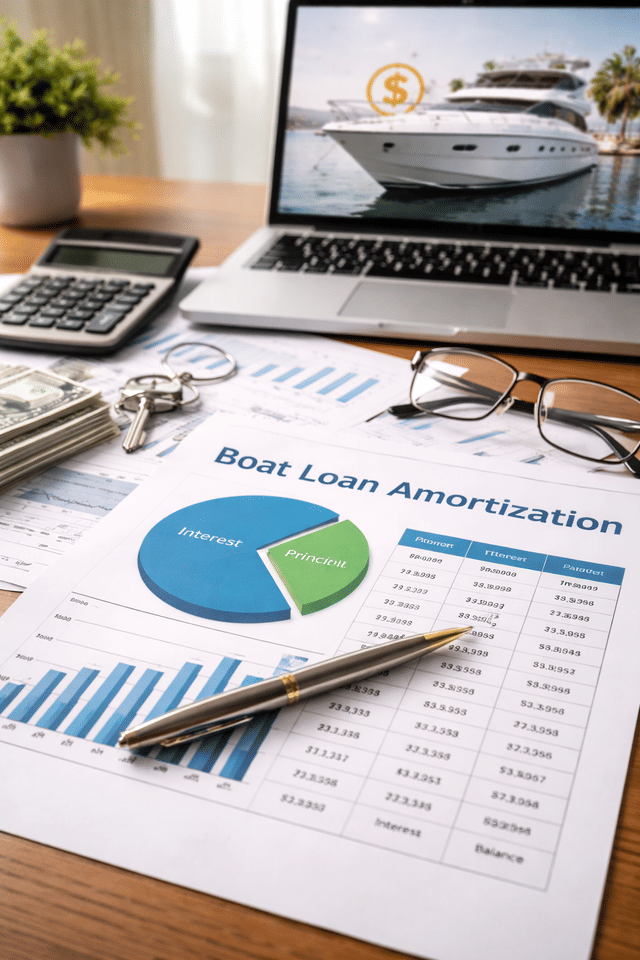
Understanding how boat loan payments are structured reveals why making extra payments early in the loan saves thousands in interest, and why your balance drops slowly at first despite consistent monthly payments. Amortization describes the process of paying down a loan over time through regular installments that cover both principal (the amount borrowed) and interest (the cost of borrowing).
Most boat buyers never look beyond their monthly payment amount. A $400 payment feels manageable, so they focus on finding a loan that hits that number regardless of the term or total cost. This approach ignores the reality that early payments go primarily toward interest while later payments finally chip away at the principal balance. Knowing how amortization works helps you make smarter decisions about loan terms, extra payments, and whether refinancing makes sense.
How Amortization Works
Amortization follows a predictable pattern: each payment covers the interest accrued since your last payment, with the remainder reducing your principal balance. Early in the loan, interest represents a larger portion because you owe more principal. As you pay down the balance over time, less interest accrues each month, so more of each payment reduces principal.
Consider a $50,000 boat loan at 8% interest over 15 years with a monthly payment of $478. Your first payment breaks down to $333 in interest and just $145 toward principal. The second month, you owe slightly less principal ($49,855), so interest drops to $332 and principal increases to $146. This continues for the life of the loan, with the ratio gradually shifting until your final payment is nearly all principal.
By payment 90 (halfway through a 15-year loan), you've made $43,020 in payments but only reduced your balance to $32,488. You've paid more than 86% of the original loan amount but still owe 65% of it. This isn't a mistake or unfair lending practice; it's simply how amortization mathematics work when interest is calculated on the remaining balance each month.
Use the boat loan calculator to see exactly how your payments break down month by month. Most calculators show an amortization schedule revealing how much of each payment goes to principal versus interest over the entire loan term.
Early Payments vs. Later Payments
The distribution between principal and interest shifts dramatically over a loan's life. In year one of a $75,000 loan at 8.5% over 20 years ($651 monthly payment), you'll make $7,810 in payments but only reduce your balance by about $1,493. The remaining $6,317 goes entirely to interest. In year 20, those same monthly payments will reduce your balance by roughly $7,250 with just $560 going to interest.
This front-loaded interest structure explains why refinancing can save money even at similar rates. When you refinance a 10-year-old loan, you restart the amortization schedule, but your new loan amount is much smaller than your original principal. A $75,000 loan at 8.5% over 20 years leaves you owing about $52,500 after 10 years. Refinancing that $52,500 at 7.5% over 10 years creates lower payments and significantly less total interest than continuing the original loan.
The same principle makes extra payments incredibly powerful early in a loan. An extra $100 toward principal in month one saves you from paying interest on that $100 for the entire loan term. That same $100 applied in year 15 only saves interest for the remaining years. Early extra payments compound their benefit over time in ways that dramatically reduce total interest paid.
The Impact of Extra Payments
Adding just $50-100 monthly to your regular payment can cut years off your loan and save thousands in interest. On a $60,000 boat loan at 8% over 15 years ($573 monthly payment), adding an extra $100 per month saves $11,855 in interest and pays off the loan 3 years and 8 months early. The total cost drops from $103,210 to $91,355.
Extra payments work best when applied directly to principal rather than prepaying future scheduled payments. Prepaying your next month's payment just pushes your due date forward without reducing the principal balance on which interest is calculated. Paying extra toward principal immediately reduces your balance, which means less interest accrues the following month.
Most lenders accept extra principal payments without penalty, but verify this before committing to a loan. Some loans include prepayment penalties that charge fees if you pay off the loan early or make substantial extra payments. These penalties protect lenders from losing expected interest income, but they defeat the purpose of making extra payments to save money.
Consistency matters more than amount when making extra payments. Adding $50 every single month for 15 years beats making occasional $500 payments when you have extra cash. The regular $50 payments continuously reduce the balance on which interest is calculated, creating compounding savings. Set up automatic transfers so extra principal payments happen without requiring monthly decisions.
When Extra Payments Make Sense
Extra payments deliver the most value early in high-interest loans. If you're paying 9-10% on a boat loan, directing extra money toward principal saves more than investing that money in conservative investments yielding 4-5% returns. The guaranteed return from avoiding loan interest exceeds what you'd likely earn elsewhere.
Extra payments make less sense if you have higher-interest debt elsewhere. Credit cards charging 18-22% or personal loans at 12-15% should get extra payments before a boat loan at 8%. Pay off the most expensive debt first to maximize the benefit of every extra dollar you can afford to allocate beyond minimum payments.
They also make less sense if you're carrying low emergency savings. Financial advisors typically recommend 3-6 months of expenses in accessible savings before aggressively paying down moderate-interest debt. If making extra boat payments would drain your emergency fund, the risk of facing an unexpected expense without cash reserves outweighs the interest savings from accelerated payments.
Frequently Asked Questions
What is boat loan amortization?
-Why does most of my payment go to interest at first?
+How much faster will extra payments pay off my loan?
+Do extra payments need to be the same amount each month?
+Should I make extra payments or invest the money instead?
+Can I skip payments if I've been making extra principal payments?
+What's the difference between principal and interest?
+Will refinancing restart my amortization schedule?
+Using Amortization Knowledge
Understanding amortization empowers better financial decisions about boat ownership. You'll know when refinancing makes sense, how to evaluate different loan term options, and where extra payments deliver the most value. The goal isn't to avoid financing; it's to use it strategically in ways that minimize total cost while maintaining the lifestyle you want.
Disclaimer: This article provides general information about boat loan amortization for educational purposes. Loan terms, interest calculations, and prepayment options vary by lender and loan agreement. Always verify your specific loan terms, consult your amortization schedule, and review your loan agreement before making extra payments or financial decisions. Information about payment structures and calculations is subject to individual loan terms and conditions.
Boats For Sale

Sea-Doo Switch Sport 21 300 hp Galvanized 2026
Switch Sport 21 300 hp Galvanized | N/A
$4,735 cash down
 Hollywood, FL
MasterCraft NXT24 2025
NXT24 | N/A
$14,067 cash down
Polk City, FL



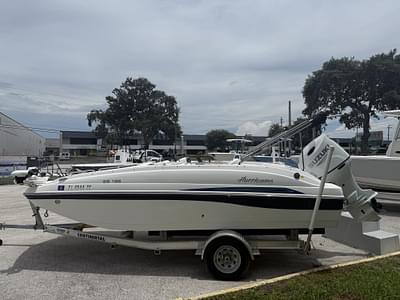
2022 Hurricane SS188
355 Hours
$4,150 cash down
tampa, FL


Copyright © 2026 Boatzon™. All Rights Reserved